Balloonflower root · Jie Geng
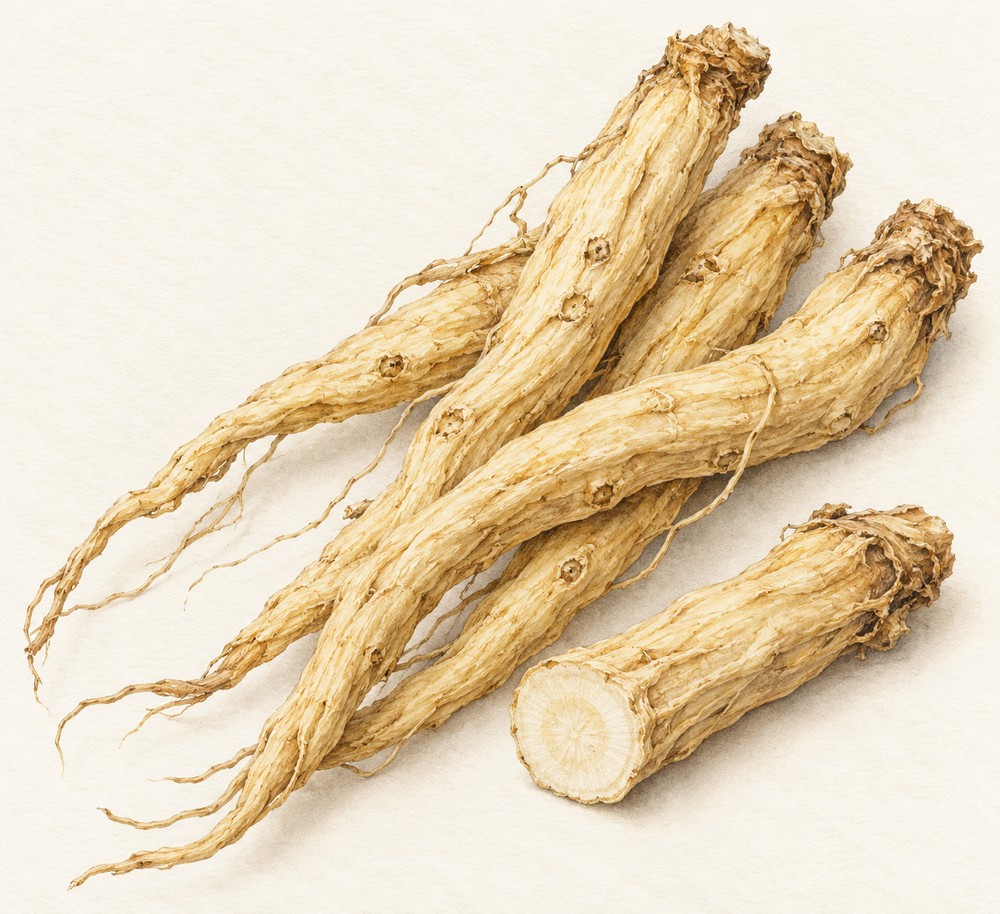
Platycodon grandiflorus (Jacq.) A. DC. · Root
Name and part used
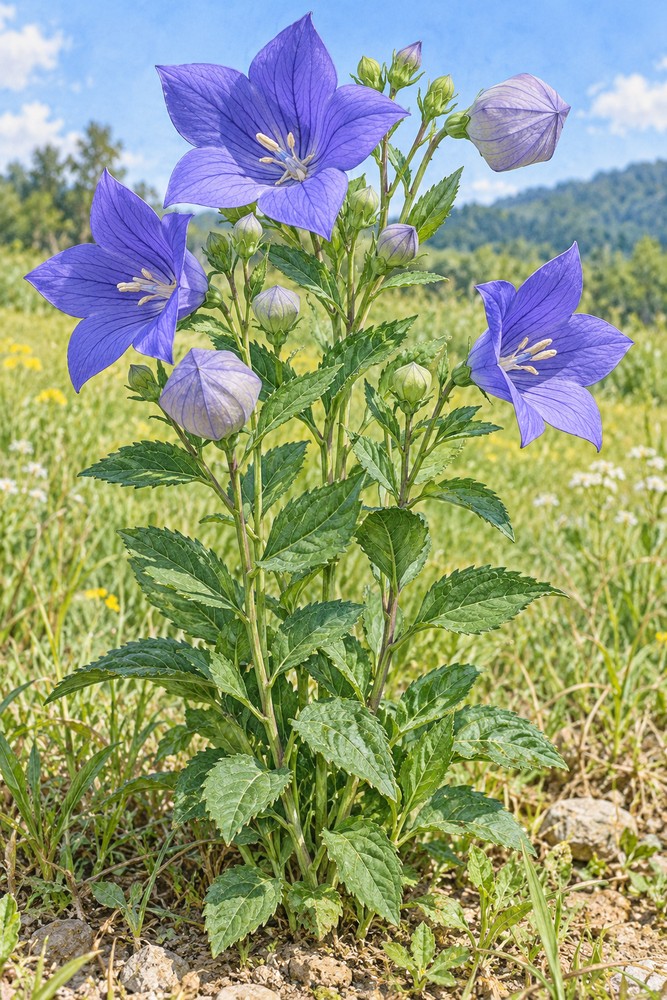
A perennial with five-lobed blue-violet bells, inflated buds, and a long fleshy root.
Traditional context
Jie Geng is dried root of Platycodon grandiflorus. HKBU records it in sunny grassland and thickets; flowers are often violet-blue. Cultivars can vary in flower color, so verify other traits and authenticated source material.
Modern evidence
Lung-dispersing, throat-benefiting, and phlegm-transforming are traditional terms. Saponins or laboratory findings do not replace reliable clinical evidence.
Safety
Correct identity and quality control matter; HKBU notes biological activity and toxicity. Avoid prolonged self-use, pregnancy use, or drug combinations without professional review.
Pairing in reference texts
Jie Geng occurs in Yin Qiao San with Bo He, honeysuckle, and other herbs. The classical reference is not a home prescription for cough or fever.
Growing, care, and harvest timing
HKBU habitat record: Growing in tussock or thickets on sunny slope at altitude 2,000m, rarely under forests. Distributed in Heilongjiang, Jilin, Liaoning, East Inner Mongolia, Hebei, Shanxi, Henan, Shandong, Jiangsu, Anhui, Zhejiang, Jiangxi, Hubei, Hunan, Guangdong, Hong Kong, Guangxi, Guizhou, Yunnan, Sichuan, South Gansu and South Shaanxi. Also distributed in Korean Peninsula, Japan, the south of Russian Far East and East Siberia. The medicinal materials are produced in all parts of China Harvest and processing as recorded: Excavated in spring and autumn, washed, removed fibrous roots, peeled the outer skin when fresh or dried with outer skin
Source-recorded harvest/processing: Excavated in spring and autumn, washed, removed fibrous roots, peeled the outer skin when fresh or dried with outer skin
The reviewed source does not provide a complete species-specific sowing/growing routine, irrigation/fertilization schedule, or universal plant age. The page therefore does not infer care instructions or years to harvest; consult local cultivation guidance.
Open habitat and season source ↗FROM PLANT / SOURCE HABITAT TO DRIED MATERIAL · REFERENCE WORKFLOW
- HKBU records root harvest in spring or autumn; verify cultivated Platycodon grandiflorus before harvest.
- Wash soil away and remove fine roots; peeling while fresh may follow the lot specification. Do not use unidentified wild material.
- Cut or prepare to the applicable standard and dry with airflow to a stable endpoint; prevent soil and fungal contamination.
- Check appearance, moisture, and foreign matter; record date, growing region, and peeling status on lot labels.
These are post-harvest study notes, not directions to prepare a remedy for self-treatment. Processing reference ↗
How to read formula amounts
The cited sources do not provide a formula with specific amounts for this profile; no ratio is invented. Absence from the incompatibility list does not establish safety.
Habitat, season, and harvest in the HKBU botanical record
HKBU botanical record (translated summary): Flowering and fruiting dates: Flowering: July to September Habitat and distribution: Growing in tussock or thickets on sunny slope at altitude 2,000m, rarely under forests. Distributed in Heilongjiang, Jilin, Liaoning, East Inner Mongolia, Hebei, Shanxi, Henan, Shandong, Jiangsu, Anhui, Zhejiang, Jiangxi, Hubei, Hunan, Guangdong, Hong Kong, Guangxi, Guizhou, Yunnan, Sichuan, South Gansu and South Shaanxi. Also distributed in Korean Peninsula, Japan, the south of Russian Far East and East Siberia. The medicinal materials are produced in all parts of China Harvest and processing as recorded: Excavated in spring and autumn, washed, removed fibrous roots, peeled the outer skin when fresh or dried with outer skin
Open botanical source ↗