Jin Qian Cao · Christina loosestrife · Jin Qian Cao
Lysimachia christinae Hance · Dried whole plant
Name and part used
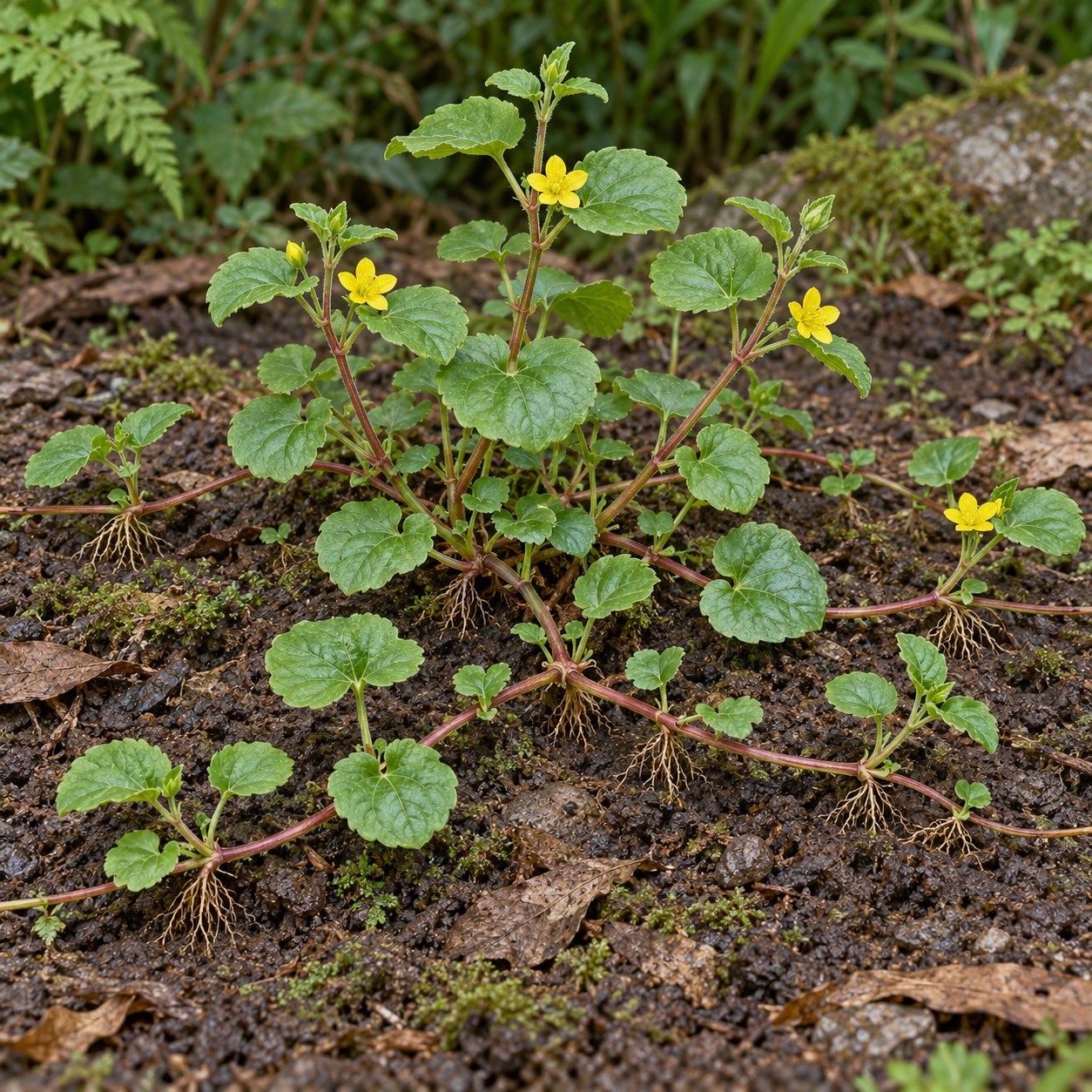
Jin Qian Cao in this record is Lysimachia christinae Hance, also called Guo Lu Huang; regional trade names do not always refer to this same species. It is a creeping perennial herb with delicate 20–60 cm stems that often root at nodes, opposite long-petioled nearly round, ovate, or kidney-shaped slightly fleshy leaves, and solitary yellow flowers in leaf axils. HKBU describes damp hillsides, ditch banks, and forest margins up to about 2,300 m. The materia medica part is the whole plant.
Traditional context
HKBU records a sweet, slightly bitter, cool nature, with traditional actions of promoting urination, clearing heat, and reducing swelling. Traditional records mention urinary/biliary stones and jaundice, but do not establish stone dissolution or treatment of hepatitis/nephritis. Colicky pain, fever, chills, vomiting, blood in urine, or jaundice needs medical assessment; delay can be dangerous.
Modern evidence
HKBU documents morphology, habitat, harvest season, and traditional actions. Recent research is largely cell/animal or mechanistic work and does not establish that people can self-use this plant to pass stones or replace procedures, antibiotics, or obstruction assessment. Distinguish Lysimachia christinae from other materials sold under similar names.
Safety
Do not self-treat renal/biliary colic, fever, hematuria, urinary retention, jaundice, kidney disease, or use alongside diuretics without medical advice. A Chinese natural-medicine reference reports contact dermatitis after external washing with fresh material; stop exposure if rash/itching occurs. Avoid harvest near roads, polluted ditches, or sprayed sites.
Safety reference ↗Pairing in reference texts
HKBU does not establish a toxic pair or standard ratio for the whole herb. One traditional example lists 45 g Jin Qian Cao with 15 g Hu Zhang (3:1) in a cholecystitis note; this is a historical example, not a personal dose or proof of treatment. Do not combine herbs to self-treat stones; diuretic actions can affect fluid/electrolyte status and medicines.
Identification and study notes
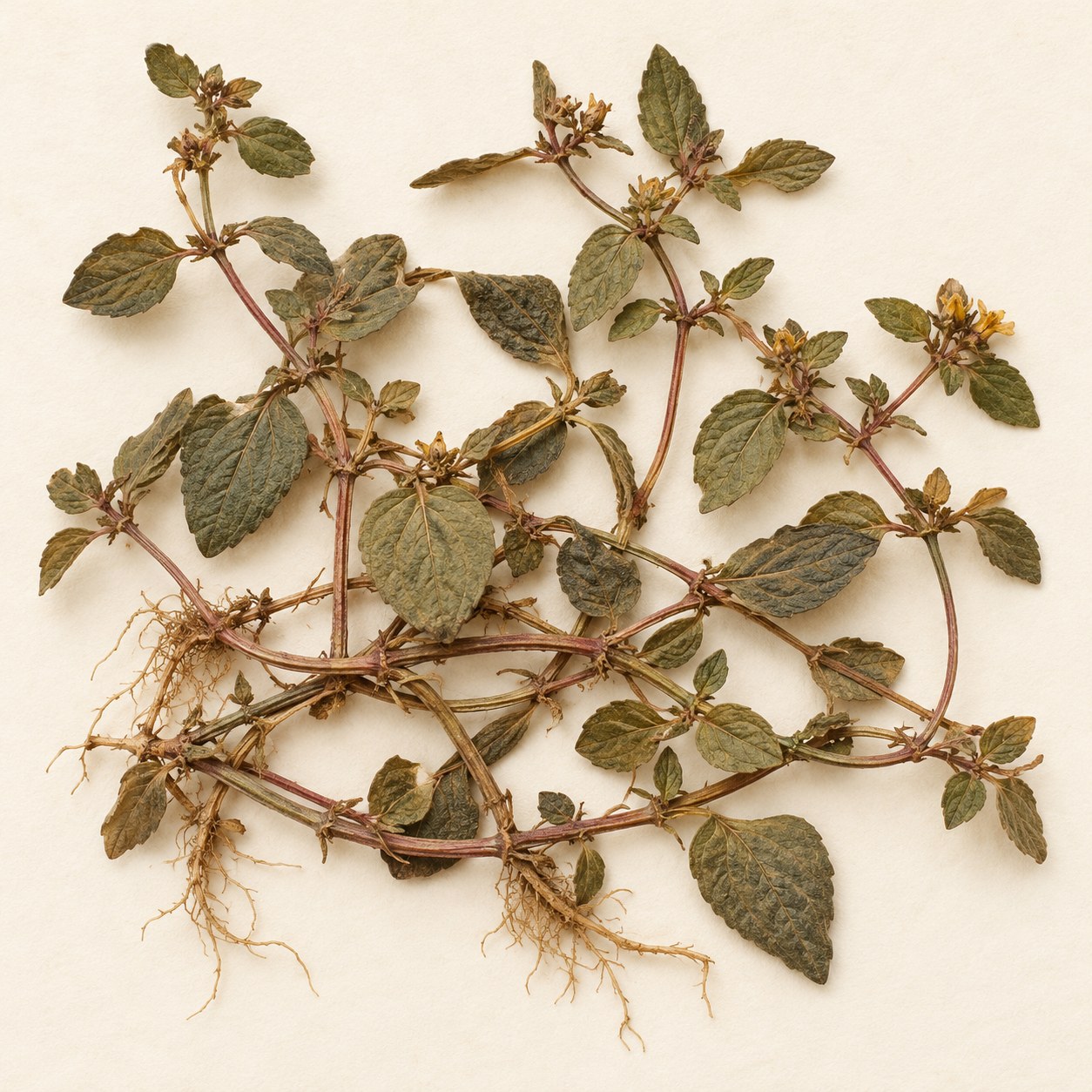
The species illustrated here creeps close to the ground: slender gray-green to reddish-violet stems root at lower nodes, and opposite petioled leaves are slightly fleshy, round/ovate/kidney-shaped. Translucent glandular lines may be visible when a leaf is backlit and darken on drying. Flowers are yellow and solitary in leaf axils rather than large clusters. Dried whole material often forms a tangled bundle of stems, node rootlets, and crumpled green-brown leaves. Appearance alone cannot authenticate a lot; trade names may include other species, so verify the Latin label, supplier, and quality testing. AI art illustrates general morphology only.
Growth and habitat
HKBU places the plant in moist ditch banks, slopes, and forest edges; lower creeping nodes often root, so a moist but drained bed is suitable. Its distribution includes central, southern, southwestern, and several northeastern Chinese provinces. Use a wide pot or contained bed because runners spread; avoid wastewater, heavy-metal-contaminated soils, and herbicide-treated sites.
Identification and study notes
The species illustrated here creeps close to the ground: slender gray-green to reddish-violet stems root at lower nodes, and opposite petioled leaves are slightly fleshy, round/ovate/kidney-shaped. Translucent glandular lines may be visible when a leaf is backlit and darken on drying. Flowers are yellow and solitary in leaf axils rather than large clusters. Dried whole material often forms a tangled bundle of stems, node rootlets, and crumpled green-brown leaves. Appearance alone cannot authenticate a lot; trade names may include other species, so verify the Latin label, supplier, and quality testing. AI art illustrates general morphology only.
Growing and care
- Trồng cây con hoặc hom thân có mắt/rễ phụ vào mùa ấm. Vùi một vài đốt, giữ ngọn và lá trên mặt đất; tưới ẩm đều sau trồng nhưng không để chậu ngập.
- Plant nursery starts or stem cuttings with nodes/rootlets in warm weather. Bury a few nodes while keeping leaves and tips above soil; water evenly after planting without leaving pots submerged.
How long until harvest? HKBU allows first-year harvest in September–October if biomass is established, then two cuts per year from subsequent years. This is a source-region seasonal schedule, not a fixed number of weeks to medicinal quality. For a garden study, record cover, flowering, and regrowth; do not assume home-grown plants are safe to ingest.
FROM PLANT / SOURCE HABITAT TO DRIED MATERIAL · REFERENCE WORKFLOW
- Cut the whole plant with clean tools in September–October of the first year or in June/September of later years per HKBU; leave about 10 cm stubble if studying regrowth.
- Remove weeds, soil, insects, and rotten parts; rinse briefly with clean water and drain immediately. Do not soak, which can increase leaching and mold risk.
- Spread thinly for sun-drying or ventilated drying and turn evenly. Dried material includes slender reddish-brown stems, opposite crumpled leaves, and possibly axillary flowers/fruits.
- Cool, seal against moisture, and label the lot. This documents a materia medica process, not treatment instructions for stones, jaundice, hepatitis, or kidney disease.
These are post-harvest study notes, not directions to prepare a remedy for self-treatment. Processing reference ↗
Habitat, season, and harvest in the HKBU botanical record
HKBU records creeping stems around 20–60 cm, opposite leaves, yellow flowers May–July, and fruit July–October; habitat includes moist slopes, ditch banks, and forest edges up to about 2,300 m. Harvest the whole plant: around September–October in year one, then June and September, leaving 10 cm stubble; wash and sun-dry/bake.
Open botanical source ↗