Japanese honeysuckle · Jin Yin Hua
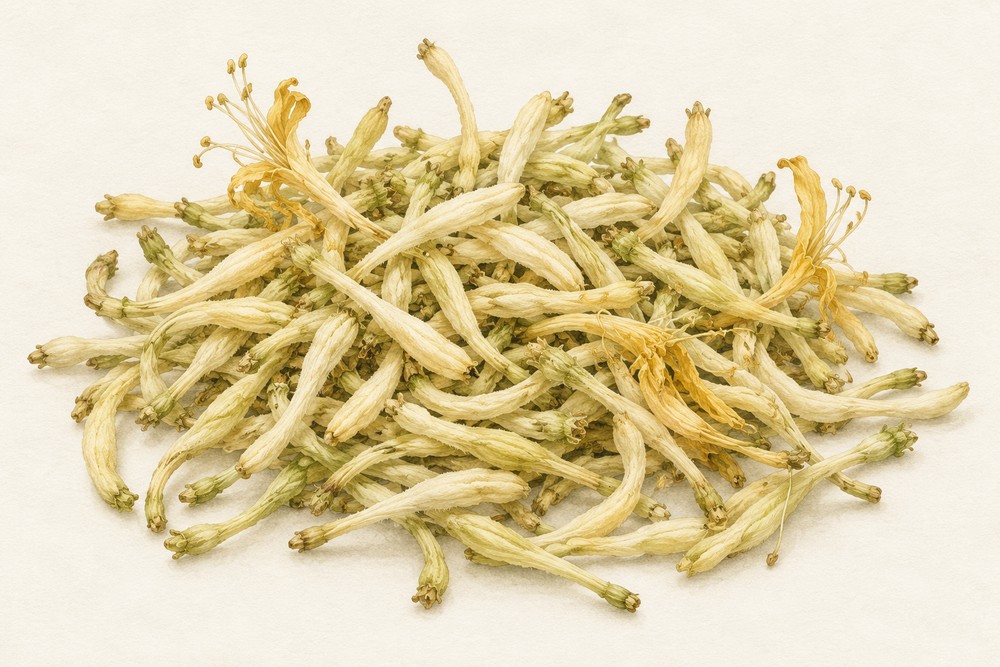
Lonicera japonica Thunb. · Flower bud
Name and part used
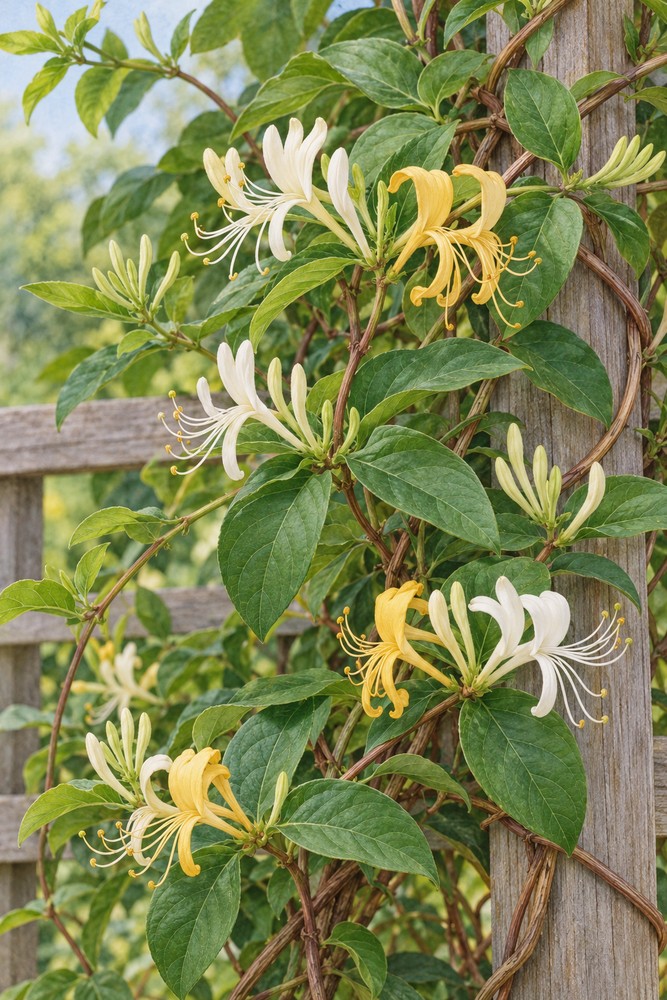
A woody twining vine with opposite leaves and tubular flowers that turn from white to yellow; paired buds grow in leaf axils.
Traditional context
HKBU identifies medicinal Jin Yin Hua as Lonicera japonica flower buds, distinct from stem-derived Jin Yin Teng. Other Lonicera species and invasive forms can look similar, so verify source and identity.
Modern evidence
Heat-clearing and toxin-resolving are traditional concepts. Extract studies do not show that it treats infection or can replace antibiotics.
Safety
Allergy and incompletely characterized interactions are possible; do not delay care for high fever, breathing difficulty, or infection. Avoid products with unknown species or residues.
Pairing in reference texts
Honeysuckle bud appears in Yin Qiao San with mint, Platycodon, and other ingredients. This is historical context, not a self-treatment recommendation for flu.
Growing, care, and harvest timing
HKBU habitat record: Growing in thin forests on hill-slopes, in thickets, by villages, roadsides. Also cultivated. Distributed in East, South-central and Southwest China, Liaoning, Hebei, Shanxi, Shaanxi, Gansu and etc. The medicinal materials are mainly produced in Henan and Shandong Harvest and processing as recorded: Buds: collected timely when flowers bloom, usually for the first time in mid- and late May, for the second time in mid- and later June. Better picked when the upper buds expand and turn bluish white, immediately air-dried or baked to dry after picked. Fruits: collected in late autumn and early winter, and sun-dried. Stem branches: sliced in autumn and winter, removed impurities, wisped or rolled up, and sun-dried. Distillate: taken flowers 500g, soaked in 1000ml water for 1-2 hours, put into stiller for distilling with appropriate water, collected 1600ml distillate, then distilled once again, collected 800 ml the second distillate, filtered, subdivided, and sterilized
Source-recorded harvest/processing: Buds: collected timely when flowers bloom, usually for the first time in mid- and late May, for the second time in mid- and later June. Better picked when the upper buds expand and turn bluish white, immediately air-dried or baked to dry after picked. Fruits: collected in late autumn and early winter, and sun-dried. Stem branches: sliced in autumn and winter, removed impurities, wisped or rolled up, and sun-dried. Distillate: taken flowers 500g, soaked in 1000ml water for 1-2 hours, put into stiller for distilling with appropriate water, collected 1600ml distillate, then distilled once again, collected 800 ml the second distillate, filtered, subdivided, and sterilized
The reviewed source does not provide a complete species-specific sowing/growing routine, irrigation/fertilization schedule, or universal plant age. The page therefore does not infer care instructions or years to harvest; consult local cultivation guidance.
Open habitat and season source ↗FROM PLANT / SOURCE HABITAT TO DRIED MATERIAL · REFERENCE WORKFLOW
- Harvest buds at the correct pre-bloom stage; HKBU records multiple collection rounds during the flowering season.
- Remove leaves and stems and discard browned or bruised buds; authenticate Lonicera japonica against related species.
- Dry promptly by sun or controlled equipment; avoid deep piles that trap heat and moisture or discolor material.
- Grade by integrity, color, and moisture; record lot origin, test residues, and protect from humidity.
These are post-harvest study notes, not directions to prepare a remedy for self-treatment. Processing reference ↗
How to read formula amounts
The cited sources do not provide a formula with specific amounts for this profile; no ratio is invented. Absence from the incompatibility list does not establish safety.
Habitat, season, and harvest in the HKBU botanical record
HKBU botanical record (translated summary): Flowering and fruiting dates: Flowering: April to July, fruiting: June to November Habitat and distribution: Growing in thin forests on hill-slopes, in thickets, by villages, roadsides. Also cultivated. Distributed in East, South-central and Southwest China, Liaoning, Hebei, Shanxi, Shaanxi, Gansu and etc. The medicinal materials are mainly produced in Henan and Shandong Harvest and processing as recorded: Buds: collected timely when flowers bloom, usually for the first time in mid- and late May, for the second time in mid- and later June. Better picked when the upper buds expand and turn bluish white, immediately air-dried or baked to dry after picked. Fruits: collected in late autumn and early winter, and sun-dried. Stem branches: sliced in autumn and winter, removed impurities, wisped or rolled up, and sun-dried. Distillate: taken flowers 500g, soaked in 1000ml water for 1-2 hours, put into stiller for distilling with appropriate water, collected 1600ml distillate, then distilled once again, collected 800 ml the second distillate, filtered, subdivided, and sterilized
Open botanical source ↗