Rough gentian root · Long Dan Cao
Gentiana scabra Bunge · Roots and rhizome
Name and part used
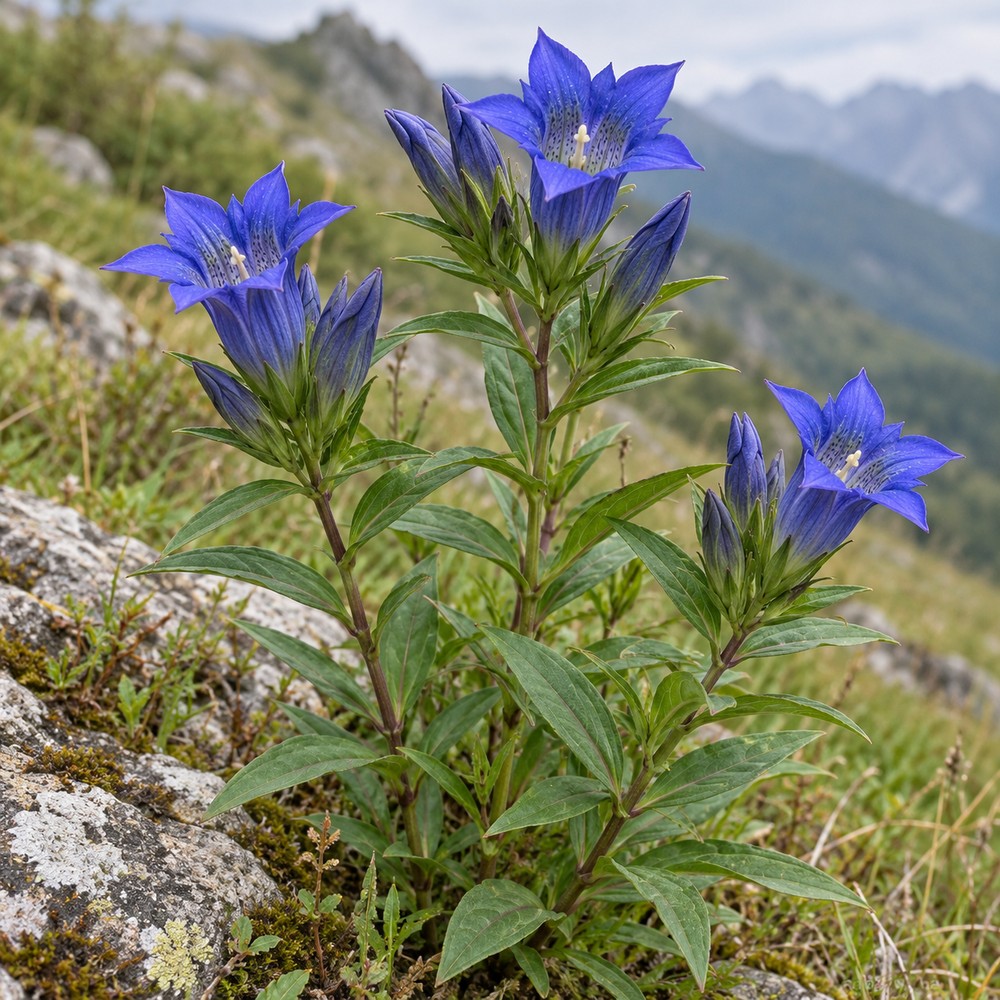
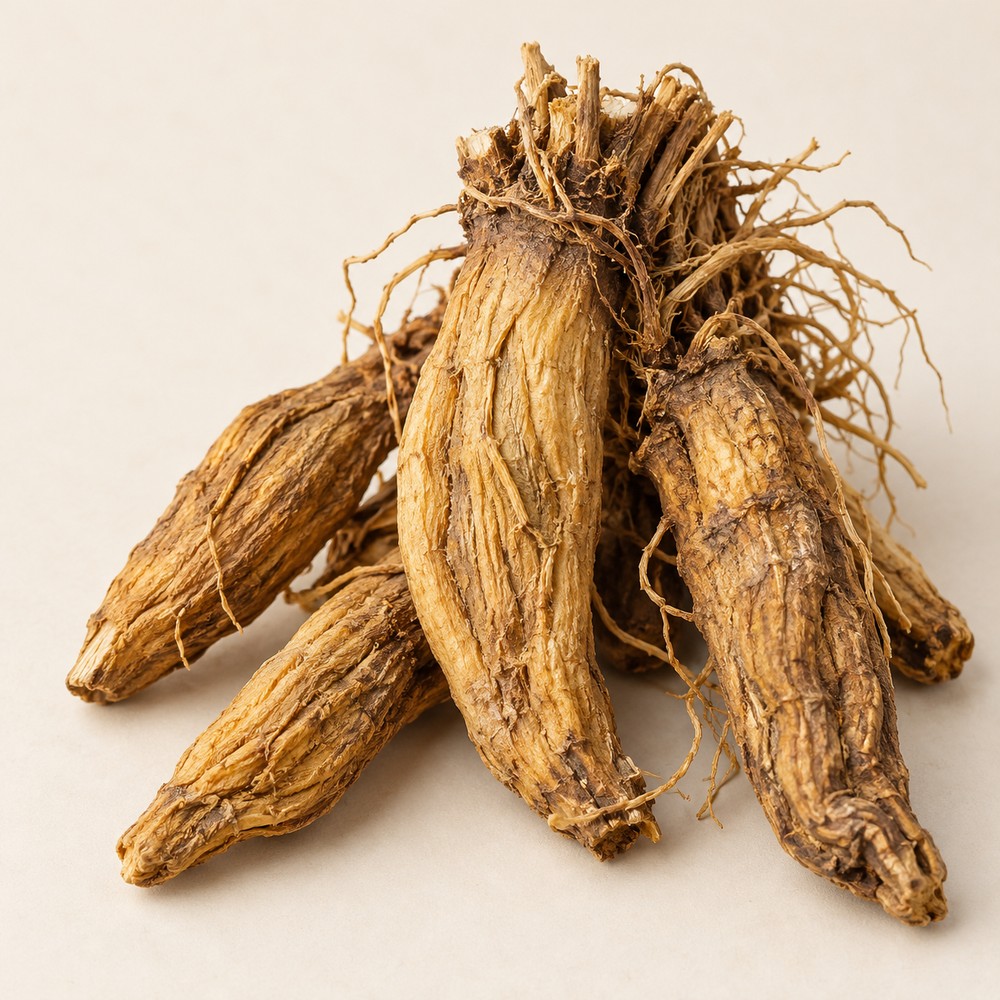
A herb with opposite leaves, deep-blue tubular bells, and pale yellow roots with transverse wrinkles.
Traditional context
Long Dan Cao uses roots and rhizomes of Gentiana scabra and other accepted Gentiana species. HKBU describes deep-blue autumn flowers; intense bitterness alone cannot authenticate the drug.
Modern evidence
Liver-gallbladder fire-clearing and dampness-drying are traditional terms. They do not establish treatment of hepatitis, jaundice, infection, or eye pain.
Safety
Strong bitterness may cause nausea, gastric irritation, or diarrhea; use caution with ulcers, pregnancy, or medicines.
Pairing in reference texts
Long Dan Cao is a chief ingredient in Long Dan Xie Gan Tang with Bupleurum, Scutellaria, and others. Do not self-prescribe it for jaundice.
Growing, care, and harvest timing
HKBU habitat record: Growing on mountain slope tussock, thickets and forest edges. Distributed in Heilongjiang, Jilin, Liaoning, Inner Mongolia, Hebei, Shandong, Jiangsu, Anhui, Zhejiang, Fujian, Jiangxi, Hunan, Hubei, Guizhou, Sichuan, Guangdong, Guangxi and etc. The medicinal materials are mainly produced in Northeast China. Produced in all parts of China except Northwest China and Tibet Harvest and processing as recorded: Collected in spring and autumn. Better in spring. After excavated, removed cauline leaf, well washed, and sun-dried
Source-recorded harvest/processing: Collected in spring and autumn. Better in spring. After excavated, removed cauline leaf, well washed, and sun-dried
The reviewed source does not provide a complete species-specific sowing/growing routine, irrigation/fertilization schedule, or universal plant age. The page therefore does not infer care instructions or years to harvest; consult local cultivation guidance.
Open habitat and season source ↗FROM PLANT / SOURCE HABITAT TO DRIED MATERIAL · REFERENCE WORKFLOW
- HKBU records spring or autumn root harvest, often favoring autumn; use cultivated traceable sources and verify species.
- Remove foliage, soil, and fine roots; wash clean and do not mix Gentiana species without pharmacopoeial confirmation.
- Dry directly or condition and redry under validated procedures to uniform reddish-yellow color; do not process for home use.
- Grade root form, color, and integrity; control moisture, contaminants, and source records.
These are post-harvest study notes, not directions to prepare a remedy for self-treatment. Processing reference ↗
How to read formula amounts
The cited sources do not provide a formula with specific amounts for this profile; no ratio is invented. Absence from the incompatibility list does not establish safety.
Habitat, season, and harvest in the HKBU botanical record
HKBU botanical record (translated summary): Flowering and fruiting dates: Flowering: September to October. Fruiting: October Habitat and distribution: Growing on mountain slope tussock, thickets and forest edges. Distributed in Heilongjiang, Jilin, Liaoning, Inner Mongolia, Hebei, Shandong, Jiangsu, Anhui, Zhejiang, Fujian, Jiangxi, Hunan, Hubei, Guizhou, Sichuan, Guangdong, Guangxi and etc. The medicinal materials are mainly produced in Northeast China. Produced in all parts of China except Northwest China and Tibet Harvest and processing as recorded: Collected in spring and autumn. Better in spring. After excavated, removed cauline leaf, well washed, and sun-dried
Open botanical source ↗