Luo Shi Teng · star jasmine vine · Luo Shi Teng
Trachelospermum jasminoides (Lindl.) Lem. · Dried leafy vine stems
Name and part used
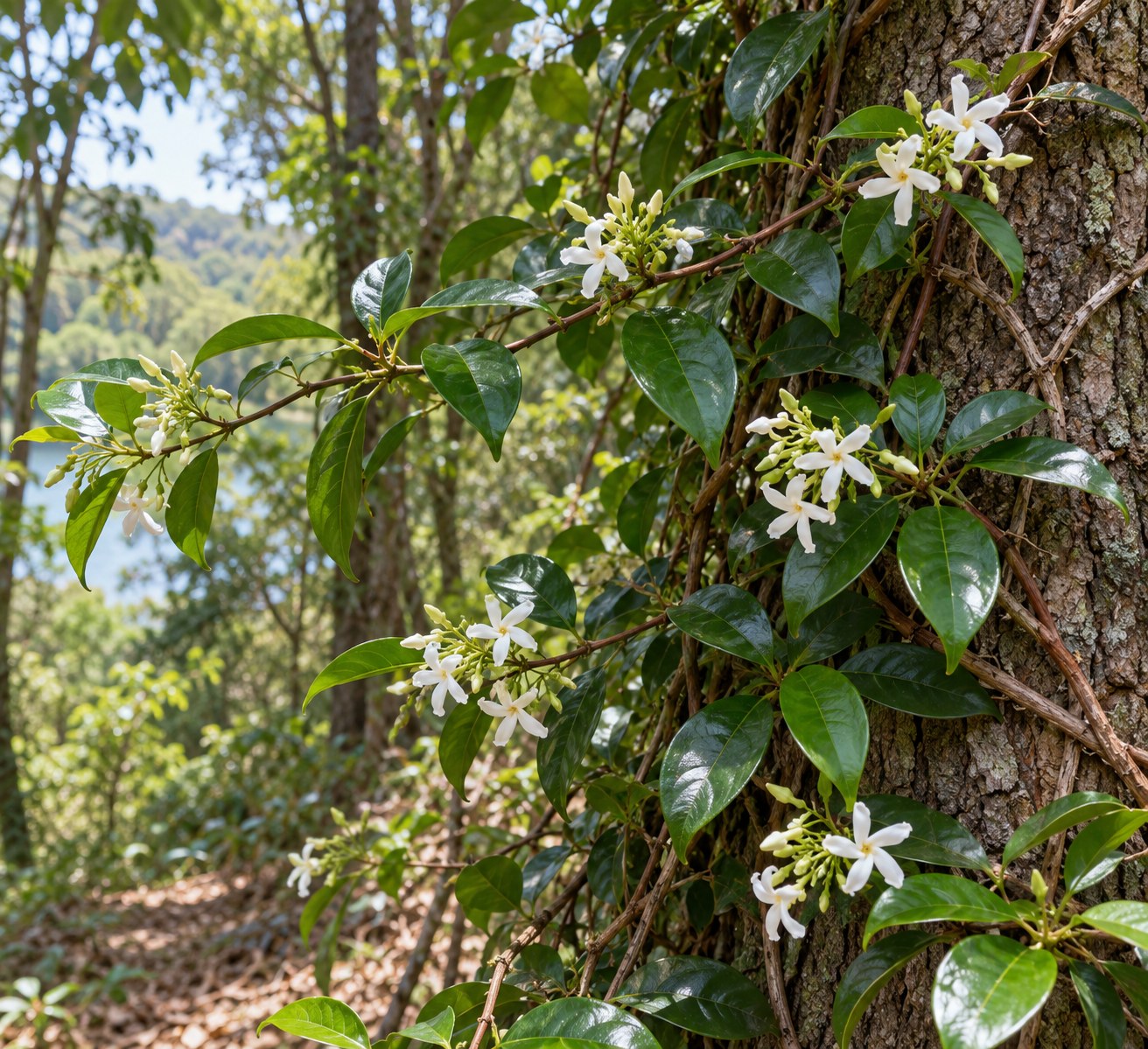
Luo Shi Teng is Trachelospermum jasminoides (Lindl.) Lem., an evergreen woody climber in Apocynaceae. Mature stems become woody and may climb many metres using adventitious roots; cut tissue exudes white latex. Opposite leaves are thick, glossy, oval to oblong, with a visible midrib. Fragrant white flowers have five twisted lobes forming a pinwheel or star; the fruit consists of paired long follicles. The materia medica is dried vine stem, often with leafy branches, cut into sections—not the flowers or latex. HKBU describes harvest from mature plants in year 3–4 during late autumn, cutting roughly 25–30 cm sections and sun-drying. It grows on rocks, tree trunks, stream banks, and forest edges. Ornamental star jasmine pruned as a shrub is not the same as a verified medicinal lot; latex may irritate, so avoid eyes and sensitive skin.
Traditional context
HKBU specimen records traditional concepts of dispelling wind and unblocking collaterals, cooling blood, and reducing swelling; historical indications include rheumatic pain and muscle spasm. This is not evidence for treating arthritis, trauma, sore throat, or skin infection. The Apocynaceae vine contains milky latex; do not use fresh latex or leaves on wounds. Joint pain or spasm after injury, or symptoms with fever/breathing difficulty, needs medical care.
Modern evidence
HKBU provides classification and material descriptions, not clinical trials. Chemical studies of lignans or triterpenoids and cell assays do not prove that dried vine stems treat joint pain or infection. The ornamental common name “star jasmine” is used for this plant, but commercial material can be confused with other Apocynaceae; verify Latin identity and plant part. Fragrance or latex appearance does not establish efficacy.
Safety
Do not taste, ingest, or apply fresh latex; keep it out of eyes, mouth, and broken skin. Rinse skin with plenty of water after contact; seek medical advice for eye exposure, persistent irritation, or allergic reaction. Do not self-use dried stems during pregnancy/breastfeeding, in children, chronic disease, or while taking medicines. Cutting vines may expose latex; use gloves and eye protection for gardening. Discard moldy dried material, mixed vines, or samples with uncertain plant parts.
Safety reference ↗Pairing in reference texts
The reviewed profile does not prove a Luo Shi Teng pair with clinical benefit, optimal ratio, or safety. Historical prescriptions may combine vine stems with other herbs, but formulas vary by pattern and cannot be converted into personal advice. Do not self-combine it with anticoagulants, analgesics, or cardiac medicines; no cited source confirmed a specific toxic pair. We do not invent a partner where reliable evidence is missing, and “no incompatibility known” must not be taken to mean safe.
Identification and study notes
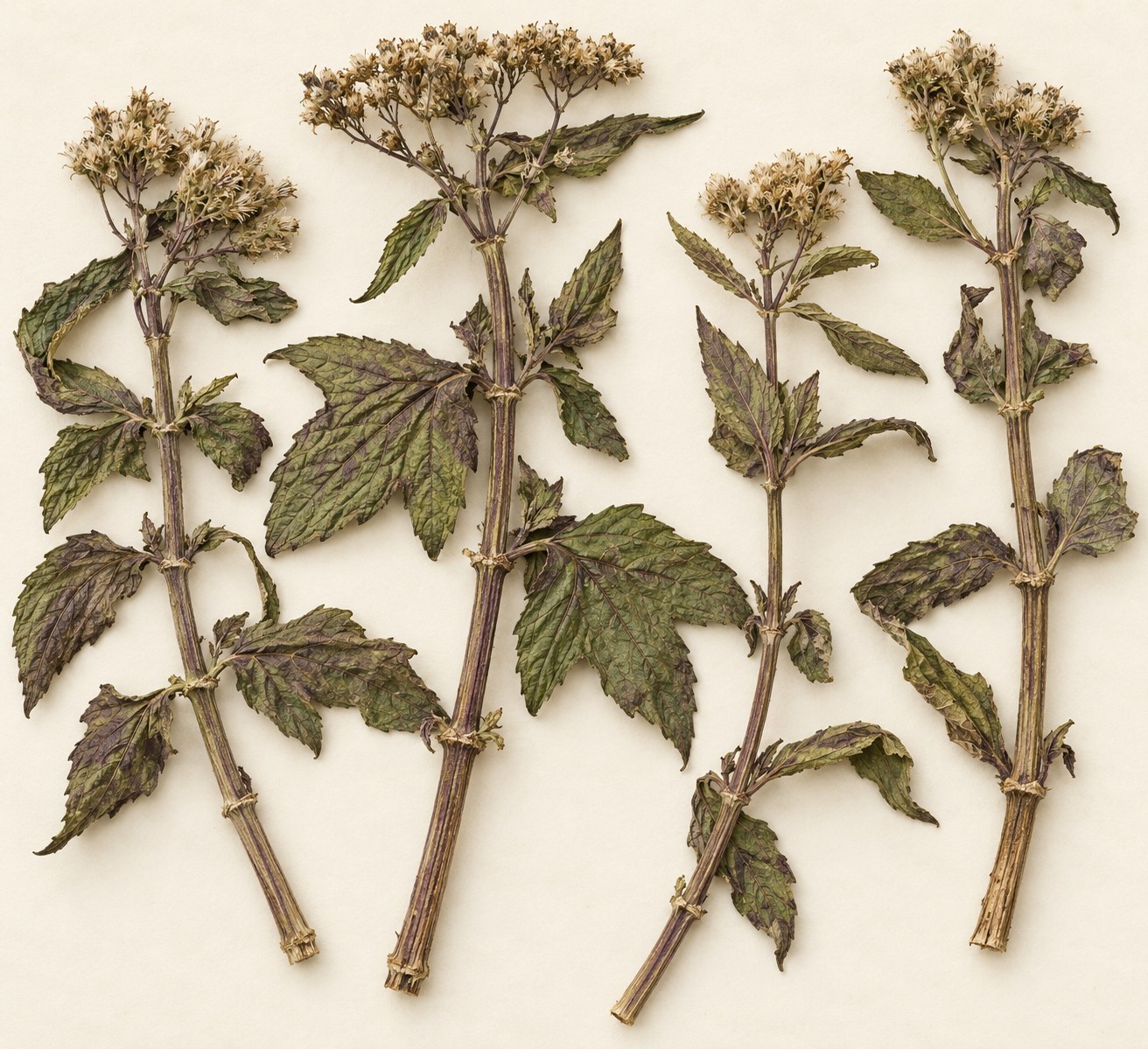
Luo Shi Teng is an evergreen climber with opposite, thick, glossy leaves and fragrant white five-lobed pinwheel flowers. Mature stems become woody and attach by adventitious roots; breaking a branch releases white latex. Latex is a handling warning, not a safe identification test—many Apocynaceae also contain latex. The dried drug consists of gray-brown vine segments and may retain opposite leaves or attachment roots; it is not the dried white flower. The AI living-plant image shows flowers and foliage on a support, while the separate dried-material image shows detached vine sections; both are study illustrations. Compare morphology with ornamental vines before reading the Latin label, and avoid confusing it with other climbers.
Growth and habitat
HKBU describes Trachelospermum jasminoides climbing over rocks, tree trunks, slopes, stream banks, and forest edges; it favors warm conditions, bright to partially shaded sites, and drained soil. In a tropical garden, an ornamental plant needs a trellis or support, watering as the soil begins to dry, and protection from waterlogging. This is general horticulture, not a medicinal production standard. Buy labeled Latin-name stock; several vines have opposite leaves or white latex, so do not collect fence growth for ingestion.
Identification and study notes
Luo Shi Teng is an evergreen climber with opposite, thick, glossy leaves and fragrant white five-lobed pinwheel flowers. Mature stems become woody and attach by adventitious roots; breaking a branch releases white latex. Latex is a handling warning, not a safe identification test—many Apocynaceae also contain latex. The dried drug consists of gray-brown vine segments and may retain opposite leaves or attachment roots; it is not the dried white flower. The AI living-plant image shows flowers and foliage on a support, while the separate dried-material image shows detached vine sections; both are study illustrations. Compare morphology with ornamental vines before reading the Latin label, and avoid confusing it with other climbers.
Growing and care
- Obtain labeled Trachelospermum jasminoides nursery stock; choose a draining container and climbing support. Do not propagate an unidentified wild vine.
- Place in bright or partial sun with loose, draining garden soil; water after the surface begins to dry. Established plants tolerate more sun, but avoid prolonged waterlogging.
- Train stems on a trellis and remove dead growth after flowering; wear gloves and eye protection because white latex may splash or contact skin. Keep children from cutting or playing with fresh stems.
- HKBU records materia-medica harvest from mature plants in year 3–4, in late autumn; this does not apply to an unverified ornamental or home-grown lot. Do not harvest for home medicine.
How long until harvest? HKBU records medicinal harvest from mature plants around year 3–4 in late autumn; this is a timing note for authenticated materia medica, not a guarantee that a home ornamental becomes medicinal material. Ornamental vines may take years to form woody stems. Grow for observation and morphology study, not to make medicine from home-grown cuttings.
Habitat, season, and harvest in the HKBU botanical record
HKBU describes Trachelospermum jasminoides as an evergreen woody climber with latex, opposite leaves, and fragrant white flowers. Habitats include host trees, rocks, stream edges, slopes, and forest margins. The medicinal part is vine stem; mature plants around year 3–4 are harvested in late autumn, cut to 25–30 cm, and sun-dried. A specimen record lists traditional wind-dispelling/collateral and cooling-blood/swelling concepts; this is not a clinical trial result.
Open botanical source ↗FROM PLANT / SOURCE HABITAT TO DRIED MATERIAL · REFERENCE WORKFLOW
- HKBU records late-autumn harvest of mature vine stems/branches, cut into roughly 25–30 cm lengths. This describes professional materia medica and is not a recommendation to harvest an ornamental plant.
- At a processing facility, separate correctly identified vine stems from attached roots and debris; discard rotten, insect-damaged, or mixed vines. Avoid fresh latex and wear gloves/eye protection.
- The source records sun-drying after cutting; for a study sample, spread the material on a clean ventilated tray, retain lot labels, and protect it from rain, soil, and insects.
- After complete drying, package in a dry place and label Latin name, part, harvest date, cut length, and processor. Do not extract latex or make a home decoction; discard moldy or untraceable material.
These are post-harvest study notes, not directions to prepare a remedy for self-treatment. Processing reference ↗