Tree peony root bark · Mu Dan Pi
Paeonia suffruticosa Andrews · Root bark
Name and part used
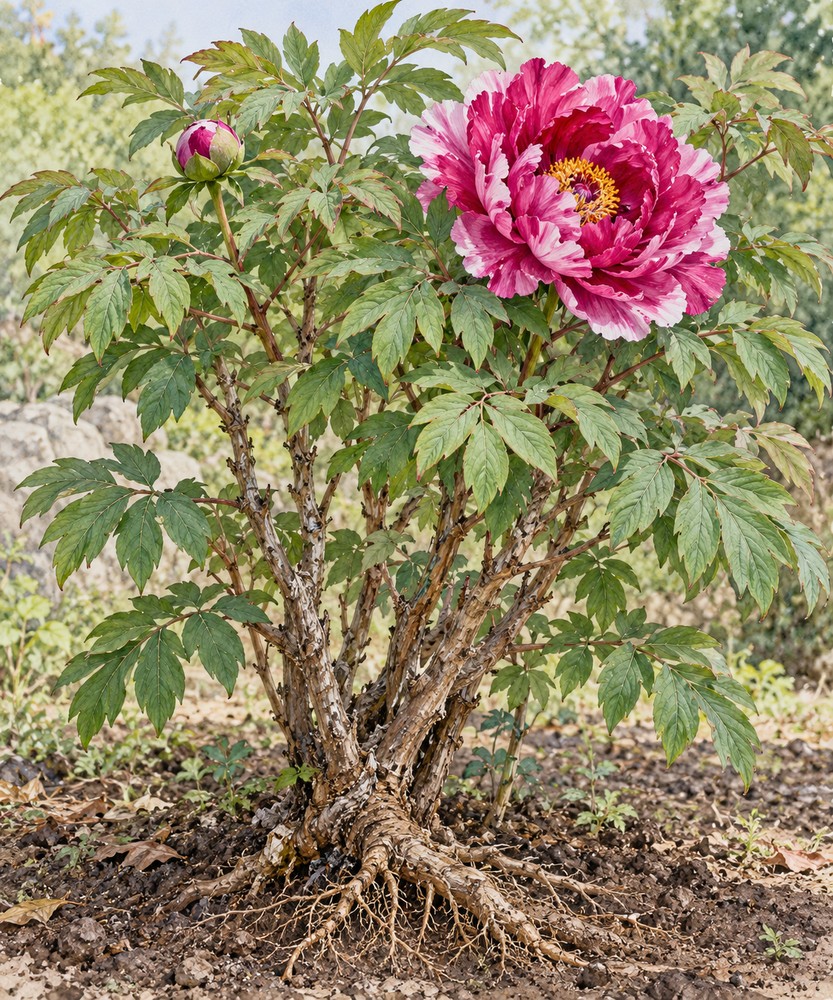
A deciduous shrub with twice-compound leaves, large peony flowers, and follicles; the materia medica is root bark.
Traditional context
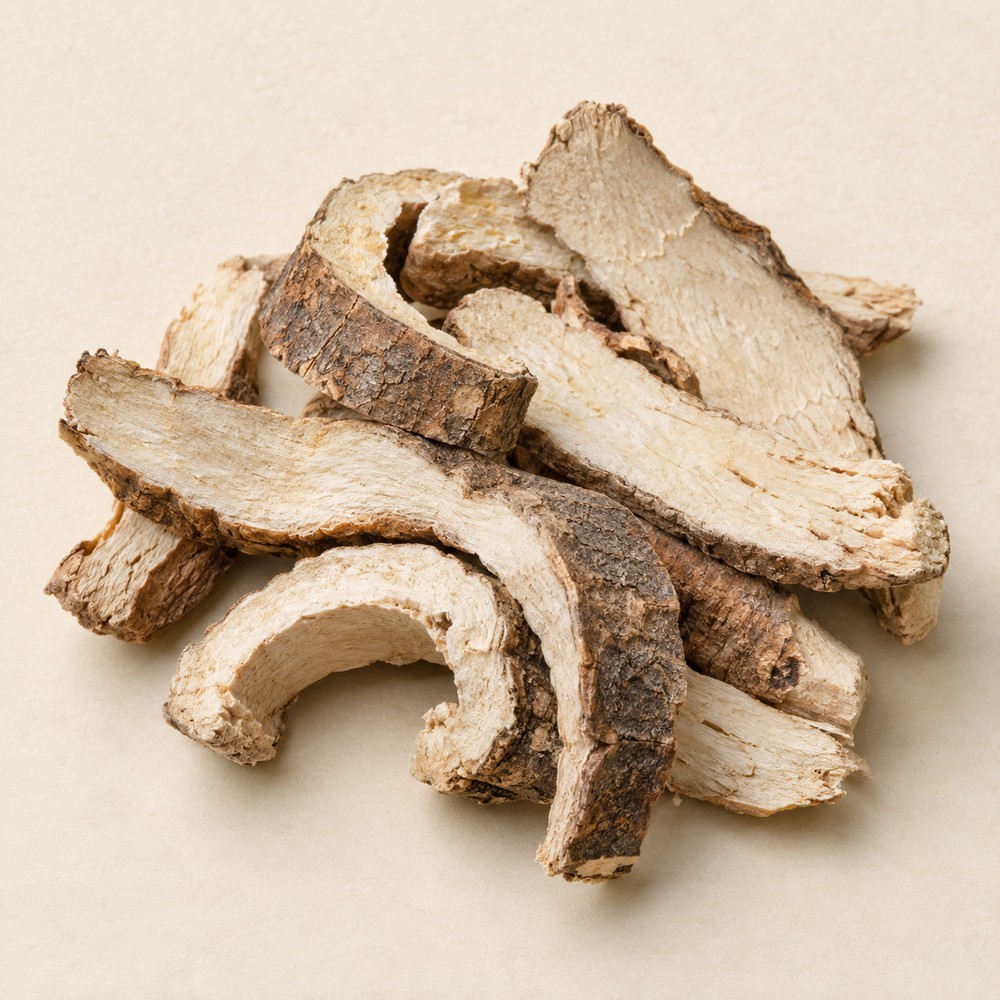
Mu Dan Pi is root bark of Paeonia suffruticosa, not the flower petals. HKBU describes harvest from cultivated plants after 3–5 years; distinguish it from White Peony root and related Paeonia.
Modern evidence
Heat-clearing, blood-cooling, and stasis-dispersing are traditional claims. Laboratory data on paeonol or anticoagulation are not clinical indications.
Safety
It may affect coagulation; people taking warfarin, anticoagulants, or antiplatelets, facing surgery, or pregnant should consult a clinician.
Pairing in reference texts
Mu Dan Pi appears with Rehmannia and White Peony in historical formulas such as Xi Jiao Di Huang Tang. Do not combine on your own with anticoagulants.
Growing, care, and harvest timing
HKBU habitat record: Growing in sunny and fertile places. Distributed in Hebei, Henan, Shandong, Sichuan, Shaanxi, Gansu and etc. The medicinal materials are mainly produced in Anhui, Sichuan, Shaanxi, Hubei, Hunan, Shandong, Guizhou and etc Harvest and processing as recorded: In autumn or spring excavated peony cultivated for 3-5 years, well washed, removed fibrous root and stem, picked off the root bark, and sun-dried
Source-recorded harvest/processing: In autumn or spring excavated peony cultivated for 3-5 years, well washed, removed fibrous root and stem, picked off the root bark, and sun-dried
The reviewed source does not provide a complete species-specific sowing/growing routine, irrigation/fertilization schedule, or universal plant age. The page therefore does not infer care instructions or years to harvest; consult local cultivation guidance.
Open habitat and season source ↗FROM PLANT / SOURCE HABITAT TO DRIED MATERIAL · REFERENCE WORKFLOW
- Harvest cultivated tree peony after the recorded 3–5 years; HKBU describes spring or autumn digging.
- Wash, remove stems and fine roots, and separate root bark with clean tools; do not confuse it with whole roots.
- Sun-dry or ventilated-dry to a brittle endpoint; handle outer cork only according to the specified product grade.
- Grade tube or strip forms, record plant age and lot, and check moisture, contaminants, and origin.
These are post-harvest study notes, not directions to prepare a remedy for self-treatment. Processing reference ↗
How to read formula amounts
The cited sources do not provide a formula with specific amounts for this profile; no ratio is invented. Absence from the incompatibility list does not establish safety.
Habitat, season, and harvest in the HKBU botanical record
HKBU botanical record (translated summary): Flowering and fruiting dates: Flowering: May to July, fruiting: July to August Habitat and distribution: Growing in sunny and fertile places. Distributed in Hebei, Henan, Shandong, Sichuan, Shaanxi, Gansu and etc. The medicinal materials are mainly produced in Anhui, Sichuan, Shaanxi, Hubei, Hunan, Shandong, Guizhou and etc Harvest and processing as recorded: In autumn or spring excavated peony cultivated for 3-5 years, well washed, removed fibrous root and stem, picked off the root bark, and sun-dried
Open botanical source ↗