Nu Zhen Zi · glossy privet fruit · Nu Zhen Zi
Ligustrum lucidum W.T.Aiton · Dried mature fruit
Name and part used
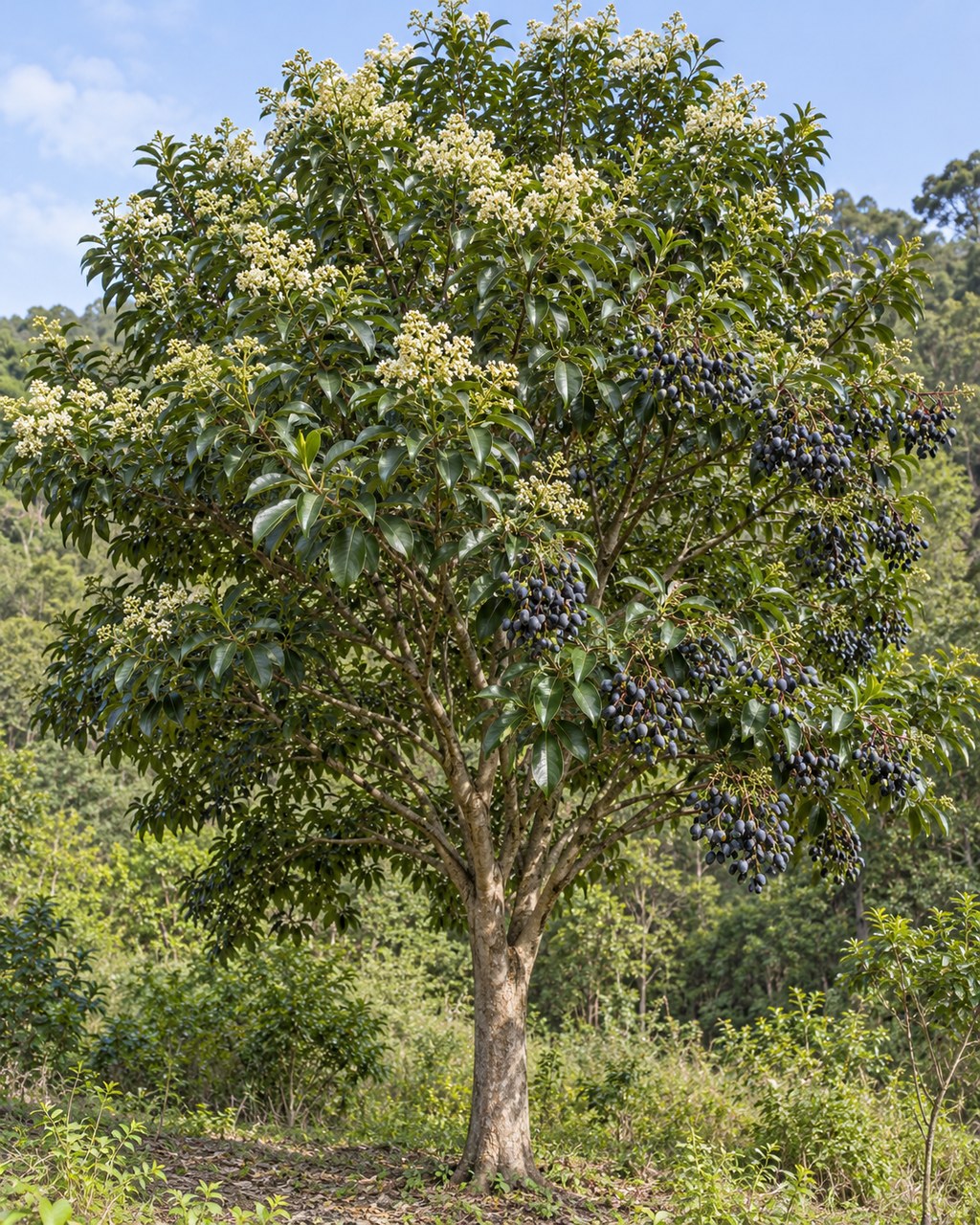
Nu Zhen Zi is the mature fruit of Ligustrum lucidum, an evergreen large shrub or small tree reaching about 25 m. Opposite leaves have entire margins and a glossy surface; small white terminal panicles become clusters of oval/kidney-shaped berries turning blue-black with a bloom. HKBU identifies dried mature fruit as the drug, not leaves/bark or fruit from every Ligustrum. Trade names can confuse congeners; AI art teaches morphology only.
Traditional context
HKBU records sweet, slightly bitter, cool properties and traditional actions of nourishing liver/kidney, benefiting vision, and darkening hair. This is not proof of treating dizziness, impaired vision, gray hair, or liver disease. Do not confuse it with Chinese privet (Ligustrum sinense), a different species.
Modern evidence
HKBU documents the species and traditional actions, not human efficacy trials. Studies on oleuropein/ligustroside or extracts do not prove raw fruit treats liver, eye, or hair conditions. Birds may eat ripe fruit; that does not establish food safety for people. Sudden vision change, eye pain, jaundice, or severe dizziness needs care.
Safety
The source establishes no universal safe dose for foraged fruit. Do not eat ornamental/wild berries or grind them for ingestion. Pregnant/breastfeeding people, children, people with liver/kidney disease, or anyone on medication should consult a clinician before extracts. Collect fallen fruit so children/pets do not ingest it.
Safety reference ↗Pairing in reference texts
No sufficiently verified HKBU formula was found to assign an effect/ratio to Nu Zhen Zi, so this page does not invent a formula or toxic pair. “Not found” does not prove a combination safe. Do not self-combine it with hormone, liver, or eye medicines.
Identification and study notes
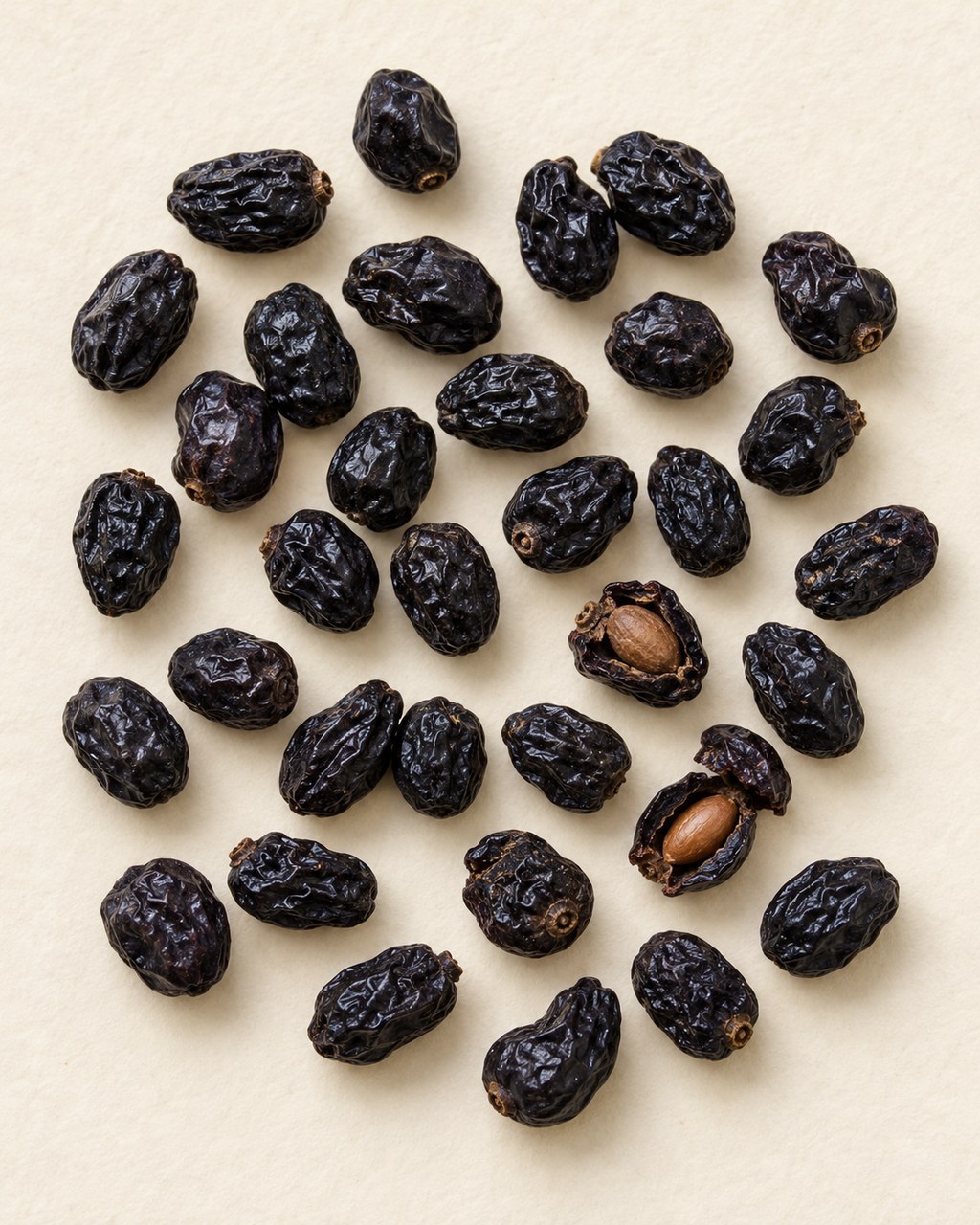
Opposite glossy entire leaves, terminal white panicles, and oval/kidney fruits ripening blue-black with bloom are study cues. The drug is small, wrinkled fruit with thin flesh around a woody-coated seed. Distinguish from red goji, reddish jujube, and ornamentals. Verify Ligustrum lucidum rather than relying on “privet.”
Growth and habitat
HKBU places it in open/dense forests and mountain areas below 2,900 m across China; it is also planted ornamentally. It prefers drained soil and warm humid climates; fruits mature in winter. Check local invasive-species rules because Ligustrum can spread by birds; avoid planting near natural habitats.
Identification and study notes
Opposite glossy entire leaves, terminal white panicles, and oval/kidney fruits ripening blue-black with bloom are study cues. The drug is small, wrinkled fruit with thin flesh around a woody-coated seed. Distinguish from red goji, reddish jujube, and ornamentals. Verify Ligustrum lucidum rather than relying on “privet.” Nữ trinh tử là quả chín Ligustrum lucidum, cây bụi/cây gỗ thường trồng cảnh. Lá đối bóng và chùm quả mùa đông giúp quan sát cây, nhưng quả cảnh không tự động an toàn hay đạt dược liệu. Cảnh quan có nhiều Ligustrum; chim ăn quả không chứng minh người ăn an toàn. Nguồn ghi thu mùa đông nhưng không có tuổi gieo đến có quả chung; cây sân vườn có quả không tự đạt chuẩn dược liệu qua vẻ ngoài. Mô tả cổ về gan-thận, mắt, tóc không chứng minh điều trị. Hồ sơ chưa tìm được bài phối hoặc cặp độc đủ xác thực nên không tự đặt công thức/tỷ lệ. Khi học mẫu, ghi loài, độ chín, nơi trồng, nguy cơ thuốc bảo vệ thực vật và lô thương mại đã kiểm nghiệm chưa. Không ăn quả hoang/cây cảnh, nghiền làm sản phẩm nhà hay phối cao chiết với thuốc gan/nội tiết khi chưa hỏi chuyên gia. Chùm quả mùa đông khiến Ligustrum trông như cây ăn được, nhưng nhãn vườn không xác nhận an toàn hay chuẩn dược liệu. Ghi đúng loài, không nếm quả cảnh. Bộ phận là quả chín, không phải lá/vỏ; nguồn cần truy xuất. Hồ sơ đã rà không xác minh bài thuốc/cặp độc nên trang để rõ khoảng trống, không mượn công thức Ligustrum khác loài. Cây phổ biến trong cảnh quan không chứng minh an toàn/chất lượng. Ligustrum được trồng cảnh phổ biến nhưng có thể dùng thuốc bảo vệ thực vật không rõ và có nhiều loài. Chùm quả mùa đông chỉ là dấu hiệu nhận dạng, không phải lời mời hái ăn. Hồ sơ nhấn mạnh xác nhận loài, nguồn và phân biệt rõ với quả thực phẩm.
Growing and care
- Buy a labeled Ligustrum lucidum sapling; do not sow unidentified ornamental berries. Allow room for a large tree.
- Plant in sun to partial shade and drained soil; water thoroughly at planting, then when the surface layer dries.
- Mulch, weed, remove dead branches, and maintain airflow. Collect fallen berries and do not spread seed into parks/woodland.
- Observe white flower panicles and fruits turning blue-black. HKBU records winter collection but gives no plant age or seed-to-fruit interval; ornamental fruit is for study, not medicine.
How long until harvest? A perennial needs multiple seasons to establish and fruit; HKBU gives no harvest age or planting-to-fruit interval. Professional harvest is in winter when fruits mature. No “X months until use” is supported; do not use home-grown fruit without authentication/testing.
Habitat, season, and harvest in the HKBU botanical record
HKBU describes Ligustrum lucidum as an evergreen tree up to 25 m with opposite oval leaves, white panicles, and blue-black ripe fruit; it grows in forests below 2,900 m. Mature fruit is collected in winter, briefly scalded/steamed before drying or dried directly.
Open botanical source ↗FROM PLANT / SOURCE HABITAT TO DRIED MATERIAL · REFERENCE WORKFLOW
- HKBU records winter collection of mature fruit; use only authenticated Ligustrum lucidum and avoid sprayed trees.
- Remove stems/leaves/damaged fruit. The source describes brief steaming/scalding then drying or direct drying; this is not a home medicine recipe.
- Dry in a clean ventilated area and keep lots separate. Dried fruits are small, oval/kidney-shaped, purple-black and wrinkled, usually with one woody-coated seed.
- Cool, seal against moisture, and label Latin name, origin, season, and processing. Do not taste/grind untraceable lots.
These are post-harvest study notes, not directions to prepare a remedy for self-treatment. Processing reference ↗