Pi Pa Ye · loquat leaf · Pi Pa Ye
Eriobotrya japonica (Thunb.) Lindl. · Dried processed leaf
Name and part used
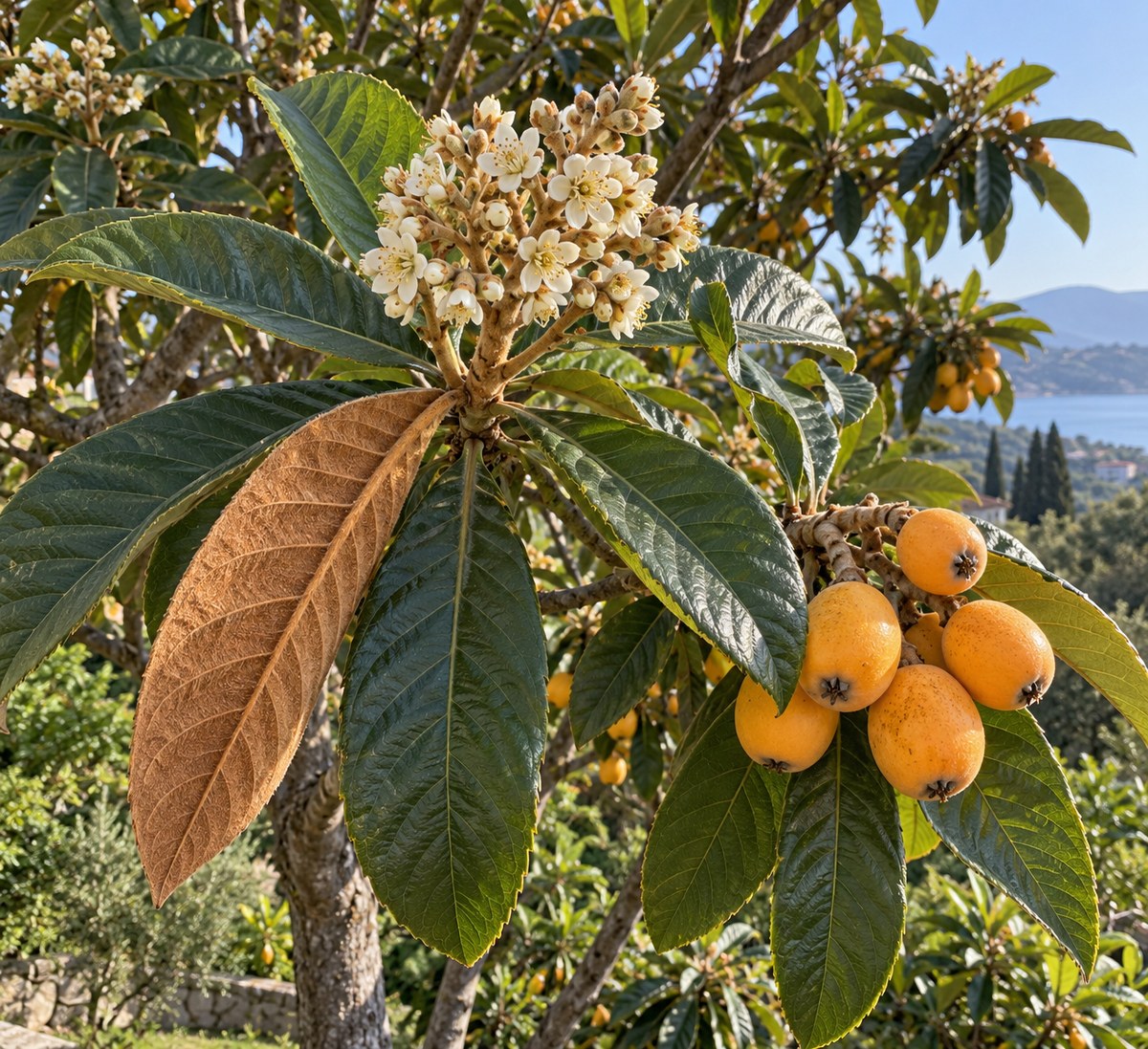
Pi Pa Ye is the dried leaf of Eriobotrya japonica, an evergreen small tree. Leaves are alternate, 12–30 cm long, glossy dark green above and rusty-hairy below, with a raised midrib and sparse serrations. HKBU records trees 3–8 m tall, white autumn flowers, and yellow-orange spring fruit. The dried drug is commonly de-haired on the underside before slicing; leaf hairs may irritate the throat.
Traditional context
HKBU records a bitter, slightly cold nature and traditional actions of clearing the lung, stopping cough, directing qi downward, and checking vomiting. “Directing qi downward” or “stopping cough” does not establish treatment of asthma, pneumonia, reflux, or serious vomiting.
Modern evidence
HKBU provides a materia medica and processing description, not proof of human treatment efficacy. Amygdalin and other compounds recorded in leaves do not establish that a foraged leaf tea is safe. Do not use leaf tea to treat cough, asthma, or vomiting; a plant image cannot verify cultivar, hair removal, or pesticide residues.
Safety
Do not use landscaping leaves from roadsides or plants that may have been sprayed. Unprocessed hairs can irritate the throat; do not chew leaves or make home powder. Pregnancy/breastfeeding, children, liver disease, asthma, or medication use warrant professional advice before any preparation. Breathing difficulty, blood in cough, persistent fever, or uncontrolled vomiting needs care.
Safety reference ↗Pairing in reference texts
HKBU describes honey-processed Pi Pa Ye using 20 kg refined honey per 100 kg leaf slices, stir-fried until no longer sticky; the source associates this processing with traditional lung-moistening/cough actions. This is a processing ratio, not a treatment recipe or dose. Plain-fried leaves are heated until lightly scorched and aromatic in the source. No specific toxic pair is established; consider honey allergy and leaf-hair irritation.
Identification and study notes
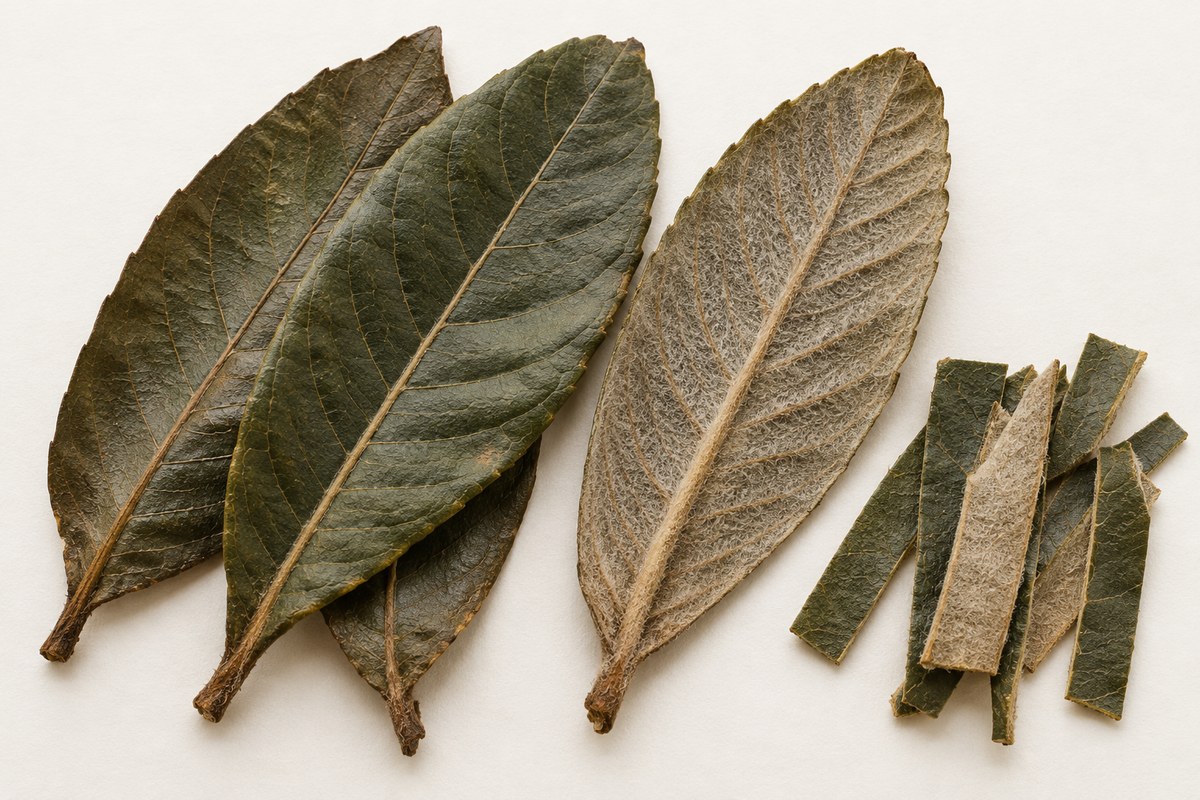
An evergreen tree about 3–8 m tall, with stout young branches covered in rusty hairs. Simple alternate leaves are large, leathery, and oblong-obovate; the upper surface is glossy dark green and the underside densely rusty-hairy. Sparse teeth occur mainly on the upper margin, and the petiole is very short. White terminal panicles bloom in autumn; spherical or oval fruits ripen yellow-orange in April–May in the recorded region. The drug is leaf, not fruit; dried blades are 12–30 cm long with gray-green/brown-yellow hairy undersides and a raised brown-red midrib. The monograph dries to 70–80%, brushes away hairs, then dries again before slicing. AI images help compare leaf surfaces but cannot detect residues or confirm proper de-hairing.
Growth and habitat
Loquat grows around villages, gardens, cultivated ground, and slopes and is widely cultivated in subtropical areas. The evergreen tree needs warmth, sun, and deep drained soil; it may tolerate light chill, while hard frost can damage flowers/fruit. At 3–8 m, it needs space and pruning for leaf access. Avoid roadside leaves exposed to dust and pesticides.
Identification and study notes
An evergreen tree about 3–8 m tall, with stout young branches covered in rusty hairs. Simple alternate leaves are large, leathery, and oblong-obovate; the upper surface is glossy dark green and the underside densely rusty-hairy. Sparse teeth occur mainly on the upper margin, and the petiole is very short. White terminal panicles bloom in autumn; spherical or oval fruits ripen yellow-orange in April–May in the recorded region. The drug is leaf, not fruit; dried blades are 12–30 cm long with gray-green/brown-yellow hairy undersides and a raised brown-red midrib. The monograph dries to 70–80%, brushes away hairs, then dries again before slicing. AI images help compare leaf surfaces but cannot detect residues or confirm proper de-hairing.
Growing and care
- Đào hố rộng hơn bầu, đặt cổ rễ ngang mặt đất, lấp đất tơi và tưới đẫm lần đầu. Cây non cần cọc chống gió và lớp phủ cách thân.
- Dig a hole wider than the root ball, keep the crown at soil level, backfill loose soil, and water deeply. Stake young trees against wind and keep mulch away from the trunk.
How long until harvest? A perennial tree; HKBU records year-round leaf harvest without waiting for fruiting. Garden leaves remain for observation unless identity, residues, mold, de-hairing, and processing are controlled.
Documented toxic incompatibility
Reviewed sources do not establish a specific toxic herb pair for Pi Pa Ye. That does not make raw leaves safe: leaf hairs may irritate, harvests may contain pesticides, and processing matters. Do not combine it with cough, sedative, or other medicines without professional advice.
AI study illustrations; not for specimen identification.
FROM PLANT / SOURCE HABITAT TO DRIED MATERIAL · REFERENCE WORKFLOW
- Select healthy mature leaves from authenticated Eriobotrya japonica year-round; wash off dust and discard diseased leaves.
- HKBU describes sun-drying to about 70–80%, brushing/scraping hairs from the underside, then drying again. Do not skip de-hairing because hairs may irritate the throat.
- Slice after cleaning when required by a qualified facility; honey-processing and plain-frying are distinct forms, not home recipes for ingestion.
- Seal dry and retain provenance and lot records. Discard moldy, unusual-smelling, or residue-unknown leaves; do not substitute untraceable landscaping leaves.
These are post-harvest study notes, not directions to prepare a remedy for self-treatment. Processing reference ↗
Material source, dried appearance, and processing forms (HKBU)
HKBU identifies Pi Pa Ye as dried Eriobotrya japonica leaf, 12–30 cm by 4–9 cm, glossy green-brown above and densely gray-brown hairy below, with a raised midrib. Leaves are leathery, brittle, faintly aromatic, and slightly bitter. Harvest year-round, dry to 70–80%, brush off hairs, then dry again. The source records 20 kg honey per 100 kg leaf slices for honey-processing; plain frying continues to a lightly scorched aroma.
Open original materia medica record ↗Habitat, season, and harvest in the HKBU botanical record
HKBU records the evergreen loquat tree at 3–8 m, flowering September–November and fruiting April–May, in village edges, cultivated ground, and slopes. Leaves are harvested year-round, partly sun-dried to 70–80%, de-haired, and dried again.
Open botanical source ↗