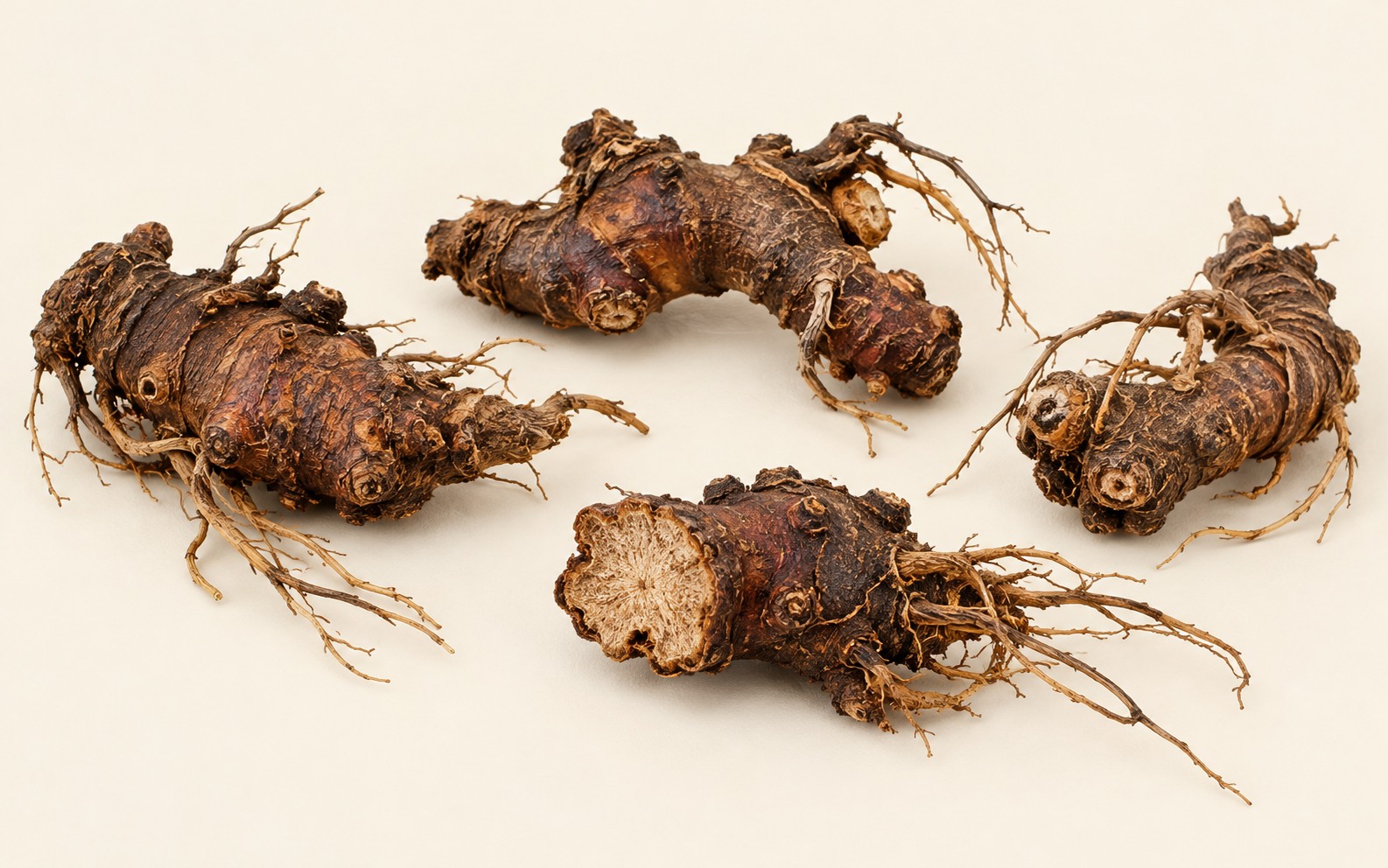
Podophyllum hexandrum Royle · Dried rhizome and root are recorded as Sinopodophylli Radix et Rhizoma; toxic plant, not for foraging or self-use
Materia medica properties in reference
Materia medica form discussed in this paragraph
Properties as recorded in the source: Hong Kong’s Chinese Medicine Regulatory Office records Sinopodophylli Radix et Rhizoma as a toxic Chinese materia medica derived from the dried root and rhizome of Sinopodophyllum hexandrum, a synonym cross-referenced by Kew under Podophyllum hexandrum. The references reviewed do not establish a complete Vietnamese or East Asian pharmacopoeial taste, temperature, meridian, or function profile for this exact species. This section records the regulator’s toxicity status and plant part; it does not turn vernacular names or historical descriptions into advice to use it.
No reliable source reviewed establishes a safe multi-herb formula with defined ingredients, ratios, and effects for this species. The regulator describes identification confusion with Clematis and Gentiana roots; that is a substitution problem, not evidence that combining those plants creates a poison. Do not experiment with combinations.
CITES international-trade evidence
Materia medica form discussed in this paragraph
The 2026.1 CITES Trade Database contains 14 comparative-tabulation rows for Podophyllum hexandrum during 2016, 2017, 2018, 2019, 2020, 2021, 2023, 2024. The query selected reported purpose T (Commercial) and trade term MED (medicine); appendices appearing in these rows: II. Reported importer codes include DE, IE, IT, JP; exporter codes include CN, JP. These are comparative-tabulation rows, not shipment counts or summed volume. This record does not establish clinical efficacy, the legality of an individual transaction, or safety of use.
Kew accepts Podophyllum hexandrum Royle in Berberidaceae; Sinopodophyllum hexandrum is a synonym frequently used in materia-medica and horticultural sources. It is a perennial rhizomatous geophyte, not a woody plant.
Dried-drug features for identification study
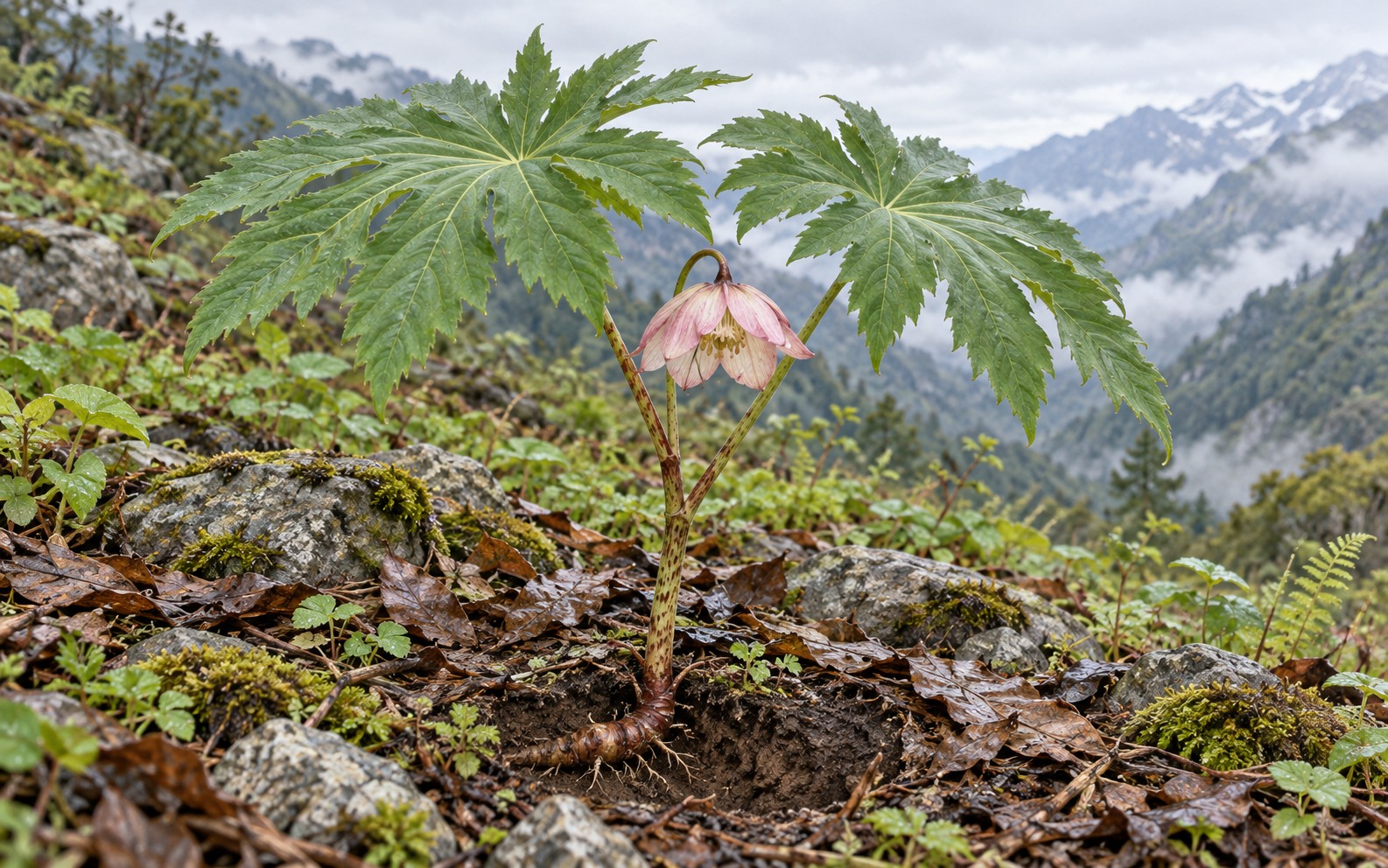
Mature plants commonly have branched petioles bearing large umbrella-like, palmately divided, toothed leaves, with a single pale pink or whitish flower near the petiole fork. A berry may follow, but this illustration must not be used to identify a real plant or judge whether fruit is edible. Hong Kong’s regulator identifies the medicinal material as dried root and rhizome. Treat the plant and medicinal parts as hazardous; identity requires reference specimens and appropriate testing, not an image alone.
Traditional context
Materia medica form discussed in this paragraph
The name Sinopodophylli Radix et Rhizoma appears in Hong Kong’s Chinese-medicine regulatory record for the dried root and rhizome of this species. Inclusion in a materia-medica system does not make the raw material safe for self-use.
Materia medica form discussed in this paragraph
The regulator classifies it as toxic; the cited record is not a recommendation or a self-care indication. Botanical and medicinal-name databases also list multiple synonyms, so descriptions of another Podophyllum or Sinopodophyllum species must not be transferred to this taxon.
Modern evidence
Materia medica form discussed in this paragraph
The project’s CITES Trade Database 2026.1 extract contains 14 comparative-tabulation rows for Podophyllum hexandrum during 2016–2024 (none in 2022), filtered to purpose T (Commercial), term MED (medicine), Appendix II. The rows report source code A and exporter codes JP or CN; some Japan-exporter rows record China in the Origin field. These are Party-reported data and importer/exporter reports may differ. Fourteen rows are not fourteen shipments, not all international commerce, and cannot be casually summed into total market volume. CITES currently lists the species in Appendix II with annotation #2: most parts and derivatives are covered, except seeds/pollen and finished products packaged ready for retail sale under the annotation’s wording. This is a conservation-trade rule, not evidence of medicinal efficacy.
Materia medica form discussed in this paragraph
The linked medical references focus on identity and toxicity.
Materia medica form discussed in this paragraph
Hong Kong’s CMRO reports podophyllotoxin and deoxypodophyllotoxin in the medicinal material; inappropriate use or amount may cause poisoning or death. That is a toxicology warning, not an extraction or use instruction. The page does not infer treatment effects from the presence of bioactive compounds.
Safety
Materia medica form discussed in this paragraph
Primary warning: Hong Kong’s CMRO classifies the dried root/rhizome as toxic and warns that inappropriate use may cause poisoning or death; the RHS says all parts of the plant are highly toxic if ingested and advises gloves and handwashing after handling. Do not taste, chew, decoct, soak, or prepare any part yourself; keep it away from children and pets. If swallowed or symptoms follow exposure, contact local emergency services or a poison center promptly and retain any label/sample for clinicians; do not induce vomiting. CMRO documents confusion with roots of Clematis chinensis
Materia medica form discussed in this paragraph
, C. hexapetala, C. manshurica, Gentiana scabra, and G. rigescens; this is a market substitution and identification hazard. AI art cannot rule out a look-alike or authenticate a product.
The references reviewed do not verify a particular herb pair that turns Podophyllum hexandrum into a “poisonous combination,” so no pair, effect, or ratio is assigned. Hong Kong’s CMRO warns of confusion with Clematis and Gentiana
Materia medica form discussed in this paragraph
because the roots can look similar. That is an ingredient-substitution warning, not a co-use record. The absence of a confirmed pair does not prove combinations are safe; this plant already carries a serious toxicity warning and is unsuitable for self-use. Medicine interactions, textual incompatibility, poisoning from dose or mistaken identity, and a purported toxic herb pair are distinct claims and must not be conflated.
Identification and study notes
Dried-drug features for identification study
Use the living-plant artwork only as a study illustration: a low herbaceous plant rises from a creeping rhizome; branched petioles carry large, deeply palmate leaves with radiating veins and toothed edges; a solitary pale pink to whitish flower hangs near the fork. RHS describes flowering in late spring or summer, with leaves expanding after flowering; flower color and leaf division can vary among plants and cultivated forms. The dried material in the regulatory record is root/rhizome
Dried-drug features for identification study
and usually lacks leaves or flowers for identification. Dried roots may be cut and resemble other medicinal roots; CMRO describes DNA-based differentiation in quality-control research. Personal sensory inspection cannot establish that material is safe to ingest.
Growth and habitat
Illustrated plant and growing setting
Kew gives a native range from northeastern Afghanistan to western and central China, including Afghanistan, north-central and south-central China, the East and West Himalaya, Nepal, Pakistan, Qinghai, and Tibet; it grows in temperate biome. RHS summarizes the horticultural range as the Himalaya and western China. This is a montane/temperate species
; that habitat does not guarantee performance in hot, humid tropical lowlands. UK horticultural advice concerns ornamental cultivation, not medicinal-crop production in Vietnam.
Living plant / habitatFor ornamental study only, start with legally sourced nursery stock or seed carrying a clear scientific label. Do not dig wild plants, collect wild seed, or trade wild specimens. CITES lists the species in Appendix II; check current rules for live specimens, parts, and documents before transport.
Living plant / habitatRHS recommends seed in containers in an open frame, or division in spring or late summer. Ex situ propagation research shows seed dormancy can vary with accession/source; do not apply one seed-treatment recipe to every lot.
Living plant / habitatPlace it in full or partial shade, in humus-rich, fertile, moist but well-drained soil and a sheltered position—the RHS guidance is for UK gardening. Avoid prolonged waterlogging; do not invent a fixed watering or fertilizer schedule where the species source gives none.
Living plant / habitatMonitor emerging shoots, slugs, moisture, and rhizome condition; RHS notes young leaves may be susceptible to slug damage. Wear gloves, wash hands after handling, and keep children/pets away. RHS warns that all plant parts are highly toxic if ingested.
Illustrated plant and growing settingRHS lists about 2–5 years to garden maturity; this is not a medicinal harvest age or a time after which the plant becomes safe. Do not use a home-grown plant as medicine; no cultivation interval removes its toxicity.
Living plant / habitat
How long until harvest? No growing period makes this species safe for self-use. The RHS 2–5-year figure is garden maturity only; the dried materia medica is regulated as toxic. Grow for observation, not for harvest or ingestion.
From plant to dried material · source-recorded workflow
Dried materia medica form of this speciesCheck the accepted name Podophyllum hexandrum Royle and synonym Sinopodophyllum hexandrum; retain plant-source records and lawful documentation. AI artwork cannot replace botanical identification or testing.
Illustration of the processing step describedIf grown ornamentally, record source, planting date, and growing conditions; exclude children and pets, wear gloves, and wash hands after handling because RHS warns of high toxicity if ingested.
Dried materia medica after processingHong Kong’s CMRO describes the medicinal material as dried root and rhizome and classifies it as toxic. This page does not instruct readers to dig roots, process, extract, prepare an oral product, or determine a dose.
Dried materia medica form of this speciesIn professional study, distinguish look-alike Clematis/Gentiana materials and use appropriate analytical methods. Toxic materia medica should be handled only by authorized facilities following controlled procedures and applicable standards.
Dried materia medica form of this speciesCITES lists the species in Appendix II with annotation #2 in its current appendices; verify the annotation’s scope and required documents with the competent authority before international transport or trade.
Illustration of the processing step described
This record supports study and processing traceability; it is not a home preparation or self-use guide.