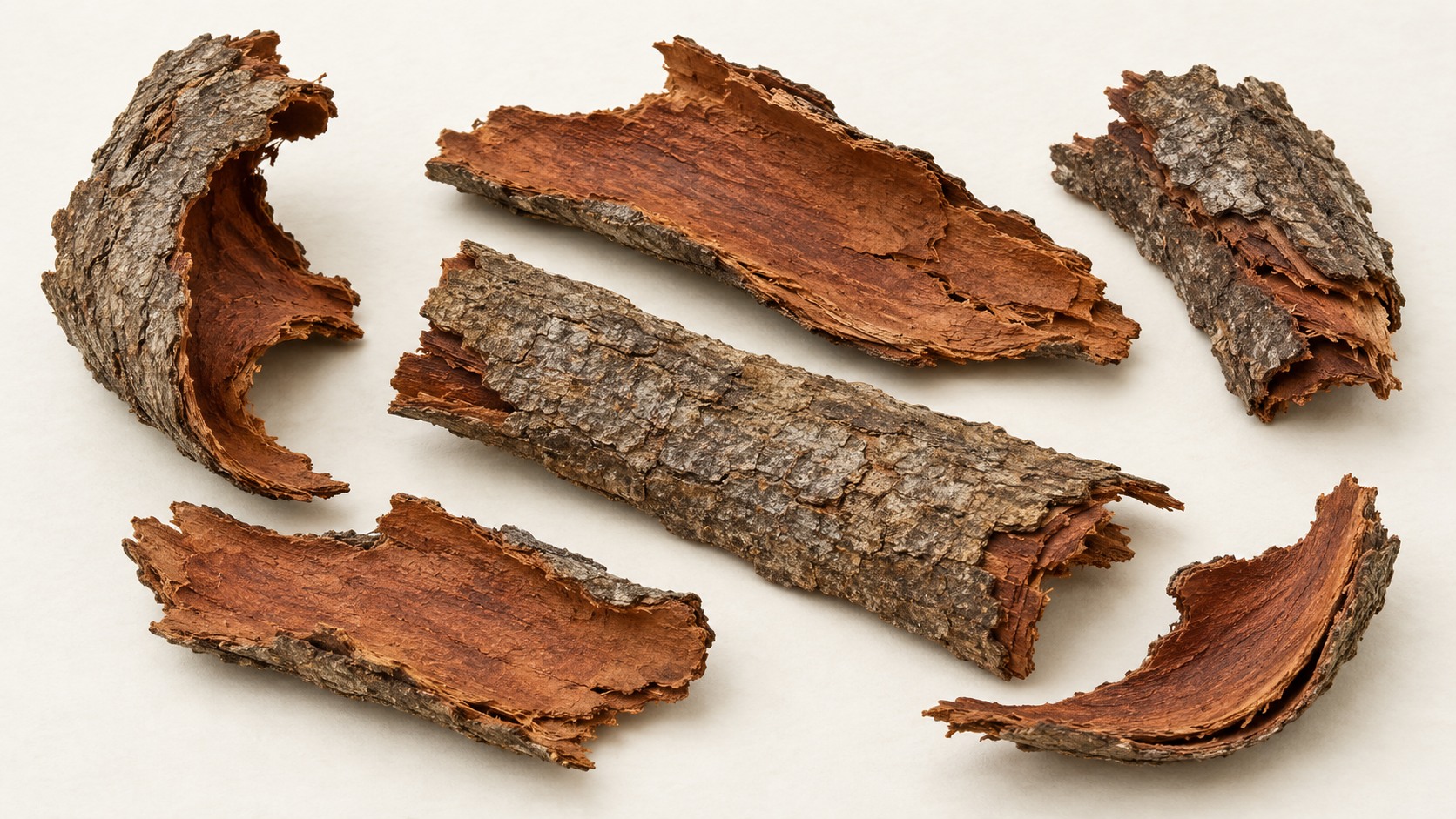
Prunus africana (Hook.f.) Kalkman · Dried stem and branch bark (Pruni africanae cortex / pygeum bark). Do not confuse it with cinnamon or bark from other Prunus species.
Materia medica properties in reference
Materia medica form discussed in this paragraph
The linked references do not establish the taste, temperature, meridian entry, and traditional functions for this exact species/material. No properties are inferred from a related species.
Identifying the tree and bark material
Materia medica form discussed in this paragraph
Kew accepts Prunus africana (Hook.f.) Kalkman; Pygeum africanum Hook.f. is a synonym found in older literature, product labels, and trade databases. Common names such as African cherry, African prune, red stinkwood, and pygeum vary by market. For study or inventory, record the scientific name, Rosaceae family, plant part, and origin. The word “pygeum” on a package alone cannot authenticate the species, part, or documented lot.
Living plant discussed in this paragraph
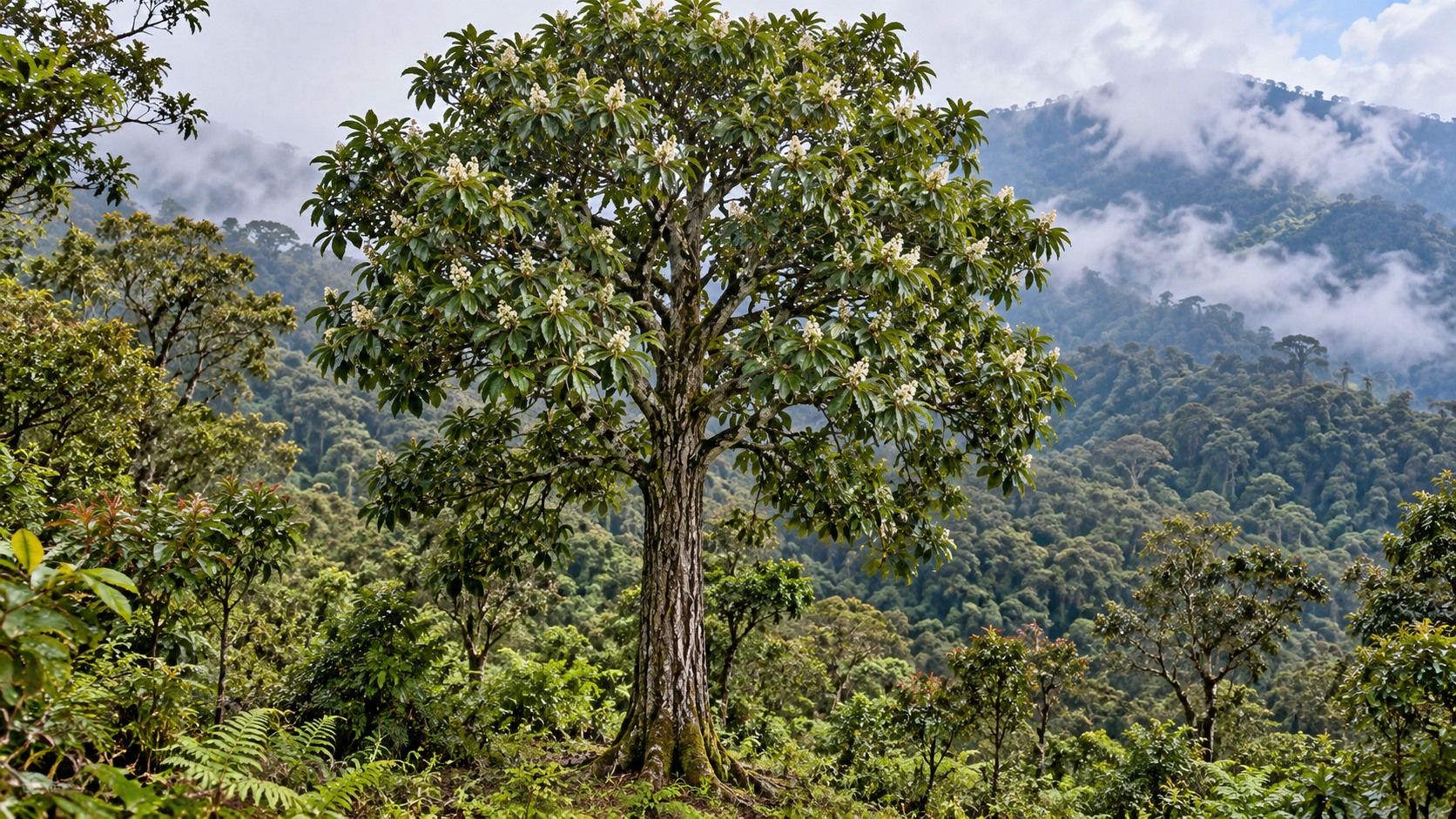
The species is an evergreen tree with a potentially large branching crown; reported height varies with locality and forest conditions. Mature bark is dark grey to brown, rough, and fissured lengthwise. Alternate leaves are thick and leathery, elliptic-oblong to lance-shaped, often with toothed margins. Small creamy-white flowers occur in axillary racemes; ripe drupes turn red to dark purplish-brown. The AI tree picture supports study of one general form, not every geographic or seasonal variation.
CITES identifies the bark as a locally used medicinal material and an export commodity for the pharmaceutical industry; international trade includes dried bark and processed medicines. EMA maintains a record for Pruni africanae cortex in the urinary and genital therapeutic area. These sources establish use and market context, but sale or inclusion in a monograph does not prove that every product has the same composition or effect.
Materia medica form discussed in this paragraph
Clinical studies have investigated bark extracts for lower urinary tract symptoms associated with BPH. The EMA assessment summarizes trials with different sample sizes, durations, and preparations; older studies were often short and did not compare comprehensively with all standard medicines. Findings therefore apply cautiously to the preparations studied. They cannot be transferred automatically to raw bark, unstandardized powder, home-made tea, or another plant sold as “pygeum.”
In the 2026.1 CITES Trade Database extract, filtering Prunus africana, term medicine, purpose T (commercial), and source W (wild) yields 22 comparative rows in reported years 2016, 2017, and 2019–2024. The extract includes exporter/importer codes such as US, CA, IN, GB, TR, PT, NL, and FJ; some records give origins CM, CD, UG, or XV. These are 22 rows under a specific filter, not 22 unique shipments or a global volume total. Quantities use different units or are blank, so they should not be added into one production figure.
Materia medica form discussed in this paragraph
The species has been listed in CITES Appendix II since 1995. Appendix II regulates international trade through permits and findings about whether trade may be detrimental; it does not mean every tree is banned from trade, nor does it prove that any individual lot is legal. CITES records populations previously categorized as of urgent concern by the Plants Committee and measures such as quotas or import suspensions at particular times. Laws, annotations, quotas, and permits can vary by source country and date.
No quantified multi-herb formula for this exact species was verified. See the pairing section for source limits; do not infer a ratio.
CITES international-trade evidence
Materia medica form discussed in this paragraph
The 2026.1 CITES Trade Database contains 22 comparative-tabulation rows for Prunus africana during 2016, 2017, 2019, 2020, 2021, 2022, 2023, 2024. The query selected reported purpose T (Commercial) and trade term MED (medicine); appendices appearing in these rows: II. Reported importer codes include FJ, GB, NL, PT, TR, US; exporter codes include CA, IN, US. These are comparative-tabulation rows, not shipment counts or summed volume. This record does not establish clinical efficacy, the legality of an individual transaction, or safety of use.
Kew gives a native range from Ghana to Ethiopia and South Africa, as well as Comoros and Madagascar; the species grows primarily in tropical montane vegetation. Regional floras describe upland rain forest, riverine forest, and moist mountain forest, with records commonly around 900–3,000 m in some areas. This is a source-described habitat range, not a mandatory condition for every population or country. The evergreen tree can grow tall; seedlings occur under canopy, and birds feed on the fruit and disperse seed.
Illustrated plant and growing settingStart with legally sourced seed or nursery plants with documented provenance; protect parent trees and do not remove wild seed or seedlings without authorization. CITES documents show that much bark entering international trade has historically come from wild harvest, so traceable cultivation can reduce pressure but does not replace permits.
Illustrated plant and growing settingSANBI describes sowing in trays or prepared seedbeds in a well-drained medium, giving bark mixed with well-washed river sand as an example. The source does not set a universal sowing depth, seed treatment, spacing, or watering calendar. Do not import parameters from another Prunus species.
Living plant / habitatFAO EcoCrop records reference values of about 900–1,400 mm annual rainfall, 14–18°C, deep soil, and good drainage. Its broader tolerance range does not guarantee good performance at every site. SANBI describes sensitivity to heavy frost and a preference for regular rainfall. Check local climate and soil before choosing a planting site.
Illustrated plant and growing settingSANBI reports that growth can reach about one metre per year under temperate conditions with good rainfall; this is a source-specific reference, not a promised rate. No universal care, fertilizing, or bark-harvest age schedule was verified. Monitor growth and follow local forestry guidance.
Illustrated plant and growing setting
How long until harvest? There is no verified universal number of years before bark harvest. Cultivation sources give growth rates only for stated conditions; local CITES plans determine minimum size and permitted lots. Medicinal bark also needs traceable provenance and quality controls.
From plant to dried material · source-recorded workflow
Illustrated post-harvest workflowConfirm Prunus africana from cultivation records or a voucher and record provenance; do not use the trade name pygeum alone instead of the scientific name.
Plant before harvestHarvest only from areas, trees, and volumes authorized under current management and CITES rules. CITES sources record overharvesting and tree damage as historical concerns.
Illustration of the processing step describedCITES trade references describe unprocessed dried bark and processed medicines as the main commodities; bark may be exported as chips or powder. This is not a home-processing recipe.
Plant before harvestLot and label the species, plant part, collection site/date, cultivated or wild source, permits, and CITES documents; check quality against applicable standards before export or use as an ingredient.
Illustration of the processing step described
This record supports study and processing traceability; it is not a home preparation or self-use guide.