Qianniuzi · lobedleaf pharbitis seed · Qian Niu Zi
Ipomoea nil (L.) Roth · Dried mature seeds
Name and part used
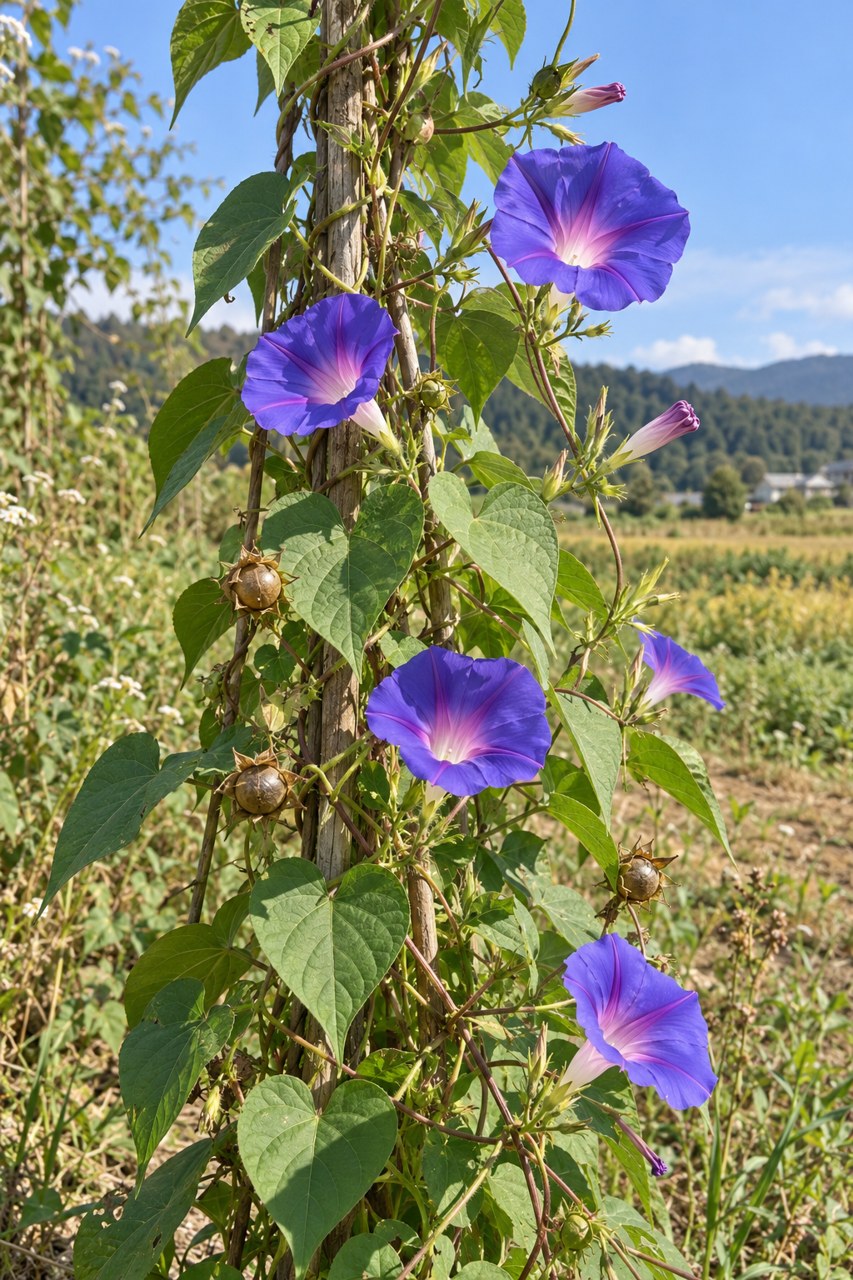
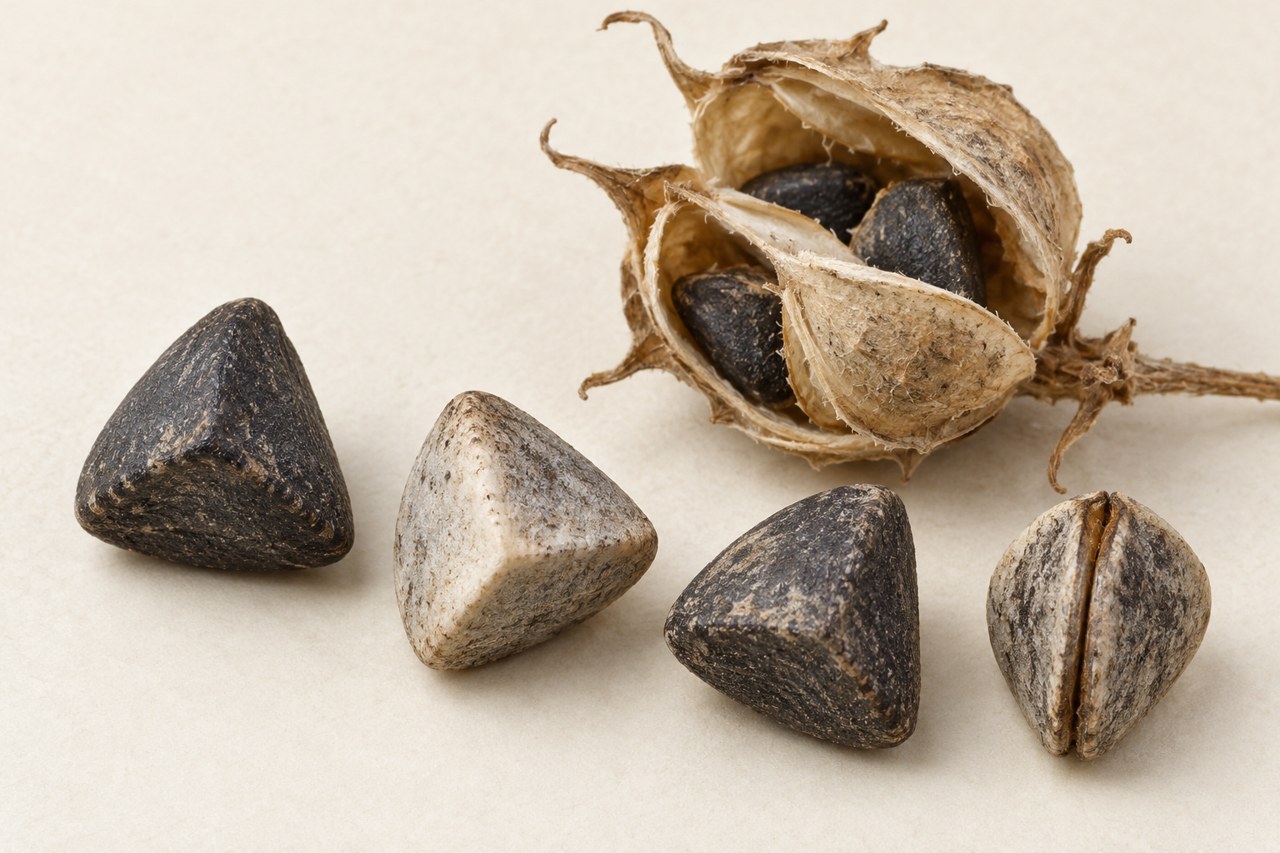
Qianniuzi is the dried mature seed of Ipomoea nil (L.) Roth, an annual morning-glory vine. The twining stem has long white hairs; leaves are alternate and broadly ovate; clusters often carry several funnel-shaped blue-purple or reddish-purple flowers. Nearly spherical capsules contain a few seeds. HKBU records flowering around July–September and fruiting around August–October; the plant occurs in mountains, fields, wall bases, and roadsides, while the medicinal material originated in the Americas. Seeds are three-angled with a longitudinal groove on the back and may be gray-black or pale yellow-white. The seeds are toxic, not food or a home remedy. AI art is for morphology study only and cannot identify field seeds.
Traditional context
HKBU classifies the seed as bitter, pungent, cold, and toxic; historical materia medica describes draining fluid, purgation, resolving phlegm, and expelling parasites. This is documentation of a toxic drug, not a recommendation. Ingestion may cause abdominal pain, vomiting, severe diarrhea, dehydration, and complications; do not follow historical doses found online.
Modern evidence
HKBU provides identity, processing, and traditional descriptions, not proof of clinical benefit. Its MPID notes pharbitin and purgative/diuretic pharmacology in older records, but this does not establish a safe modern dose or benefit-risk balance. Poison-induced diarrhea is not treatment for edema or constipation. Historical formula examples are not practical instructions.
Safety
Qianniuzi seeds are documented as toxic. Do not eat, taste, decoct, grind, soak in alcohol, or use them as a home remedy; do not grow them for self-treatment. Wear gloves when handling study material, keep it sealed away from children and pets, wash hands, and store separately from food seed. If swallowed or if abdominal pain, vomiting, diarrhea, or dizziness occurs, contact emergency services/poison control immediately; do not induce vomiting.
Safety reference ↗Pairing in reference texts
This page gives no pairing, ratio, or recipe for a toxic seed. HKBU preserves historical examples, which do not establish safety for self-use and may be harmful if copied. Do not combine with laxatives, diuretics, cardiovascular medicines, or any herb; interactions and toxicity cannot be predicted from images.
Identification and study notes
The twining vine, alternate leaves, funnel flowers, and round capsule describe the plant; the medicinal seed is the hazardous part. The source describes 5–6 ovate black seeds per botanical capsule, while commercial drug material may occur in two color forms. Do not confuse the seeds with edible beans or vegetables. AI art may misrender seed counts or capsule anatomy and must never guide real-world seed selection. For study, separate the ornamental vine from its drug seed: attractive morning-glory flowers do not make the seeds food. Observing capsules on the living plant is botanical learning only; do not open pods or grind seeds. Commercial lots may be called black or white by seed-coat color, but neither color indicates that toxicity has been removed. Do not confuse the three-angled grooved seed with edible beans, millet, or cereal grains. Seeds require sealed, “toxic” labeling and separation from tea, spices, and food seed; do not share samples without hazard packaging. Historical texts include actions and processing descriptions, but roasting does not turn this record into a household guide. Only trained personnel should handle research samples under institutional safety procedures. For flashcard practice, first name the family-level clues—twining stem, alternate broad leaves, and funnel corolla—then reveal the seed form and toxicity warning. The live-plant picture and dried-seed picture are separate teaching views, not a claim that a seed collected from any morning glory is Qianniuzi. Commercial identity depends on an authenticated species and medicinal part. Never use a taste test: the source notes a numbing sensation, but tasting an unknown seed is unsafe. Keep this specimen in a hazard-aware learning collection, and choose a harmless substitute image for classroom handling.
Growth and habitat
HKBU places it on mountains, plains/fields, wall bases, and roadsides across China; its funnel flowers are conspicuous on sunny supports. The species originated in the Americas and is cultivated or naturalized elsewhere. Never collect ornamental or roadside seeds for use: the seeds are toxic and sites may be contaminated.
Identification and study notes
The twining vine, alternate leaves, funnel flowers, and round capsule describe the plant; the medicinal seed is the hazardous part. The source describes 5–6 ovate black seeds per botanical capsule, while commercial drug material may occur in two color forms. Do not confuse the seeds with edible beans or vegetables. AI art may misrender seed counts or capsule anatomy and must never guide real-world seed selection. For study, separate the ornamental vine from its drug seed: attractive morning-glory flowers do not make the seeds food. Observing capsules on the living plant is botanical learning only; do not open pods or grind seeds. Commercial lots may be called black or white by seed-coat color, but neither color indicates that toxicity has been removed. Do not confuse the three-angled grooved seed with edible beans, millet, or cereal grains. Seeds require sealed, “toxic” labeling and separation from tea, spices, and food seed; do not share samples without hazard packaging. Historical texts include actions and processing descriptions, but roasting does not turn this record into a household guide. Only trained personnel should handle research samples under institutional safety procedures. For flashcard practice, first name the family-level clues—twining stem, alternate broad leaves, and funnel corolla—then reveal the seed form and toxicity warning. The live-plant picture and dried-seed picture are separate teaching views, not a claim that a seed collected from any morning glory is Qianniuzi. Commercial identity depends on an authenticated species and medicinal part. Never use a taste test: the source notes a numbing sensation, but tasting an unknown seed is unsafe. Keep this specimen in a hazard-aware learning collection, and choose a harmless substitute image for classroom handling.
Growing and care
- Sow only for botanical observation, never to harvest seeds for use. Choose seed labeled Ipomoea nil and use a large pot or dedicated trellis away from children and pets.
- Provide bright sun and loose drained soil; install support before vines elongate. Do not sow in a food bed or near edible seed.
- Water to keep soil moderately moist, not waterlogged; train vines on the trellis and monitor capsules. Wear gloves when pruning and collect fallen capsules/seeds in a sealed bag.
- HKBU records flowers around July–September and fruit around August–October, varying by climate. No safe medicinal-cultivation timetable is provided. Do not harvest, store, or use the seeds; manage ornamental plants under local rules.
How long until harvest? It is an annual plant; HKBU records fruiting around August–October but gives no sowing-to-fruiting interval. Mature seeds are not safe: this part is documented as toxic and is not for home use.
Habitat, season, and harvest in the HKBU botanical record
HKBU describes Ipomoea nil as an annual twiner with a roughly 2 m white-hairy stem, broad alternate leaves, and blue-purple/reddish-purple funnels; flowering is July–September and fruiting August–October. It grows in mountains, fields, wall bases, and roadsides. Mature seeds are separated from vines and cleaned; the materia-medica source classifies them as toxic.
Open botanical source ↗FROM PLANT / SOURCE HABITAT TO DRIED MATERIAL · REFERENCE WORKFLOW
- HKBU describes cutting vines at fruit maturity, threshing out seeds, removing husk/debris, and sun-drying; this documents processing of a toxic drug, not a home-processing guide.
- Do not pan-fry or taste seeds. A professional facility must control identity, seed dust, equipment, cross-contamination, and waste under applicable rules.
- Reference material has three-angled firm seeds with a back groove; color may be gray-black or pale yellow-white. Color cannot determine toxicity or quality.
- For a study collection, use illustrations in place of real seeds. If authentic seeds are required for research, label as toxic, seal, and follow institutional safety procedures.
These are post-harvest study notes, not directions to prepare a remedy for self-treatment. Processing reference ↗