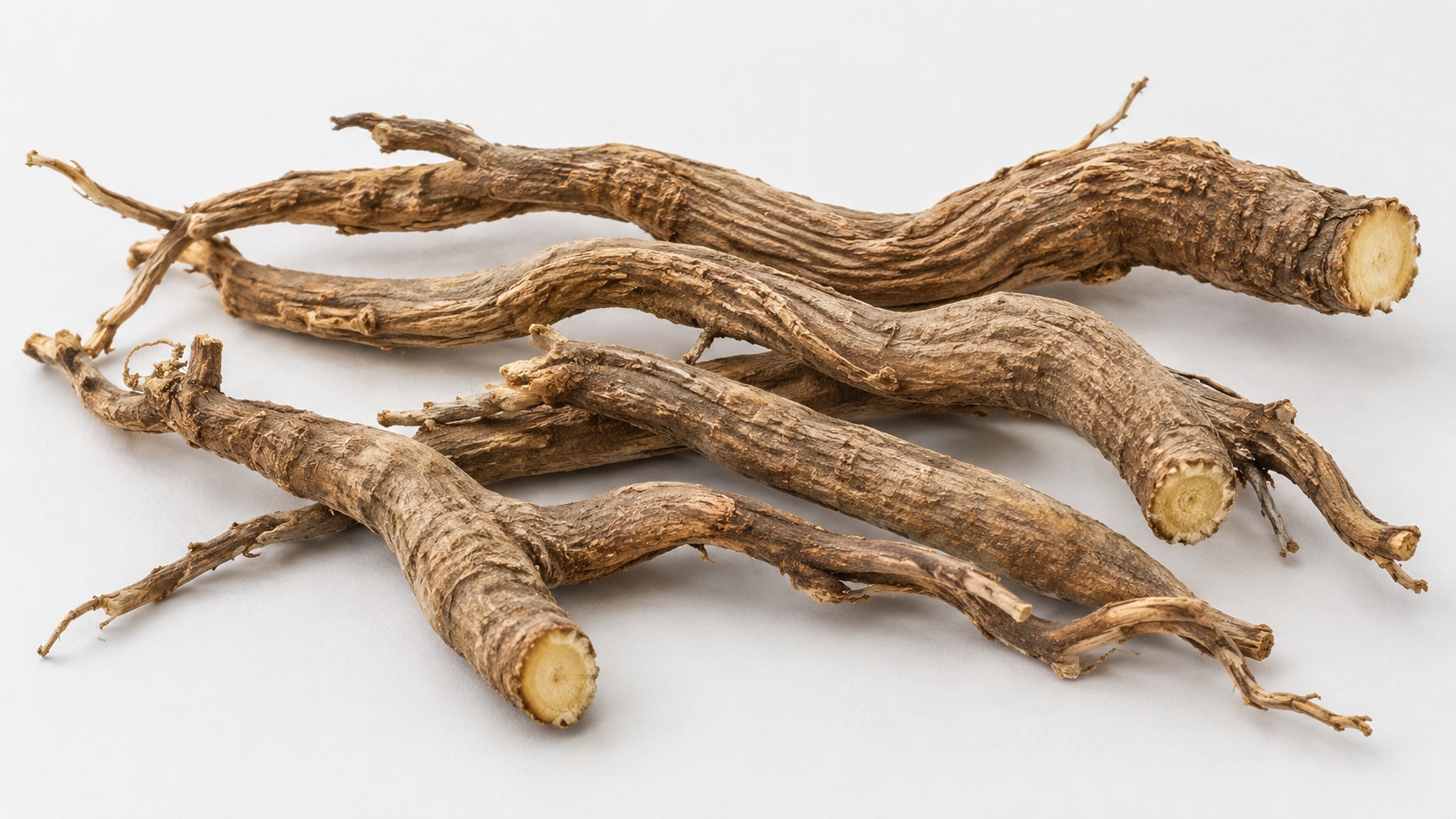
Rauvolfia serpentina (L.) Benth. ex Kurz · Dried root (Rauvolfiae Serpentinae Radix / Indian snakeroot root). This is a pharmacopoeial material with potent alkaloids; the study image is not a tested drug lot.
Materia medica properties in reference
Materia medica form discussed in this paragraph
The linked references do not establish the taste, temperature, meridian entry, and traditional functions for this exact species/material. No properties are inferred from a related species.
Botanical identification and species distinction
Dried-drug features for identification study
Kew POWO accepts Rauvolfia serpentina (L.) Benth. ex Kurz in Apocynaceae. Historical synonyms include Ophioxylon serpentinum, O. album, Rauvolfia obversa, and R. trifoliata; older labels may spell the name “Rauwolfia” with a w. A materia medica record should connect the accepted scientific name to the name used by its source, rather than treating an orthographic variant as another species or pooling every Rauvolfia as one drug.
Living-plant features for identification study
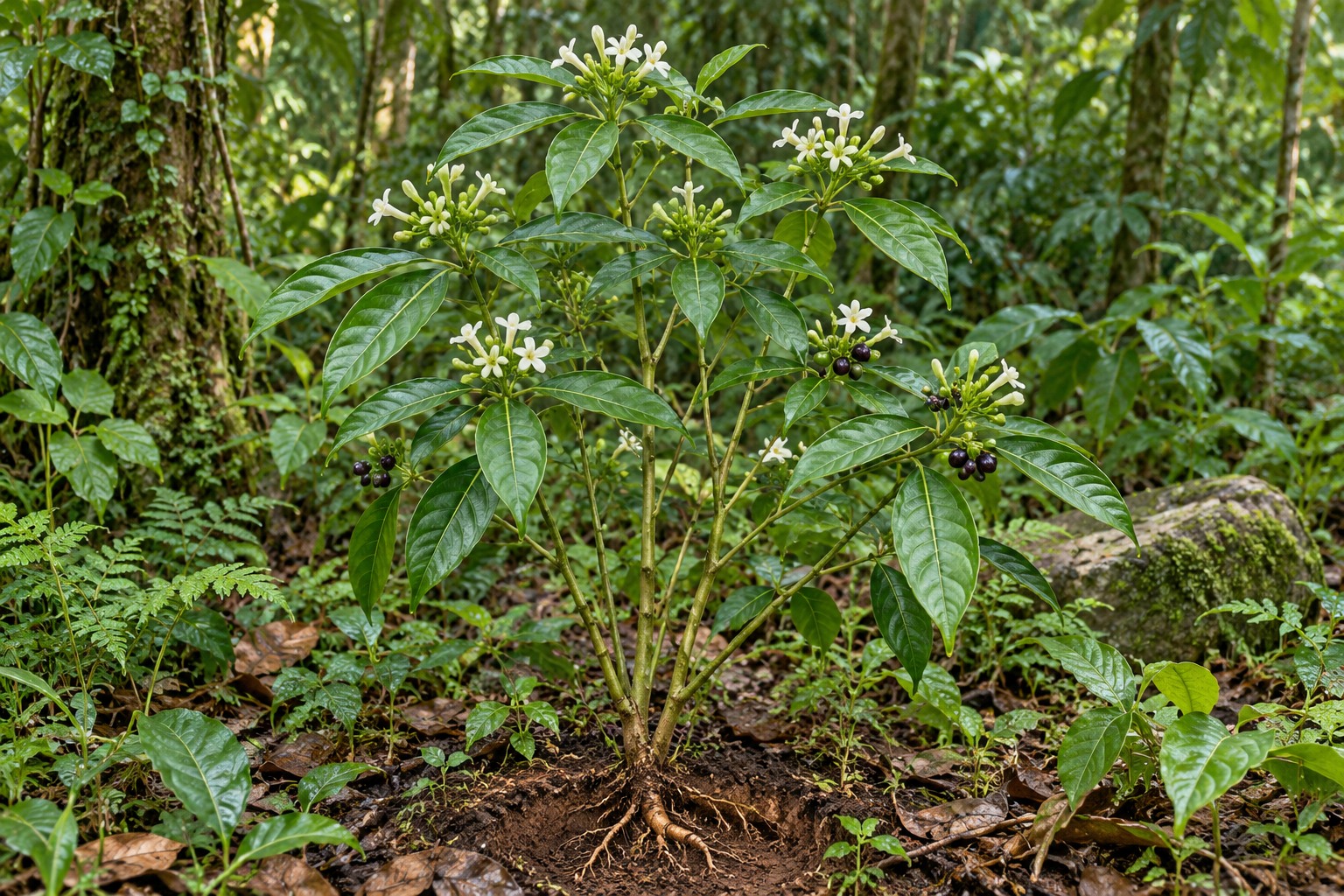
The Thai Herbal Pharmacopoeia describes a small shrub with slender, smooth, upright stems and simple leaves usually arranged in whorls of three to five at a node. Blades are narrowly elliptic to obovate with entire margins. Clusters bear white tubular flowers; small drupe-like fruits darken at maturity. Whorled leaves are a useful field clue, but are not enough to identify a wild specimen without flowers or fruit, a voucher, and botanical expertise.
Dried-drug features for identification study
The pharmacopoeial material is dried root, sometimes with pieces of rhizome or stem base. Roots may be long, curved, twisted, and longitudinally wrinkled; cut-face appearance varies by lot and processing. The AI images here illustrate plant and root form for study only. They cannot replace a voucher, microscopy, chromatography, chemical tests, or a lot-specific certificate of analysis, and must not be used to authenticate a product.
Sarpagandha is a South Asian drug name associated with Rauvolfia serpentina root in Ayurveda and regional pharmacopoeias. The Thai Herbal Pharmacopoeia places the material in antihypertensive and antipyretic categories; PROSEA records a history of use in South and Southeast Asia. Such classifications describe how references categorize the drug; they are not advice to use the plant to self-manage blood pressure, fever, insomnia, or neurological illness.
Materia medica form discussed in this paragraph
Botanical and trade references record traditional use for snake or insect bites and some nervous-system complaints; practices vary by community, period, root preparation, and context. Some sources mention use in mixtures with other plants but do not give names, amounts, and ratios sufficient to identify a reproducible formula. This profile therefore supplies no recipe, attributes no benefit to a particular pair, and does not infer efficacy from disease names in ethnobotanical records.
Materia medica form discussed in this paragraph
Presence in Ayurveda or a Thai pharmacopoeial record does not make this a Vietnamese or Chinese materia medica drug with equivalent properties, channels, or use. Its root contains potent pharmacological alkaloids; traditional practice does not remove toxicity, misidentification, or interaction risks. This section documents historical context and distinguishes knowledge systems; it does not encourage self-treatment.
Kew places the native range from the Indian subcontinent to south-central China and western Malesia. Its regional distribution includes India, Nepal, Bangladesh, Myanmar, Sri Lanka, Thailand, Vietnam, south-central China, and islands of Southeast Asia. Kew assigns the species to the wet tropical biome. A regional distribution record does not show that the plant remains common at a particular site; habitat loss and root collection have affected some populations.
Illustrated plant and growing setting
PROSEA reports the plant in relatively open parts of forest landscapes, including forest edges and riverbanks; Indian floristic surveys also record moist deciduous forest. For cultivation, PROSEA notes slightly acidic soil around pH 5–6.5 as favourable, shade tolerance, and moist conditions with drainage. These refer to the source contexts described, not a universal soil recipe. Prolonged waterlogging is not the same as well-drained moisture.
Illustrated plant and growing setting
Habitat records and cultivation studies answer different questions: where the species has been found growing naturally and which conditions were tested in crops. Sources do not guarantee that every Vietnamese climate is suitable or establish a fixed watering calendar. For study cultivation, check plant provenance, local rules, rainfall, shade, drainage, and local pest pressure; do not collect forest plants for planting stock.
Kew gives a native range from the Indian subcontinent to south-central China and western Malesia, including India, Nepal, Bangladesh, Sri Lanka, Myanmar, Thailand, Vietnam, parts of China, and nearby islands. Kew describes it as a shrub of the wet tropical biome. PROSEA notes that Rauvolfia serpentina is often found in more open places such as forest edges and riverbanks, although congeners can occur in secondary forest or scrub. A Botanical Survey of India flora records it in moist deciduous forest in an Odisha sanctuary and as rare at some surveyed sites. A locality in one flora record does not mean the species is common throughout that region.
Illustrated plant and growing settingSelect mature, full seeds from an identified, legally sourced parent plant. PROSEA notes that Rauvolfia serpentina seed viability declines with storage and recommends sowing within six months of ripening; germination can be low, so seed count is not a reliable estimate of surviving plants.
Illustrated plant and growing settingA Vietnam cultivation example in PROSEA soaks the fruits for 12 hours, removes the seed from the pulp, then soaks seed in 40–45°C water for another 12 hours before sowing in nursery beds. The source reports germination beginning in about three weeks, but climate and seed quality affect results. This is a reported local method, not a universal standard.
Living plant / habitatKew and PROSEA describe a wet tropical setting; PROSEA notes that slightly acidic soil at pH 5–6.5 is favourable and the plant tolerates shade and grows at forest edges or riversides. When seedlings reach about 10–12 cm, PROSEA gives an example of transplanting during the rainy season at roughly 45 × 30 cm. Provide drainage and avoid prolonged waterlogging; do not transfer a Vietnam rainy-season calendar to other climates.
Illustrated plant and growing settingDuring cultivation, PROSEA reports regular weeding and hoeing, about 2–3 times per growing season in the Indian context; farmyard manure and compost were reported to benefit growth. Monitor for Fusarium wilt, leaf spot/blight, mosaic virus, and root-knot nematodes. These are reported cultivation problems, not diagnoses for every plant. Do not apply pesticides outside their labels and local guidance.
Illustrated plant and growing setting
How long until harvest? PROSEA reports cultivated roots harvested after about 1.5–3 years depending on conditions and production goals. It does not establish one suitable harvest age for every region; a commercial harvest age is not a self-use recommendation.
Medicinal root, constituents, and reading standards
Materia medica form discussed in this paragraph
Kew’s Medicinal Plant Names Services maps the drug name “serpentina root” to dried Rauvolfia serpentina root in Ayurvedic and Unani pharmacopoeial sources. The Thai Herbal Pharmacopoeia also defines the crude drug as dried root of this exact species. Agreement across drug references supports material identification, but a trade name alone is insufficient: retain scientific name, plant part, provenance, lot, and testing standard.
Materia medica form discussed in this paragraph
The Thai monograph lists indole alkaloids such as ajmaline, ajmalicine, reserpine, and serpentine. USP describes dried root and an assay standard for the reserpine–rescinnamine group in its monograph; that criterion belongs to that edition. Do not compare or transfer standards across pharmacopoeias without checking the method, reference standard, edition, and specific product.
Materia medica form discussed in this paragraph
A chemical criterion for identity or quality is not a dose and cannot show that a handful of roots has a predictable effect. Composition varies with genetics, soil, season, plant age, root part, storage, and extraction. Images show gross morphology only; species and alkaloid content require professional methods. This section helps readers interpret labels and sources, not prepare medicine.
The root is not a self-use material. Reserpine is an alkaloid affecting nervous and cardiovascular systems; prescription reserpine products can cause sedation, dizziness, hypotension, bradycardia, and depression. DailyMed urges caution in people with a history of depression; a propranolol combination label warns of increased hypotension, marked bradycardia, dizziness or postural fainting, and potentiated depression. Active-ingredient data do not quantify the risk of every root lot, but they are sufficient reason not to treat raw material as harmless.
Materia medica form discussed in this paragraph
Do not combine Rauvolfia root or products with blood-pressure medicines, heart-rate-lowering medicines, sedatives, or mood-affecting medicines without a clinician reviewing the case. Interactions depend on active constituents, extract concentration, health conditions, and current medicines; this profile does not invent a dose or dosing interval. Do not stop or reduce prescribed treatment to substitute the plant. For a product of uncertain composition, retain its package and lot details and consult a clinician or pharmacist.
Materia medica form discussed in this paragraph
Fainting, unusual drowsiness, a slow heartbeat, low blood pressure, persistent vomiting, or severe mood changes need urgent assessment; contact emergency or poison-control services locally. Pregnant or breastfeeding people, children, people with depression, peptic ulcer or cardiovascular disease, and people preparing for surgery should not self-administer or handle medicinal material. Images and traditional-use notes cannot replace identification, toxicology testing, or clinical advice.
In the project’s 2026.1 CITES Trade Database extract, filtering the exact taxon Rauvolfia serpentina, term medicine, purpose T (commercial), and Appendix II yields three comparative rows for 2019, 2021, and 2023. All three report source A; the specific rows list India as origin, Germany/Switzerland as exporters, and Switzerland/Austria as importers. These are comparative rows under a defined filter, not unique shipment counts, summed volume, or a measure of the whole global market.
Materia medica form discussed in this paragraph
CITES lists Rauvolfia serpentina in Appendix II; current annotation #2 must be read with the Appendices to understand covered specimens and exemptions. Appendix II does not mean every product is prohibited, but transactions within CITES scope must meet permit and source requirements. CITES rows are Party-reported records and may not cover every active ingredient, finished preparation, or unreported transaction.
Materia medica form discussed in this paragraph
PROSEA notes that root harvest destroys plants and reports overexploitation of wild populations; some areas have become rare or lost the species. Source A in the three filtered rows denotes artificially propagated source under CITES source coding, but does not prove that the whole market comes from cultivated plants. Conservation requires lot-level traceability and management of collection areas; a materia medica name or general CITES listing is not a certificate for an individual shipment.
Cultivation, harvest, and processing in references
Illustration of the processing step described
PROSEA describes propagation mainly by seed, with stem or root cuttings used in some methods. Because germination can be low and variable, the source recommends selecting mature, full seed and sowing within six months after ripening. A Vietnam example cleans seed from the fruit, soaks fruits for 12 hours, then soaks seed in 40–45°C water for another 12 hours; seed is sown in nursery beds and begins germinating in about three weeks. This is a source-specific method, not a guarantee of home germination.
Dried materia medica after processing
When seedlings reach 10–12 cm, PROSEA gives an example of transplanting into the field during the rainy season at about 45 × 30 cm. The plant favours a humid tropical setting, slightly acidic and well-drained soil, and tolerates partial shade. Weed and hoe 2–3 times per growing season in the Indian cultivation example; the source reports benefits from farmyard manure and compost. Monitor wilt, leaf spot/blight, mosaic virus, and root-knot nematodes. Climate, planting stock, and local rules may require changes.
Plant before harvest
PROSEA reports cultivated roots are commonly harvested after 1.5–3 years; root harvest may kill the plant, and wild collection creates conservation pressure. This is a production interval in the source, not a safe-use age or advice to harvest for self-treatment. CITES rules, land rights, and management plans for a cultivation or collection area must be addressed before harvest or trade.
Plant before harvest
After lawful harvest, references describe removing soil and foreign matter, cutting roots into sections for handling, drying thoroughly to limit mould, and segregating lots. Qualified processors should record species, part, provenance, harvest/processing date, and test results. USP and Thai Pharmacopoeia set their own crude-drug criteria; colour, smell, or an AI image cannot confirm reserpine content, purity, or safety. This is a material-handling overview, not a recipe for oral preparation.
No quantified multi-herb formula for this exact species/root was verified. The prescription-drug warning is documented separately under safety.
CITES international-trade evidence
Materia medica form discussed in this paragraph
The 2026.1 CITES Trade Database contains 3 comparative-tabulation rows for Rauvolfia serpentina during 2019, 2021, 2023. The query selected reported purpose T (Commercial) and trade term MED (medicine); appendices appearing in these rows: II. Reported importer codes include AT, CH; exporter codes include CH, DE. These are comparative-tabulation rows, not shipment counts or summed volume. This record does not establish clinical efficacy, the legality of an individual transaction, or safety of use.
From plant to dried material · source-recorded workflow
Illustrated post-harvest workflowConfirm Rauvolfia serpentina from the seed source, lot label, and botanical records; do not confuse it with Rauvolfia verticillata or congeners. CITES records source code A in the filtered rows for this species, but a source code does not replace permits, traceability, or lot identification.
Plant before harvestPROSEA reports cultivated roots may be harvested after 1.5–3 years. The root is the harvested part; harvest may kill the plant, and wild populations have faced collection pressure. Harvest only from lawful cultivation or collection areas under applicable management and conservation rules.
Plant before harvestShake off soil, remove foreign matter, and segregate lots by species, plant part, cultivation or collection site, harvest date, and processor. Do not mix unidentified material with other Rauvolfia species; commercial labels should retain the scientific name and root part.
Dried materia medica after processingPROSEA describes roots cut into sections for storage and dried thoroughly to limit mould; material should meet the applicable pharmacopoeial standard and be tested for identity, moisture, and chemical specifications by a qualified facility. The USP monograph gives a reserpine–rescinnamine assay criterion for its edition; neither visual inspection nor an AI image can establish quality or alkaloid content.
Illustration of the processing step described
This record supports study and processing traceability; it is not a home preparation or self-use guide.