Rhodiola rosea L. · Rhizome and root; not every product labeled Hong Jing Tian is assumed to be this species
Materia medica properties in reference
Materia medica form discussed in this paragraph
Properties as recorded in the source: The sources reviewed do not establish a complete East Asian taste, temperature, meridian, or materia-medica profile for Rhodiola rosea that can be stated as a pharmacopoeial fact. EMA assesses this species’ rhizome and root and a defined dry extract under the EU traditional-use framework; that is not an East Asian classical property system. Hong Jing Tian may refer to more than one Rhodiola species, so records should state the Latin name and plant part.
No sourced multi-herb formula with defined amounts and a specific effect for Rhodiola rosea was verified. This profile therefore gives no beneficial pairing or assumed ratio; the losartan warning is a reported medicine interaction, not a herb–herb incompatibility.
CITES international-trade evidence
Materia medica form discussed in this paragraph
The 2026.1 CITES Trade Database contains 1 comparative-tabulation rows for Rhodiola rosea during 2024. The query selected reported purpose T (Commercial) and trade term MED (medicine); appendices appearing in these rows: II. Reported importer codes include TW; exporter codes include JP. These are comparative-tabulation rows, not shipment counts or summed volume. This record does not establish clinical efficacy, the legality of an individual transaction, or safety of use.
Kew accepts Rhodiola rosea L. in the Crassulaceae. It is a long-lived succulent perennial native across subarctic and subalpine parts of the Northern Hemisphere. In European medicinal references, the assessed drug is the rhizome and root (rhizoma et radix), not the leaves or flowers.
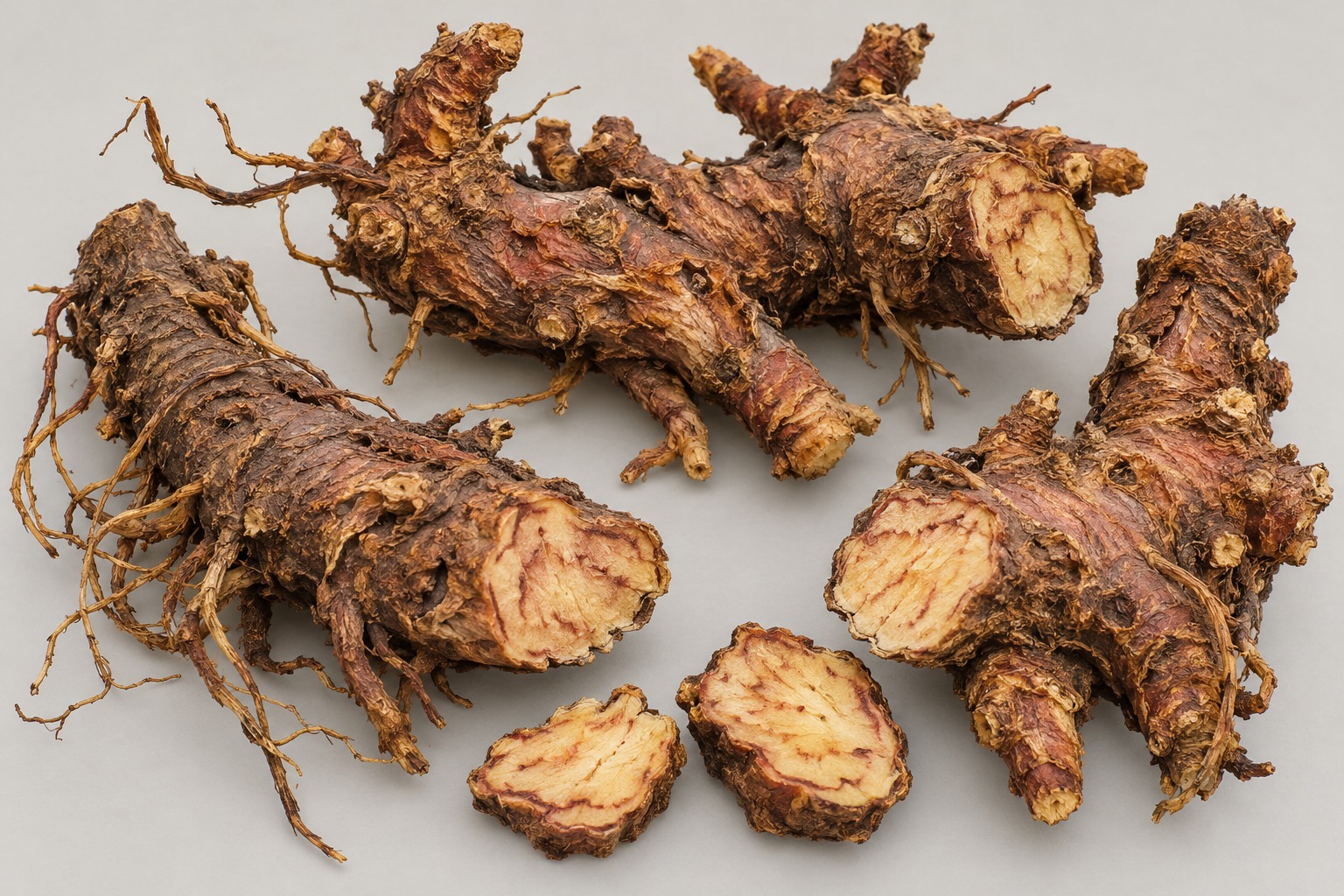
Dried-drug features for identification study
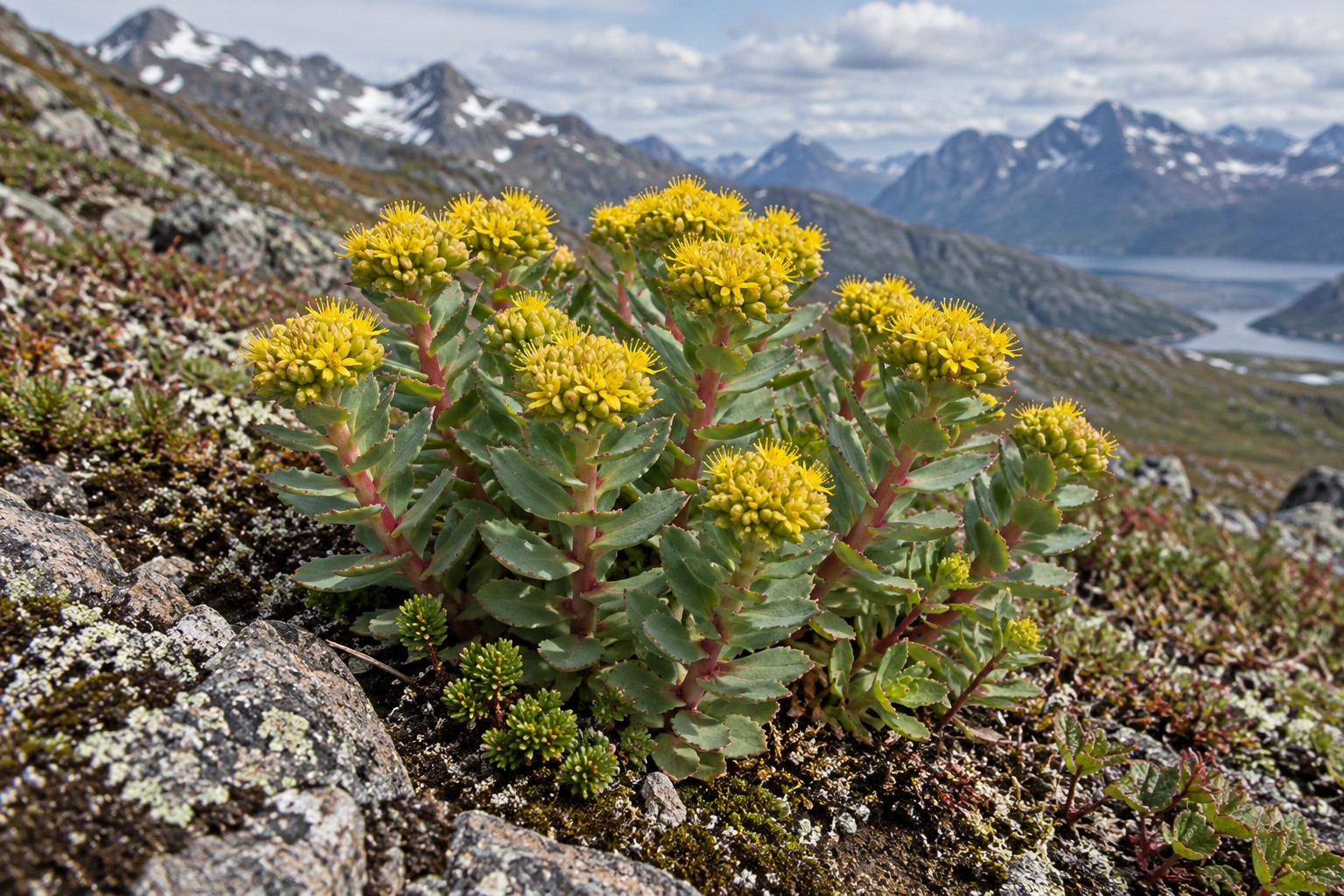
A plant may carry several fleshy green-purple stems, alternate thick lance-shaped leaves with small teeth, and dense terminal heads of small yellow flowers; male and female flowers are generally on separate plants. Mature rhizomes bear stem scars and fine roots. A yellow-brown exterior alone cannot authenticate the species.
Traditional context
Materia medica form discussed in this paragraph
NCCIH records a history of Rhodiola use in Russia, Scandinavia, and other parts of Europe; reported traditional purposes include work endurance, fatigue, mood, and adaptation to altitude. These are historical records, not proof that a foraged root treats depression, exhaustion, or altitude illness.
Materia medica form discussed in this paragraph
EMA assessed the correct drug as R. rosea rhizome and root and a specific dry extract under the EU traditional-use framework. This profile does not assign Chinese materia-medica properties or a classical formula merely from a commercial Hong Jing Tian label; vernacular names may refer to several Rhodiola species.
Modern evidence
Materia medica form discussed in this paragraph
The project’s CITES 2026.1 extract contains one specific 2024 comparative row: the exporter reported 6,414 g of term MED (medicine), purpose T (commercial), Appendix II, from Japan to Taiwan; source code O is defined by CITES as pre-Convention specimens, while the Origin field is recorded as XX. This is an exporter-reported quantity in one data row, not the whole market, revenue, or proof of biological origin in Japan. CITES PC27 Doc. 22 separately records China reporting exports of source-Y cultivated specimens from 2023; that statement must not be merged into the 2024 row’s quantity.
Materia medica form discussed in this paragraph
The current EMA assessment (2024 revision) is regulatory evidence for a defined preparation
Materia medica form discussed in this paragraph
: dry extract DER 1.5–5:1, ethanol 67–70% by volume, in solid oral forms. It is assessed within a traditional-use framework; it is not a clinical finding that every powder, tea, or raw root works. NCCIH concludes that evidence from human research is not sufficiently reliable to determine whether Rhodiola is useful for any health purpose; many studies are low to moderate quality. Differences in species, plant part, extraction ratio, solvent, composition, and quality prevent transferring findings from one standardized extract to raw herb or an unlabeled product.
Safety
Materia medica form discussed in this paragraph
NCCIH describes Rhodiola as possibly safe for up to 12 weeks under studied conditions; reported side effects include dizziness, headache, insomnia, dry mouth, or excessive saliva. It also notes reported interactions with losartan, a medicine for high blood pressure; this does not establish the frequency or risk for every product.
Materia medica form discussed in this paragraph
Safety during pregnancy and breastfeeding is unclear. Do not replace prescribed treatment; people taking medicines, living with a mood disorder, or managing another condition should consult a health professional before considering a product. Data for a standardized extract do not establish a safe self-use dose for wild-collected plant material.
On a living plant, look for a low cushion-like clump with many stems arising from a rhizome; stems may be reddish or purple. Leaves are fleshy, alternate, nearly sessile, oblong to lance-shaped, and toothed toward the upper half. Dense heads terminate the stems; the small four-petaled flowers are commonly yellow, though populations vary.
Dried-drug features for identification study
The underground rhizome is thick and branched, with old stem scars and a scent described as rose-like in some references; do not identify by smell or taste. Commercial dried roots may be cut, mixed, or extracted, and an illustration cannot reliably distinguish close Rhodiola relatives.
Growth and habitat
Living plant / habitat
Kew places the native range in subarctic and subalpine regions of the Northern Hemisphere; NCCIH summarizes growth in cold, high-altitude areas of Europe, Asia, and North America. A broad wild range does not mean the plant suits hot, humid lowlands.
RHS recommends sun and well-drained soil and rates the plant hardy under UK conditions; applying that gardening advice in Vietnam requires accounting for different temperature, humidity, and elevation. The CITES account of North China populations describes small, scattered wild populations, many remaining in protected places; wild collection can create conservation pressure.
Living plant / habitatStart with legally sourced seed or nursery stock labeled Rhodiola rosea and retain lot records. Do not collect plants or seed from protected areas; the CITES account says wild-seed collection in the North China context is subject to permission and supervision.
Living plant / habitatRHS recommends seed propagation in containers in a cold frame; division in spring or early summer is another option. Use draining trays, clean medium, and lot-level records for the small seed; the source does not establish a universal cold-stratification recipe or germination percentage.
Living plant / habitatPlace plants in a cool, bright site with moderately fertile, well-drained soil; RHS recommends full sun and drainage. Avoid prolonged waterlogging. This is UK gardening advice, not a validated medicinal-crop protocol for every region of Vietnam.
Living plant / habitatMonitor drainage, competing weeds, pests, ground cover, and plant vigor; do not impose a fixed fertilizer or irrigation calendar when the references do not specify one. Male and female flowers are generally on separate plants, so seed production depends on suitable pollination between sexes.
Living plant / habitatThe CITES account of North China plantations reports about 3–4 years from germination to whole-plant harvest in the described system. This is a regional, system-specific interval, not a yield promise or a universally safe harvest age for every cultivar, climate, or growing purpose.
Living plant / habitat
How long until harvest? There is no universal interval for home-grown plants. The CITES report gives 3–4 years from seed to harvest in the North China system; that does not certify a plant grown in a hot, humid region as medicinal-grade. EMA assessed a dry extract with defined specifications; plant age does not replace identity checks, constituent testing, microbiological and heavy-metal controls, pesticide-residue testing, and provenance records.
From plant to dried material · source-recorded workflow
Plant before harvestVerify Rhodiola rosea L., the seed or nursery-stock lot, and its lawful provenance; check CITES and local rules before purchase, sale, or international movement. Do not collect wild plants for identification practice.
Dried materia medica form of this speciesKeep records for parent plants, propagation method, growing site, sowing date, and transplant date. Use only lawfully sourced seed; do not take seed from protected areas or wild populations on your own.
Plant before harvestAt harvest in a controlled cultivation operation, confirm the plant part discussed in the monograph: rhizome and root. CITES records roots and extracts in trade contexts; this is not an instruction to dig wild roots.
Illustration of the processing step describedClean soil and grade material in a suitable facility; the references reviewed do not provide a general home-drying process, temperature, duration, or standard slice size that can responsibly be recommended. Record product form, lot quality, and testing against applicable standards.
Dried materia medica after processingStorage and trade records should state the Latin name, plant part, origin, CITES source, and relevant documents. AI artwork illustrates morphology only; it cannot authenticate a root, cultivation source, or legal trade lot.
Illustration of the processing step described
This record supports study and processing traceability; it is not a home preparation or self-use guide.