Chinese yam · Shan Yao
Dioscorea opposita Thunb. (syn. Dioscorea polystachya) · Tuber
Name and part used
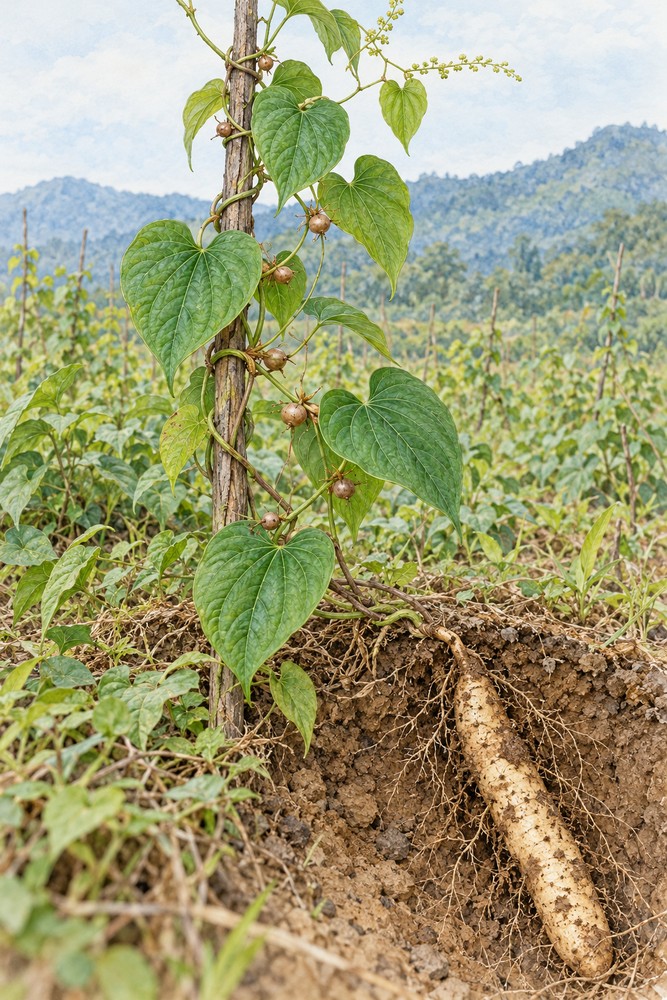
A herbaceous twining vine with heart-shaped leaves and a long underground tuber; some cultivars bear small aerial bulbils.
Traditional context
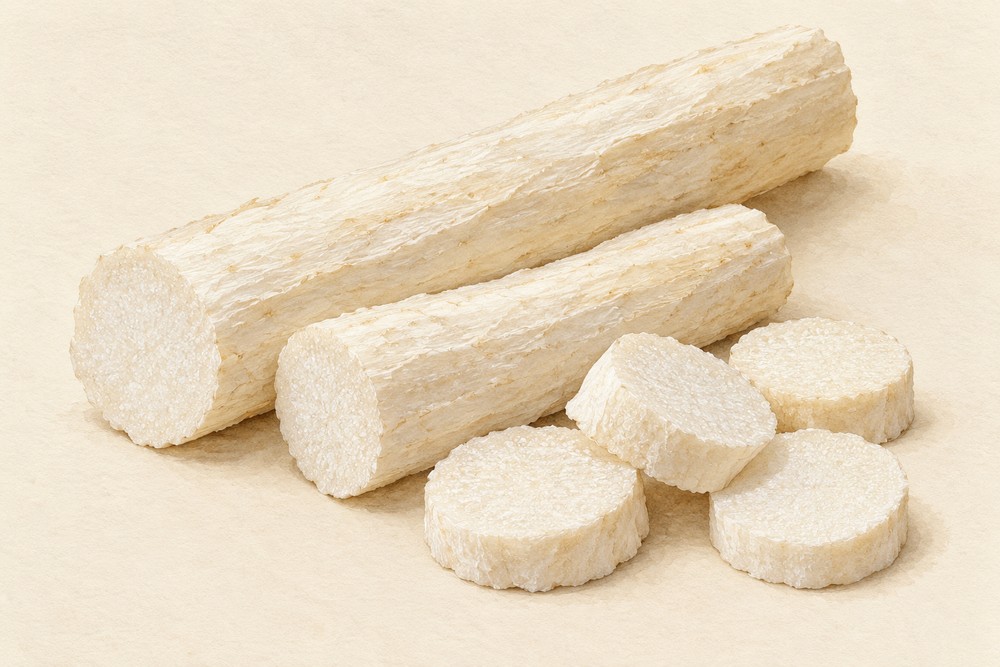
HKBU records Shan Yao as the tuber of Dioscorea opposita; modern sources may also use D. polystachya. Whole tubers, dried slices, and foods are different forms.
Modern evidence
Food use is not equivalent to medicinal extracts; traditional records do not establish treatment effects for digestive or metabolic conditions.
Safety
Some yam sap can irritate skin or cause allergy; verify species and cook when used as food. Ask a professional before using concentrated products with medicines.
Pairing in reference texts
It appears in classical formulas, including Liu Wei Di Huang Wan; this is a textual note, not a self-decoction instruction.
Growing, care, and harvest timing
HKBU habitat record: Growing in sunny places of mountainous fields. Distributed in all parts of China. The medicinal materials are produced in Henan, Guangxi, Shanxi and etc Harvest and processing as recorded: Excavated from November to December, cut root tip, washed earth, scraped the skin by shinai, sun-dried or baked to dry, that is Maoshanyao. Soaked thick and large Maoshanyao by water, slightly heated, covered with cotton wadding, kept wet and stuffy, knead on the board into column shape, sundried, polished, that is Guangshanyao
Source-recorded harvest/processing: Excavated from November to December, cut root tip, washed earth, scraped the skin by shinai, sun-dried or baked to dry, that is Maoshanyao. Soaked thick and large Maoshanyao by water, slightly heated, covered with cotton wadding, kept wet and stuffy, knead on the board into column shape, sundried, polished, that is Guangshanyao
The reviewed source does not provide a complete species-specific sowing/growing routine, irrigation/fertilization schedule, or universal plant age. The page therefore does not infer care instructions or years to harvest; consult local cultivation guidance.
Open habitat and season source ↗FROM PLANT / SOURCE HABITAT TO DRIED MATERIAL · REFERENCE WORKFLOW
- Dig tubers in late autumn or winter at harvest time; verify the cultivated climbing species.
- Trim the root tip, wash soil off, and peel under a suitable procedure; use gloves if sap irritates skin.
- Dry in clean sun or a suitable dryer; some commercial forms are softened and shaped by qualified processors.
- Label species, source, date, and processing form; store dry and mold-free. Food preparation follows separate safe-food practices.
These are post-harvest study notes, not directions to prepare a remedy for self-treatment. Processing reference ↗
How to read formula amounts
The cited sources do not provide a formula with specific amounts for this profile; no ratio is invented. Absence from the incompatibility list does not establish safety.
Habitat, season, and harvest in the HKBU botanical record
HKBU botanical record (translated summary): Flowering and fruiting dates: Flowering: June to September, fruiting: July to November Habitat and distribution: Growing in sunny places of mountainous fields. Distributed in all parts of China. The medicinal materials are produced in Henan, Guangxi, Shanxi and etc Harvest and processing as recorded: Excavated from November to December, cut root tip, washed earth, scraped the skin by shinai, sun-dried or baked to dry, that is Maoshanyao. Soaked thick and large Maoshanyao by water, slightly heated, covered with cotton wadding, kept wet and stuffy, knead on the board into column shape, sundried, polished, that is Guangshanyao
Open botanical source ↗