She Chuang Zi · Cnidium fruit · She Chuang Zi
Cnidium monnieri (L.) Cusson · Dried ripe fruit
Name and part used
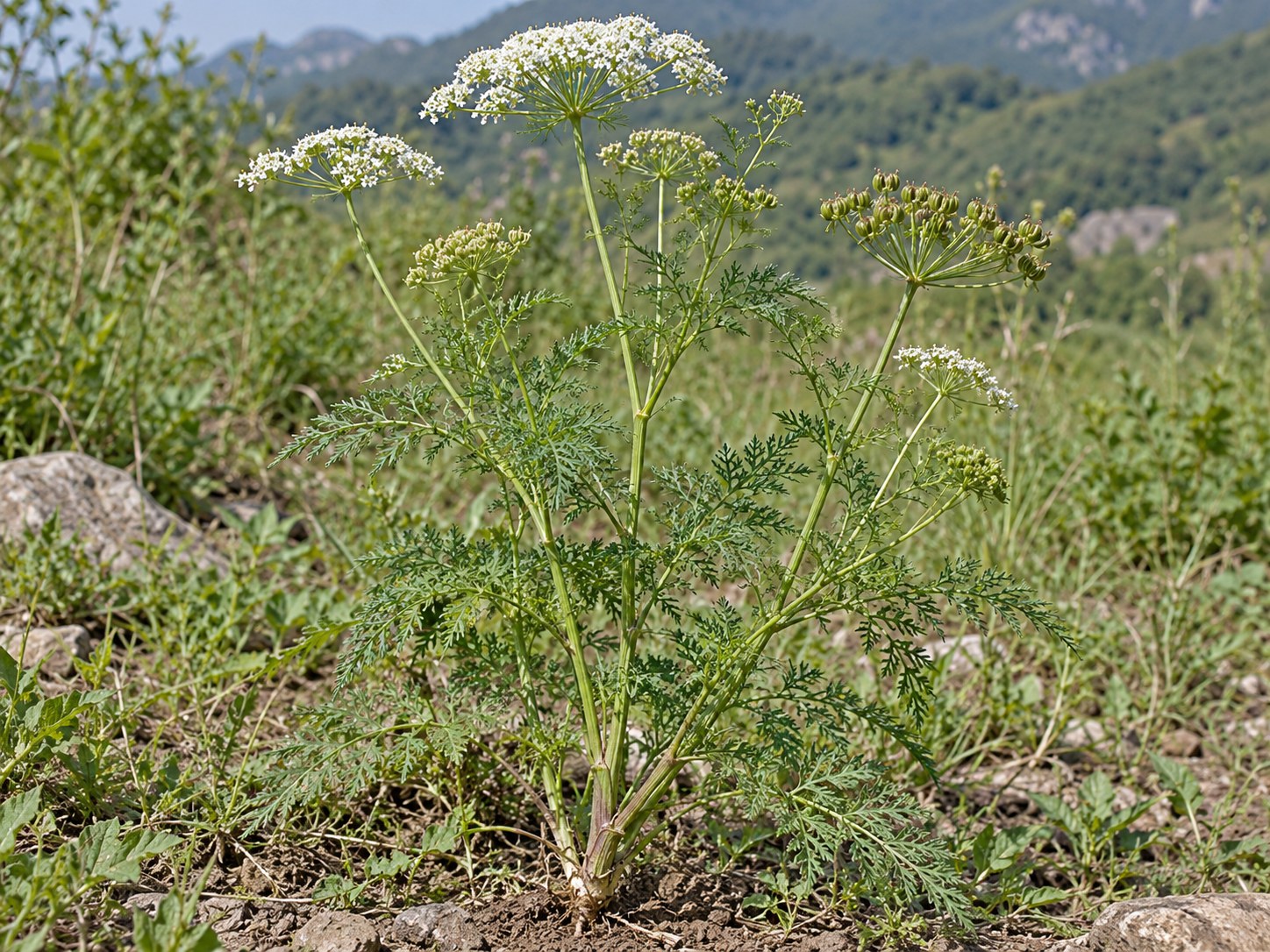
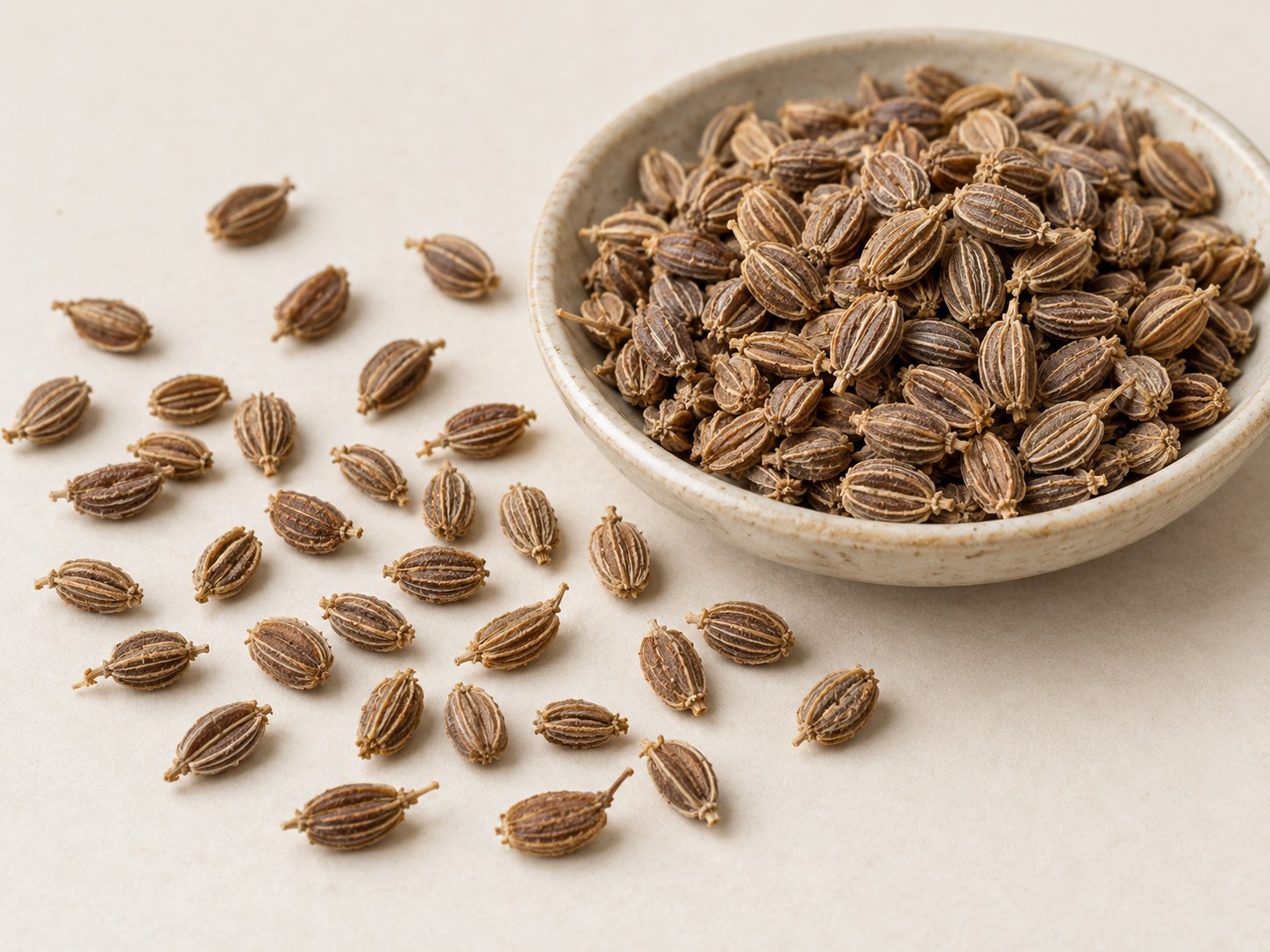
She Chuang Zi is the ripe fruit of Cnidium monnieri (L.) Cusson, an annual Apiaceae herb. Plants are about 30–80 cm tall with upright stems. Leaves are twice pinnate or three-parted, their final lobes narrow and sharply pointed. Compound umbels have many rays and small white flowers. The oblong-ovate fruit is only about 2.5–3 mm long. Plants occur in grassland, on hillsides, in fields, and beside roads. The medicinal drug is not the root or whole plant: HKBU identifies it as the ripe fruit, harvested in summer or autumn as it turns yellow, with the cut plants threshed, impurities removed, and the fruits sun-dried. The fruit is enlarged in the study image; its actual size is only a few millimetres. Apiaceae contains many similar species, so a wild roadside plant must not be collected for medicine on appearance alone.
Traditional context
HKBU records the fruit as pungent and bitter, warm, and mildly toxic in traditional classification, with traditional actions described as warming the kidney, drying dampness, dispelling wind, and addressing parasites or itching. The source recounts historical use for some reproductive or urinary complaints and external skin conditions. These descriptions do not establish treatment of infertility, vaginitis, fungal infection, or eczema. Genital symptoms need diagnosis; do not insert homemade decoctions, powders, or preparations into the vagina.
Modern evidence
HKBU lists volatile oil and several pharmacological activities, but laboratory or animal experiments do not establish benefit in people. Historical formula examples and disease labels are not controlled clinical evidence. Results for osthole or a concentrated extract cannot be generalized to dried fruit, homemade tea, or topical use. This entry is for identification and source literacy, not a treatment recommendation.
Safety
The source classifies the material as mildly toxic; do not self-administer, prepare remedies, or use vaginally. Contact may irritate or trigger allergy; keep it away from eyes and mucosa, children, and pregnancy. Do not delay evaluation for pain, fever, abnormal discharge, painful urination, or persistent itching. Ask a clinician or pharmacist before considering any product if pregnant, breastfeeding, on treatment, or managing a chronic condition. Never confuse it with unidentified wild Apiaceae fruits.
Safety reference ↗Pairing in reference texts
HKBU transcribes one historical example combining She Chuang Zi, Tu Si Zi, and Wu Wei Zi in equal amounts to make pills; this is not a modern prescription or dosing recommendation. Interaction and mixture safety evidence is incomplete, so do not use ratios copied from an old text. Historical external-wash examples also contain several other materials and are not home-care recipes.
Identification and study notes
The plant image shows upright stems, finely divided leaves, and white umbels; the enlarged drug image shows tiny ridged ovate fruits. The actual medicine is not a large culinary fennel seed. Aroma or a single fruit cannot confirm identity; use a documented source and authenticated specimen. HKBU describes 15–30 umbel rays, fruits 2.5–3 mm long, and sun-drying after threshing. The key study cue is that the drug is ripe fruit, not the whole plant. When viewing the plant, assess the full character set rather than one leaf: upright habit, repeated leaf divisions, compound umbels with many rays, white flowers, and tiny fruits. An umbel identifies the family, not the species; toxic Apiaceae can also grow in fields. AI art cannot show the true scale of fruits only a few millimetres long, so use a lens and a labelled reference specimen. The drug part is ripe fruit; stems and leaves appear only in the identification image. Fruits are threshed after harvest, so processing needs a clean catch surface and protection from dust and mixed seeds. A commercial record should note Latin identity, harvest date, region, maturity, drying method, and contaminant testing. The local name She Chuang may vary by region; a label without a Latin name is inadequate for authentication.
Growth and habitat
HKBU records the plant from hillside grass, fields, and roadsides, with a broad distribution in China. Open sunny, well-drained ground describes its field context; it does not make roadside plants safe to harvest. Avoid sites exposed to pesticides, wastewater, or traffic. Expert identification is essential because toxic Apiaceae can share white umbels and finely divided leaves.
Identification and study notes
The plant image shows upright stems, finely divided leaves, and white umbels; the enlarged drug image shows tiny ridged ovate fruits. The actual medicine is not a large culinary fennel seed. Aroma or a single fruit cannot confirm identity; use a documented source and authenticated specimen. HKBU describes 15–30 umbel rays, fruits 2.5–3 mm long, and sun-drying after threshing. The key study cue is that the drug is ripe fruit, not the whole plant. When viewing the plant, assess the full character set rather than one leaf: upright habit, repeated leaf divisions, compound umbels with many rays, white flowers, and tiny fruits. An umbel identifies the family, not the species; toxic Apiaceae can also grow in fields. AI art cannot show the true scale of fruits only a few millimetres long, so use a lens and a labelled reference specimen. The drug part is ripe fruit; stems and leaves appear only in the identification image. Fruits are threshed after harvest, so processing needs a clean catch surface and protection from dust and mixed seeds. A commercial record should note Latin identity, harvest date, region, maturity, drying method, and contaminant testing. The local name She Chuang may vary by region; a label without a Latin name is inadequate for authentication.
Growing and care
- Start only with traceable seed labelled Cnidium monnieri; do not collect fruit from unidentified wild plants.
- Choose a sunny bed with loose, well-drained soil; remove weeds and use clean irrigation water.
- Sow shallowly according to the seed supplier’s instructions; keep lightly moist during emergence, prevent waterlogging, and avoid unlabelled pesticides.
- Have an expert confirm the divided leaves, white umbels, and tiny fruits; rogue off-types and keep a lot log.
How long until harvest? The source times harvest for ripe yellow fruit in summer–autumn but gives no months-from-sowing figure. Harvest only after expert confirmation of the species and fruit maturity; observe a local growing season before setting a schedule.
Habitat, season, and harvest in the HKBU botanical record
HKBU describes Cnidium monnieri as 30–80 cm tall, occurring on hillsides, grassland, fields, and roadsides, with white flowers and tiny fruits. Yellow ripe fruit is harvested in summer–autumn by cutting plants, threshing, removing impurities, and sun-drying. This is a botanical-record workflow, not a substitute for current materia-medica standards or field authentication.
Open botanical source ↗FROM PLANT / SOURCE HABITAT TO DRIED MATERIAL · REFERENCE WORKFLOW
- Confirm Cnidium monnieri in the field; never use roadside wild plants or moldy fruit.
- Following HKBU, harvest in summer–autumn when fruits turn yellow; cut the plants and thresh over a clean, lot-labelled surface.
- Sieve away leaves, stems, soil, and damaged fruit; dry in a thin layer protected from rain, dust, insects, and cross-contamination with other Apiaceae.
- Cool, label species, lot, date, place, and drying method; seal in a dry location and discard anything damp, moldy, or unusual in odor.
These are post-harvest study notes, not directions to prepare a remedy for self-treatment. Processing reference ↗