Shi Chang Pu · grassleaf sweetflag rhizome · Shi Chang Pu
Acorus tatarinowii Schott · Rhizome
Name and part used
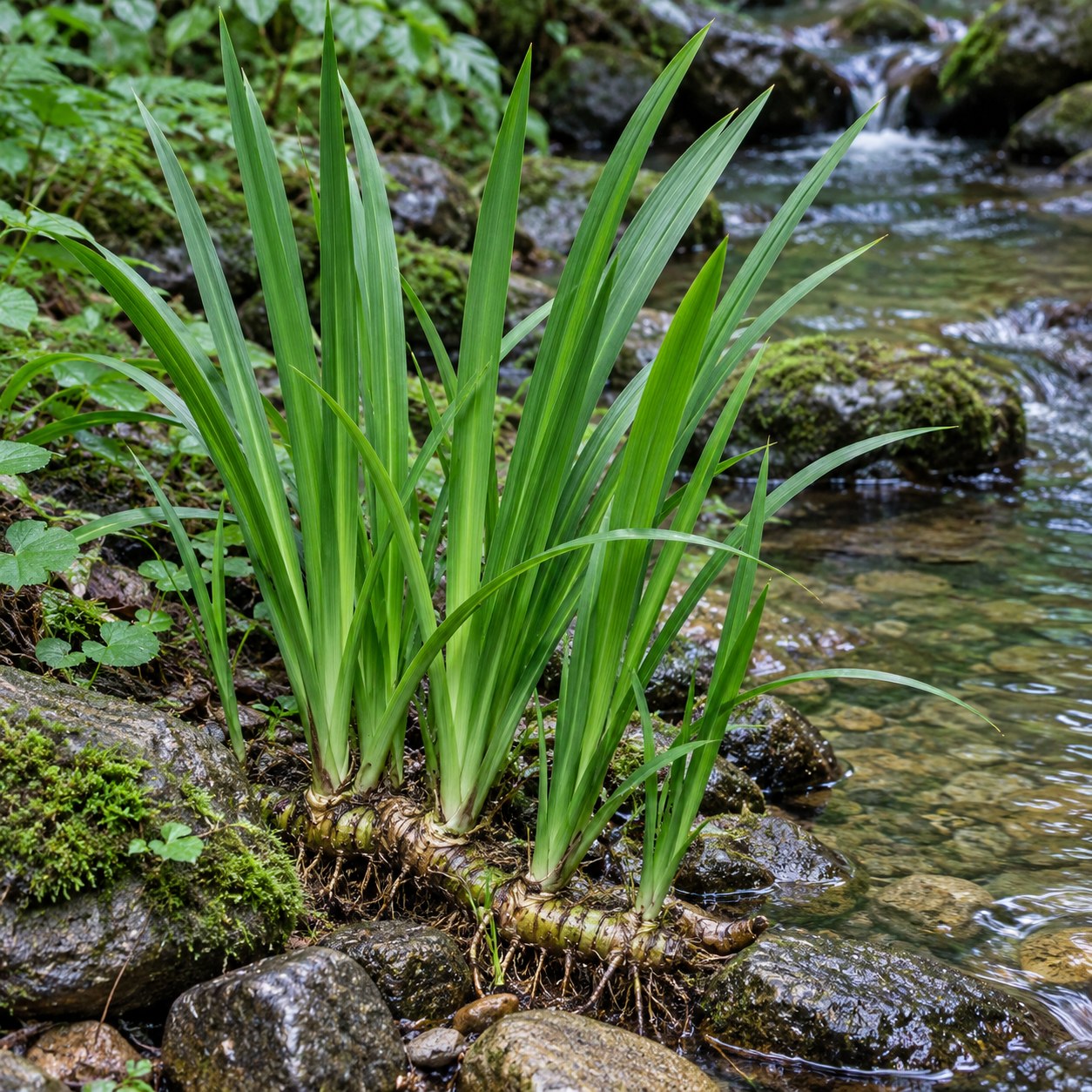
Shi Chang Pu is the rhizome of Acorus tatarinowii Schott, a perennial Araceae plant. Narrow sword-like leaves grow in clumps from a creeping rhizome; parallel veins are visible and the small inflorescence may hide among leaves. HKBU records humid ravines, stream banks, and seepage rocks; rhizomes are collected in autumn. Distinguish A. calamus and other Acorus because materials/oils are not interchangeable. AI art supports morphology study, not species or oil verification.
Traditional context
HKBU records acrid, bitter, warm qualities and traditional actions of opening orifices, transforming phlegm/dampness, and harmonizing the stomach. These are materia medica descriptions, not proof of treating gastritis, tinnitus, memory disorders, seizures, or arthritis. Constituent research establishes no dose or long-term safety.
Modern evidence
HKBU supports botanical/rhizome identification but not clinical benefit. Acorus oils vary by species, origin, and extraction; research on one constituent does not establish safety of every product. Do not ingest concentrated oil, fumigate it as treatment, or use it long term. Dizziness, vomiting, confusion, or seizures after exposure are emergencies.
Safety
Distinguish A. tatarinowii from other Acorus and essential-oil products. Do not ingest oil; pregnancy/breastfeeding, children, liver/kidney disease, or neurological/sedative medicines need professional review. Reviewed sources establish no universal safe dose. Breathing difficulty, chest pain, or seizures are emergencies.
Safety reference ↗Pairing in reference texts
HKBU places it among orifice-opening materia medica and historical formulas, but the botanical record gives no toxic pair or modern ratio. Do not combine with alcohol, sedatives, anticonvulsants, or other oils. Do not invent ratios when species/amounts are unspecified; missing incompatibility data is not proof of safety.
Identification and study notes
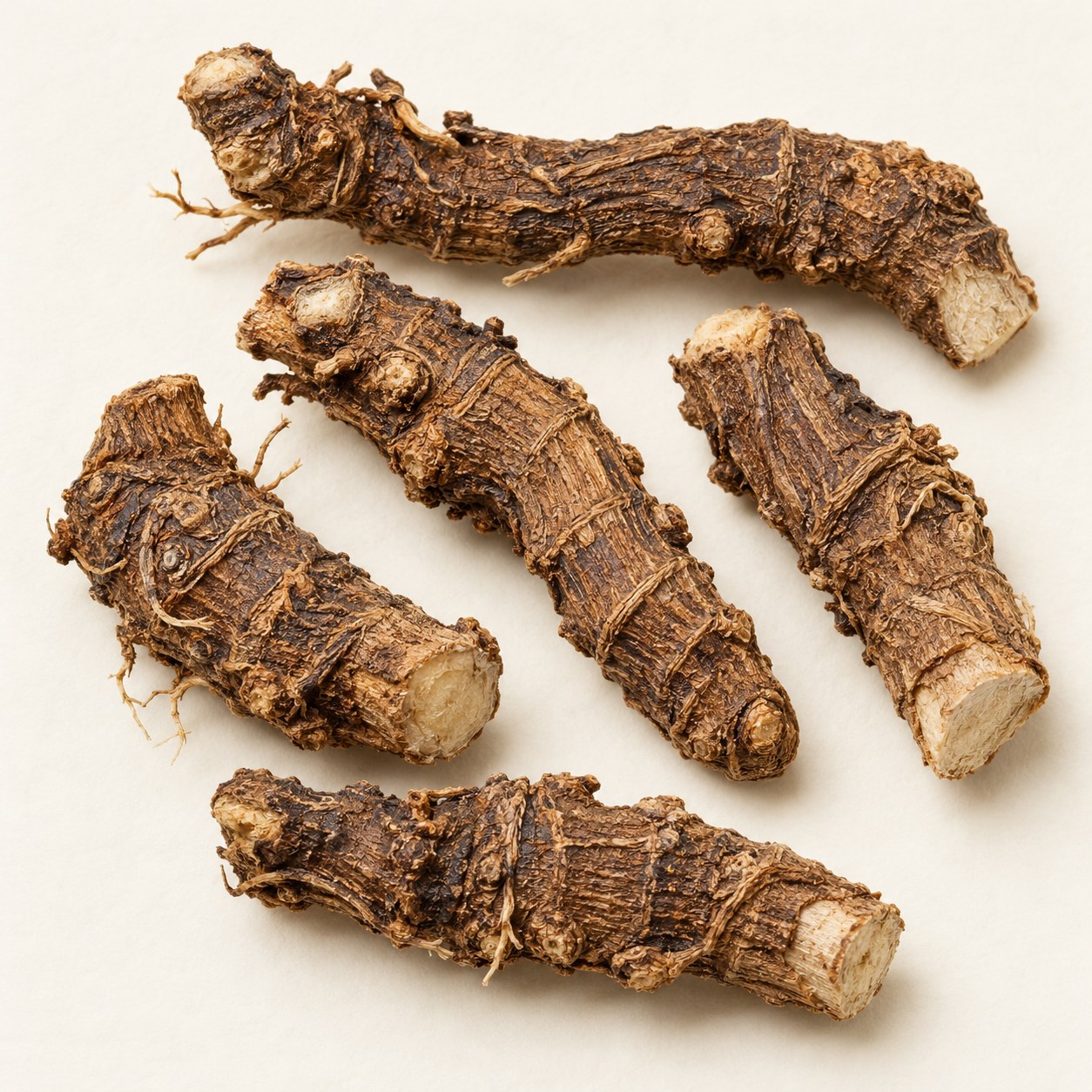
The plant forms narrow flat parallel-veined leaves from a creeping rhizome; a small inflorescence may grow on a side stalk. Dried rhizomes have transverse nodes, longitudinal grooves, fine roots, and pale cuts. Aroma is a study cue, not permission to inhale powder closely or taste. Acorus oils vary; AI art cannot test composition or purity.
Growth and habitat
HKBU records ravines, stream banks, and damp rocks across regions south of the Yangtze. The environment is cool/moist but clean water should drain; avoid hot dry soil and polluted stagnant water. For study use a separate bright-shade pot and contain rhizomes; do not dig wild plants.
Identification and study notes
The plant forms narrow flat parallel-veined leaves from a creeping rhizome; a small inflorescence may grow on a side stalk. Dried rhizomes have transverse nodes, longitudinal grooves, fine roots, and pale cuts. Aroma is a study cue, not permission to inhale powder closely or taste. Acorus oils vary; AI art cannot test composition or purity. Compare the parallel-veined leaf blade, overlapping leaf bases, and segmented rhizome rather than relying on aroma alone. Dried material can lose or change its scent during storage. Do not use aroma, taste, or color to infer species purity, potency, or suitability for ingestion. Thạch xương bồ là thân rễ Acorus tatarinowii; “sweet flag” là tên rộng có thể chỉ Acorus khác hoặc sản phẩm khác. Lá kiếm hẹp, gân song song, mọc thành bụi và thân rễ bò giúp định hướng quan sát, nhưng hóa học tinh dầu đổi theo loài, nơi và cách chiết. Chai dầu không tương đương thân rễ toàn phần của hồ sơ dược liệu. Sinh cảnh bờ suối và mùa thu trong nguồn là ghi chép sinh thái/nguồn cung, không phải lời khuyên đào cây đất ngập nước. Tách mẫu khỏi cây thực phẩm; không uống dầu đậm đặc hay xông như cách chữa bệnh. “Khai khiếu/hóa đàm” cổ truyền không chứng minh chữa trí nhớ, co giật, ù tai hay bệnh tiêu hóa. Tài liệu bài thuốc không đưa tỷ lệ phổ quát hiện đại. Ghi loài Latin, thân rễ hay dầu, vùng, chế biến và nguồn khi so nghiên cứu. Mẫu nhìn sạch vẫn cần định danh truy xuất vì lẫn loài/tạp nhiễm. Tách hồ sơ thân rễ nguyên, thân rễ bột, tinh dầu và Acorus khác loài. Thành phần dầu phụ thuộc loài/cách chiết, không suy từ ảnh hay tên chung. Lá gân song song và sinh cảnh ẩm giúp học cây, nhưng hàng thương mại vẫn cần định danh. Bài cổ có thể ghi Thạch xương bồ cùng nhiều vị; cùng xuất hiện không chứng minh hiệu quả/an toàn cho người đang dùng thuốc an thần/thần kinh. Không xông, uống dầu hay dùng thân rễ vườn để chữa bệnh. Khi trích nghiên cứu hóa học/lâm sàng, ghi rõ dạng nguyên liệu và nguồn.
Growing and care
- Choose nursery stock labeled Acorus tatarinowii; avoid unidentified “calamus.” Use a wide pot with clean moist but drained soil in bright shade.
- Set a healthy rhizome shallowly, growing tip up. HKBU gives no establishment rate or rooting time; record provenance and actual date.
- Maintain even moisture without dirty immersion; remove broken leaves, check rhizome rot, clear debris, and avoid raw manure or untraceable sprays.
- Observe sword-leaf clumps, small inflorescences, and rhizomes. Autumn collection is a source record, not a reason to dig ornamentals for ingestion; age is unspecified.
How long until harvest? A perennial; HKBU records autumn rhizome collection but gives no age or minimum cultivation duration. No readiness date is promised; potted plants are for morphology study, not medicine.
FROM PLANT / SOURCE HABITAT TO DRIED MATERIAL · REFERENCE WORKFLOW
- HKBU identifies the rhizome and autumn harvest; only facilities with authenticated stock should handle it. Do not dig wild/unidentified ornamentals.
- Remove leaves, fine roots, and soil; rinse briefly and drain. Sources mention short sections; this is not home medicinal preparation.
- Air-dry evenly. Finished pieces are yellow-brown, segmented, aromatic, and pale inside; do not dry beside food.
- Label species, part, lot, and date. Aroma proves neither potency nor safety; do not taste or substitute essential oil.
These are post-harvest study notes, not directions to prepare a remedy for self-treatment. Processing reference ↗
Habitat, season, and harvest in the HKBU botanical record
HKBU records a rhizomatous perennial with narrow sword leaves in damp ravines/streambanks; rhizomes are collected in autumn, cleaned, washed, cut, and dried.
Open botanical source ↗