Prepared rehmannia root · Shu Di Huang
Rehmannia glutinosa (Gaert.) Libosch. ex Fisch. & C.A.Mey. · Processed tuberous root
Name and part used
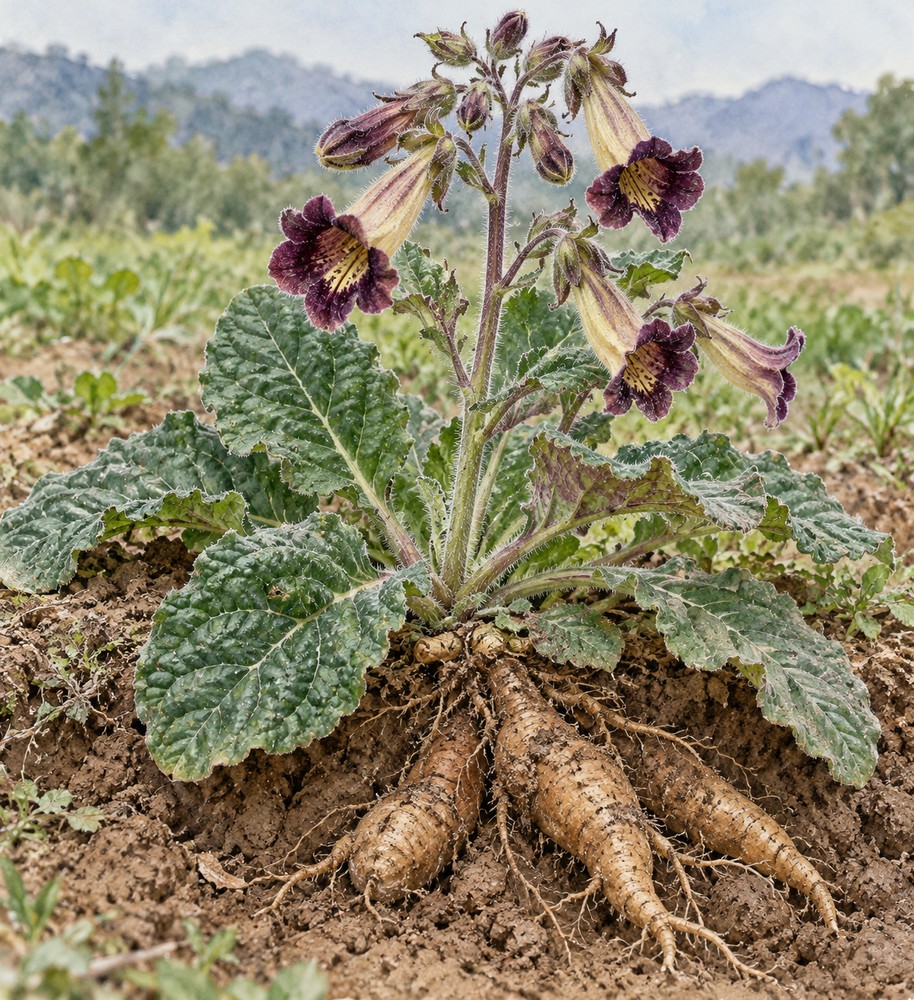
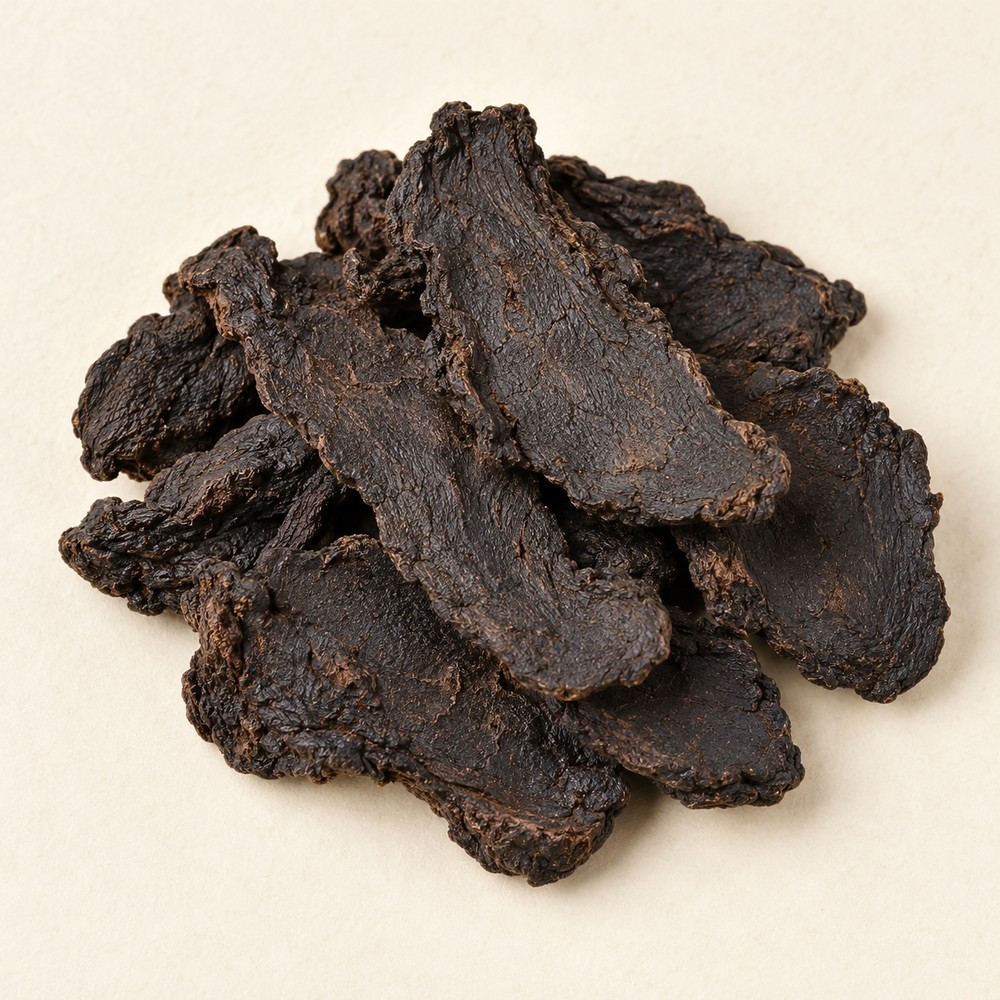
The same Rehmannia glutinosa species as Sheng Di; its plant and flowers are alike, while the prepared root becomes dark brown-black.
Traditional context
Shu Di is standardized processed Rehmannia glutinosa root, distinct from Sheng Di by processing and commercial characteristics. HKBU lists the two as separate materia medica forms.
Modern evidence
Blood-nourishing and yin-enriching are traditional descriptions. Processing changes composition but does not prove treatment of anemia, infertility, or kidney disease.
Safety
Bloating or glucose effects may occur; people with diabetes, anticoagulants, or liver/kidney disease should consult a clinician or pharmacist.
Pairing in reference texts
Shu Di is part of Liu Wei Di Huang Wan with Cornus fruit, yam, and other ingredients. This reference is not a recommendation for kidney supplementation.
Growing, care, and harvest timing
HKBU habitat record: Mostly cultivated, also growing wild on hill-slopes at altitude 50-1,100m and on roadside wastelands. Distributed in Liaoning, Inner Mongolia, Hebei, Shanxi, Shaanxi, Shandong, Anhui, Zhejiang, Henan, Hubei, Hunan, Sichuan and etc. The medicinal materials are mainly produced in Wenxian, Mengxian, Wuling, Boai, Qinyang and etc of Henan Harvest and processing as recorded: Early Dihuang harvested in early and middle Oct; late Dihuang harvested from late Oct to the early Nov; wild Dihuang also harvested in spring. Taken care when excavating, and not break the root, cleared stem leaves, rhizome residue and fibril, washed off earth; or buried under dried sandy soil without washing, can be kept in dried and shady places for 2-3 months
Source-recorded harvest/processing: Early Dihuang harvested in early and middle Oct; late Dihuang harvested from late Oct to the early Nov; wild Dihuang also harvested in spring. Taken care when excavating, and not break the root, cleared stem leaves, rhizome residue and fibril, washed off earth; or buried under dried sandy soil without washing, can be kept in dried and shady places for 2-3 months
The reviewed source does not provide a complete species-specific sowing/growing routine, irrigation/fertilization schedule, or universal plant age. The page therefore does not infer care instructions or years to harvest; consult local cultivation guidance.
Open habitat and season source ↗FROM PLANT / SOURCE HABITAT TO DRIED MATERIAL · REFERENCE WORKFLOW
- Use authenticated Rehmannia glutinosa roots with harvest traceability; processing requires qualified equipment and batch records.
- Clean and grade at a facility. Shu Di undergoes pharmacopoeial heat processing; do not steam, soak in wine, or repeat cycles at home.
- Facilities control temperature, time, moisture, and finished-product criteria for each batch; deviations can yield inconsistent quality.
- Document processed form, input material, production date, and test results; never label this product as Sheng Di.
These are post-harvest study notes, not directions to prepare a remedy for self-treatment. Processing reference ↗
How to read formula amounts
The cited sources do not provide a formula with specific amounts for this profile; no ratio is invented. Absence from the incompatibility list does not establish safety.
Habitat, season, and harvest in the HKBU botanical record
HKBU botanical record (translated summary): Flowering and fruiting dates: Flowering: April to May, fruiting: May to June Habitat and distribution: Mostly cultivated, also growing wild on hill-slopes at altitude 50-1,100m and on roadside wastelands. Distributed in Liaoning, Inner Mongolia, Hebei, Shanxi, Shaanxi, Shandong, Anhui, Zhejiang, Henan, Hubei, Hunan, Sichuan and etc. The medicinal materials are mainly produced in Wenxian, Mengxian, Wuling, Boai, Qinyang and etc of Henan Harvest and processing as recorded: Early Dihuang harvested in early and middle Oct; late Dihuang harvested from late Oct to the early Nov; wild Dihuang also harvested in spring. Taken care when excavating, and not break the root, cleared stem leaves, rhizome residue and fibril, washed off earth; or buried under dried sandy soil without washing, can be kept in dried and shady places for 2-3 months
Open botanical source ↗