Cochinchinese asparagus root · Tian Men Dong
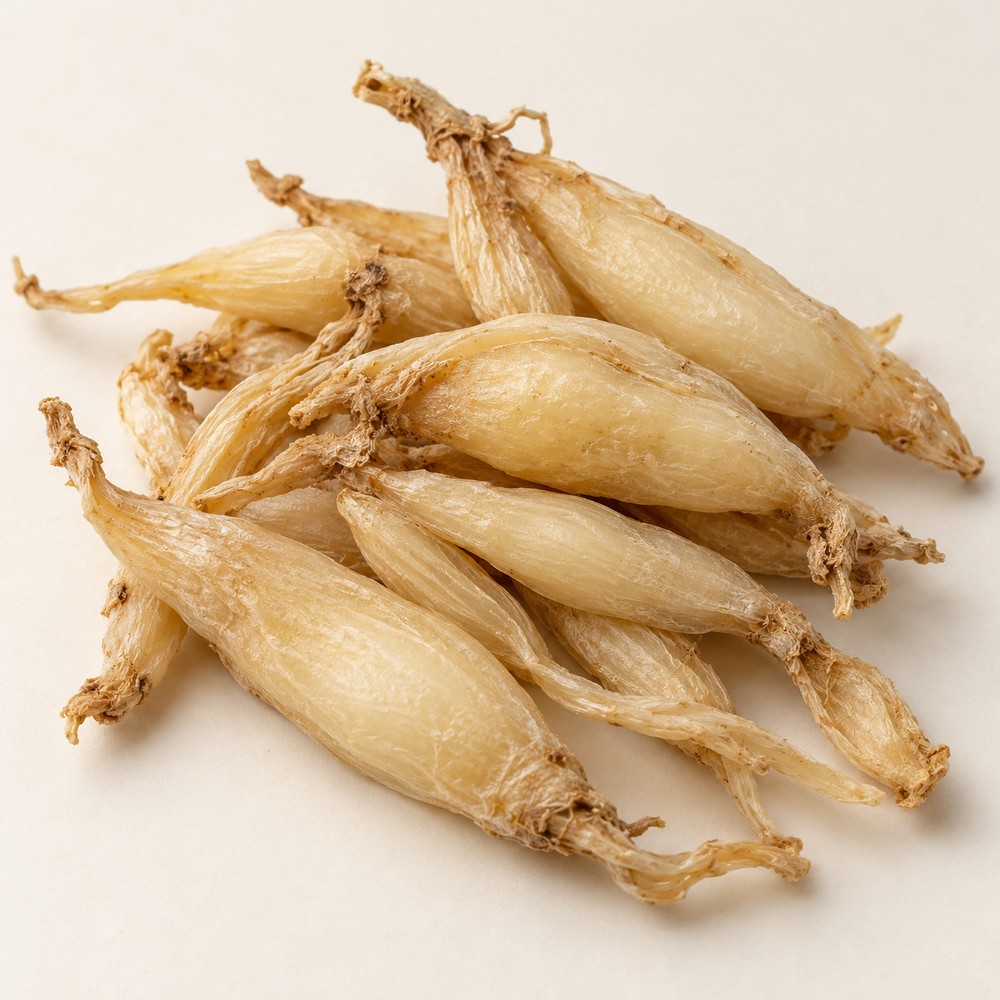
Asparagus cochinchinensis (Lour.) Merr. · Tuberous roots
Name and part used
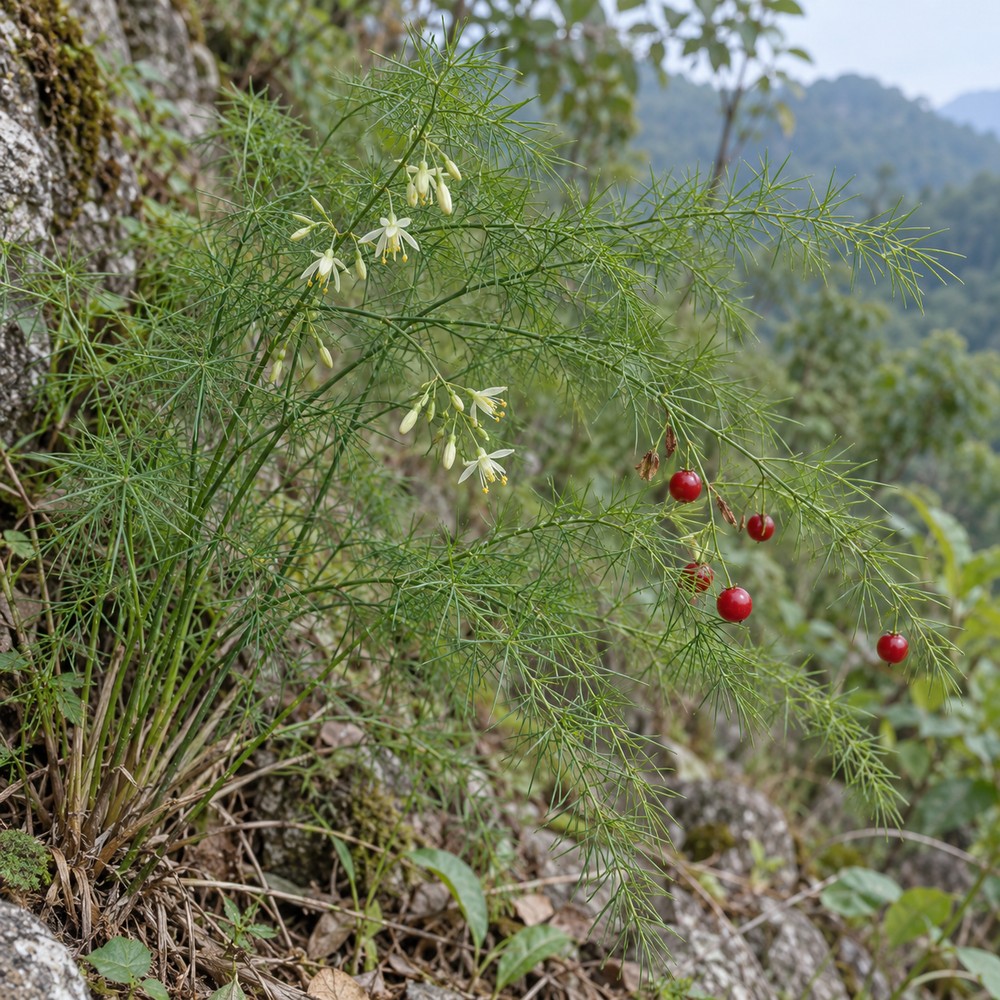
A slender spiny climber with clustered flat cladodes and red berries; it bears fleshy tuberous roots.
Traditional context
Tian Men Dong is Asparagus cochinchinensis root, distinct from edible asparagus and ornamental Asparagus setaceus. HKBU records autumn-winter tuber harvest; roots form clusters.
Modern evidence
Yin-nourishing and lung-moistening are traditional claims. Ingredient studies do not establish treatment for chronic cough, tuberculosis, or constipation.
Safety
Diarrhea or allergy may occur. Pregnancy, diuretic medicines, or kidney disease warrant professional advice.
Pairing in reference texts
Tian Men Dong appears with Mai Men Dong, Sheng Di, or Sha Shen in yin-nourishing formulas. Historical pairing does not establish safety with modern medicines.
Growing, care, and harvest timing
HKBU habitat record: Growing in dank places of mountains. Distributed in Central and Northwest China, the Yangtze River basin and the southern parts of China. The medicinal materials are mainly produced in Guizhou, Sichuan, Guangxi, Zhejiang, Yunnan, Shaanxi, Gansu, Anhui, Hubei, Henan, Jiangxi and etc Harvest and processing as recorded: Excavated in autumn or winter, better quality in winter, well washed, removed fibrous root, divided by size, boiled or steamed in boiling water, taken out when the bark easily to be taken off, put in clean water, taken off the bark and dried by low fire or smoked by sulfur, then dried
Source-recorded harvest/processing: Excavated in autumn or winter, better quality in winter, well washed, removed fibrous root, divided by size, boiled or steamed in boiling water, taken out when the bark easily to be taken off, put in clean water, taken off the bark and dried by low fire or smoked by sulfur, then dried
The reviewed source does not provide a complete species-specific sowing/growing routine, irrigation/fertilization schedule, or universal plant age. The page therefore does not infer care instructions or years to harvest; consult local cultivation guidance.
Open habitat and season source ↗FROM PLANT / SOURCE HABITAT TO DRIED MATERIAL · REFERENCE WORKFLOW
- Harvest tuberous roots in autumn-winter from authenticated cultivation; reject damaged material and distinguish from ornamental Asparagus.
- Remove stems and fine roots, wash soil, and grade tubers for consistent processing.
- HKBU describes blanching or steaming until peeling is possible, then peeling and low-heat drying. This is professional processing only.
- Control moisture and color, pack against humidity, and document peeled form and tested lot.
These are post-harvest study notes, not directions to prepare a remedy for self-treatment. Processing reference ↗
How to read formula amounts
The cited sources do not provide a formula with specific amounts for this profile; no ratio is invented. Absence from the incompatibility list does not establish safety.
Habitat, season, and harvest in the HKBU botanical record
HKBU botanical record (translated summary): Flowering and fruiting dates: Flowering: May to July; fruiting: August Habitat and distribution: Growing in dank places of mountains. Distributed in Central and Northwest China, the Yangtze River basin and the southern parts of China. The medicinal materials are mainly produced in Guizhou, Sichuan, Guangxi, Zhejiang, Yunnan, Shaanxi, Gansu, Anhui, Hubei, Henan, Jiangxi and etc Harvest and processing as recorded: Excavated in autumn or winter, better quality in winter, well washed, removed fibrous root, divided by size, boiled or steamed in boiling water, taken out when the bark easily to be taken off, put in clean water, taken off the bark and dried by low fire or smoked by sulfur, then dried
Open botanical source ↗