Tian Hua Fen · snakegourd root · Tian Hua Fen
Trichosanthes kirilowii Maxim. · Dried tuberous root
Name and part used
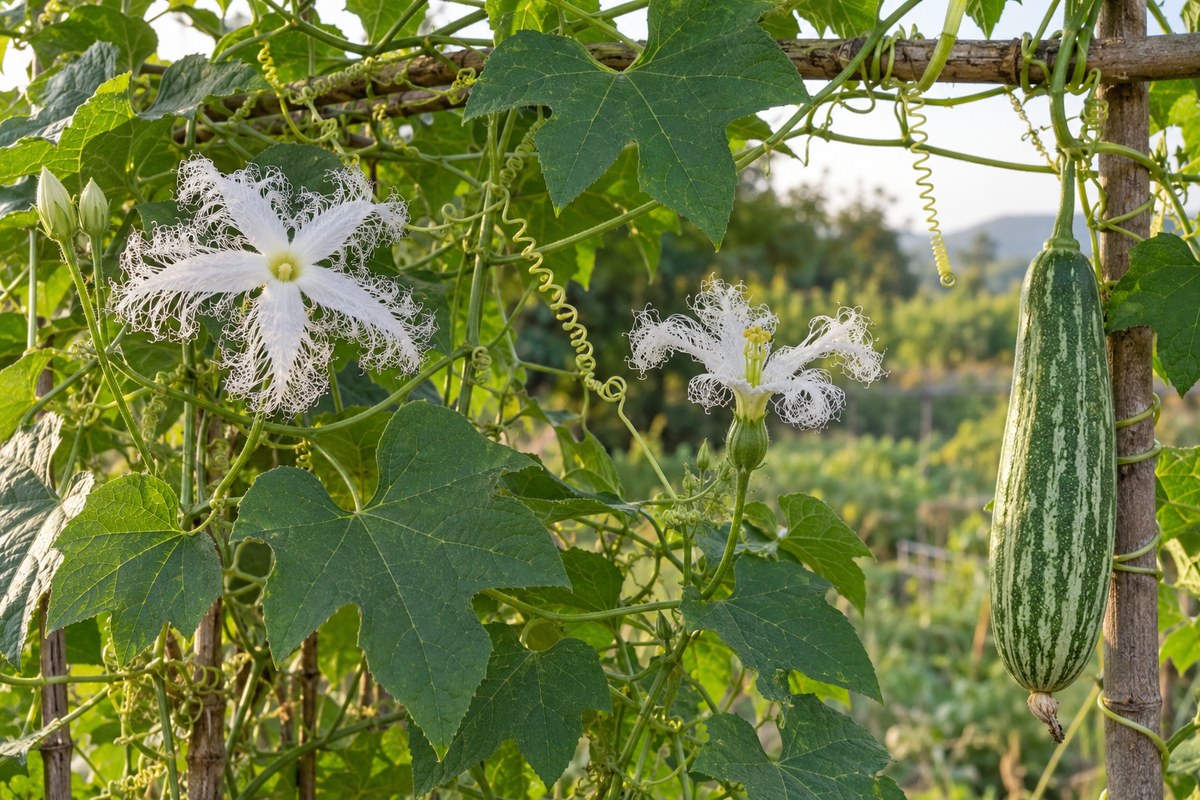
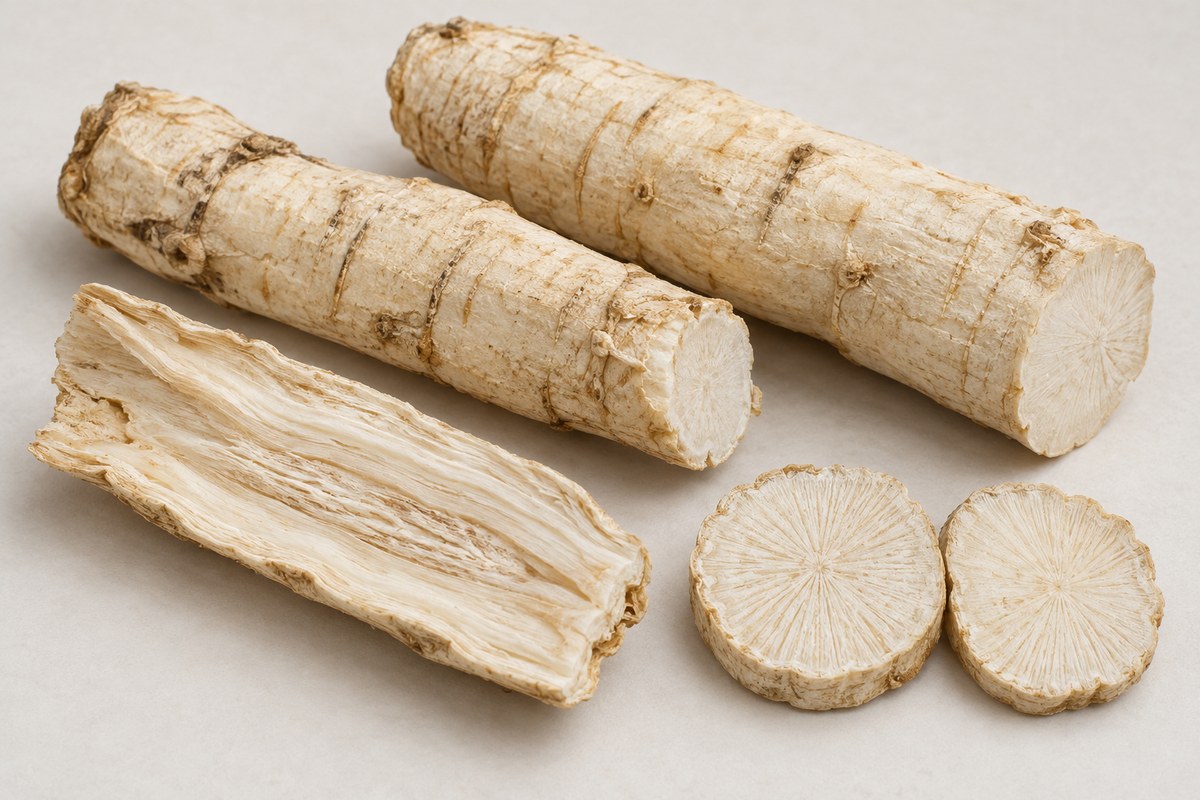
Tian Hua Fen is the dried tuberous root of Trichosanthes kirilowii, a perennial vine with branched tendrils, alternate lobed heart-shaped leaves, and white finely fringed flowers; male and female flowers occur on separate plants. The plant bears striped oval gourds. HKBU describes a gray-yellow cylindrical root harvested in autumn/winter. Do not confuse the root with Gua Lou fruit or Gua Lou Zi seed, which are different drugs.
Traditional context
HKBU records traditional actions of generating fluids, relieving thirst, expelling pus, and reducing swelling; traditional texts also mention dry cough and certain heat patterns. These descriptions do not establish treatment of diabetes, mastitis, abscess, or infection.
Modern evidence
HKBU plant and material records describe source, morphology, and traditional actions; they do not establish clinical efficacy. Cucurbits have species- and part-specific safety profiles; do not infer that an edible fruit from another species makes Trichosanthes root or fruit safe.
Safety
Do not self-use during pregnancy/breastfeeding, gastrointestinal disease, or glucose-lowering treatment. HKBU cautions in spleen/stomach deficiency-cold, poor appetite, loose stool, and cold-damp phlegm. Chest pain, excessive thirst with frequent urination, high glucose, persistent cough, or a breast lump needs evaluation rather than a home root decoction.
Safety reference ↗Pairing in reference texts
An HKBU formula record lists Tian Hua Fen 9 g in Fu Yuan Huo Xue Tang with Chai Hu 15 g, Dang Gui 9 g, Hong Hua 6 g, Gan Cao 6 g, Chuan Shan Jia 6 g, Da Huang 30 g, and Tao Ren 15 g (as converted in that record). This historical formula includes a regulated animal ingredient and is not for home preparation. No specific toxic pair was confirmed for Tian Hua Fen; do not combine with glucose-lowering drugs without professional guidance.
Identification and study notes
This perennial cucurbit vine has shallowly grooved stems and axillary tendrils commonly split into 2–5 branches. Leaves are alternate, nearly round or heart-shaped, usually 3–7 lobed. White flowers have finely fringed margins; male flowers are often clustered and female flowers solitary. Young fruits are oval with pale green stripes. Tian Hua Fen is the gray-yellow cylindrical tuberous root; do not confuse it with orange-yellow Gua Lou fruit or flat Gua Lou Zi seeds. HKBU records autumn/winter root harvest, while other plant parts supply distinct materia medica. Study images separate the plant and root but cannot verify species or residues.
Growth and habitat
Trichosanthes kirilowii is a warm-temperate climbing vine found in sunny sites, fences, and humus-rich slopes with support. It needs a warm growing season, deep well-drained soil, and no waterlogging around the tuberous root. The species is dioecious, so fruit production requires a pollinated female plant; root harvest still requires correct species identification.
Identification and study notes
This perennial cucurbit vine has shallowly grooved stems and axillary tendrils commonly split into 2–5 branches. Leaves are alternate, nearly round or heart-shaped, usually 3–7 lobed. White flowers have finely fringed margins; male flowers are often clustered and female flowers solitary. Young fruits are oval with pale green stripes. Tian Hua Fen is the gray-yellow cylindrical tuberous root; do not confuse it with orange-yellow Gua Lou fruit or flat Gua Lou Zi seeds. HKBU records autumn/winter root harvest, while other plant parts supply distinct materia medica. Study images separate the plant and root but cannot verify species or residues.
Growing and care
- Gieo trong giá thể sạch, ấm; chuyển cây ra đất khi hết rét. Chọn nơi có nắng, đất sâu, giàu hữu cơ và thoát nước; chừa chỗ cho dây dài và củ phát triển.
- Start in clean warm propagation medium and transplant after frost risk. Choose a sunny site with deep, organic-rich, drained soil; allow room for long vines and tuber growth.
How long until harvest? A perennial; the source gives autumn/winter tuber excavation but no years from sowing to harvest. Fruiting does not mean the tuber meets medicinal standards. Do not use a home-grown product without verifying species and plant part.
Documented toxic incompatibility
Reviewed sources do not establish a specific toxic pair for Tian Hua Fen root. A multi-ingredient historical formula cannot establish safety for arbitrary pairs; take particular care with glucose-lowering medicines.
AI study illustrations; not for specimen identification.
FROM PLANT / SOURCE HABITAT TO DRIED MATERIAL · REFERENCE WORKFLOW
- Excavate the tuber in autumn/winter per HKBU from authenticated Trichosanthes kirilowii; keep root, fruit, and seed separate because they are different materials.
- Shake off soil, wash, and remove damaged tissue; the monograph places tuber harvest in autumn/winter. Do not mix roots from other Trichosanthes species.
- Process and dry under controlled conditions; record source plant, part, harvest date, and drying conditions. Home sun-drying is not automatically medicinal-grade.
- Store dry and protect from mold and insects. Do not grind or decoct it for cough, thirst, or a lump without qualified assessment.
These are post-harvest study notes, not directions to prepare a remedy for self-treatment. Processing reference ↗
Material source, dried appearance, and processing forms (HKBU)
HKBU identifies Tian Hua Fen from Trichosanthes kirilowii Maxim., Cucurbitaceae; the cylindrical gray-yellow tuber is excavated in autumn and winter. Gualou, Gualoupi, and Gualouzi refer to the fruit, fruit peel, and seed; they are not interchangeable with the tuberous root.
Open original materia medica record ↗Habitat, season, and harvest in the HKBU botanical record
HKBU records a perennial vine up to about 10 m with lobed heart-shaped leaves, branched tendrils, and fringed white flowers; the tuber is excavated in autumn/winter. The vine needs support and drained soil; no planting-to-harvest duration is specified.
Open botanical source ↗