Schisandra berry · Wu Wei Zi
Schisandra chinensis (Turcz.) Baill. · Mature fruit
Name and part used
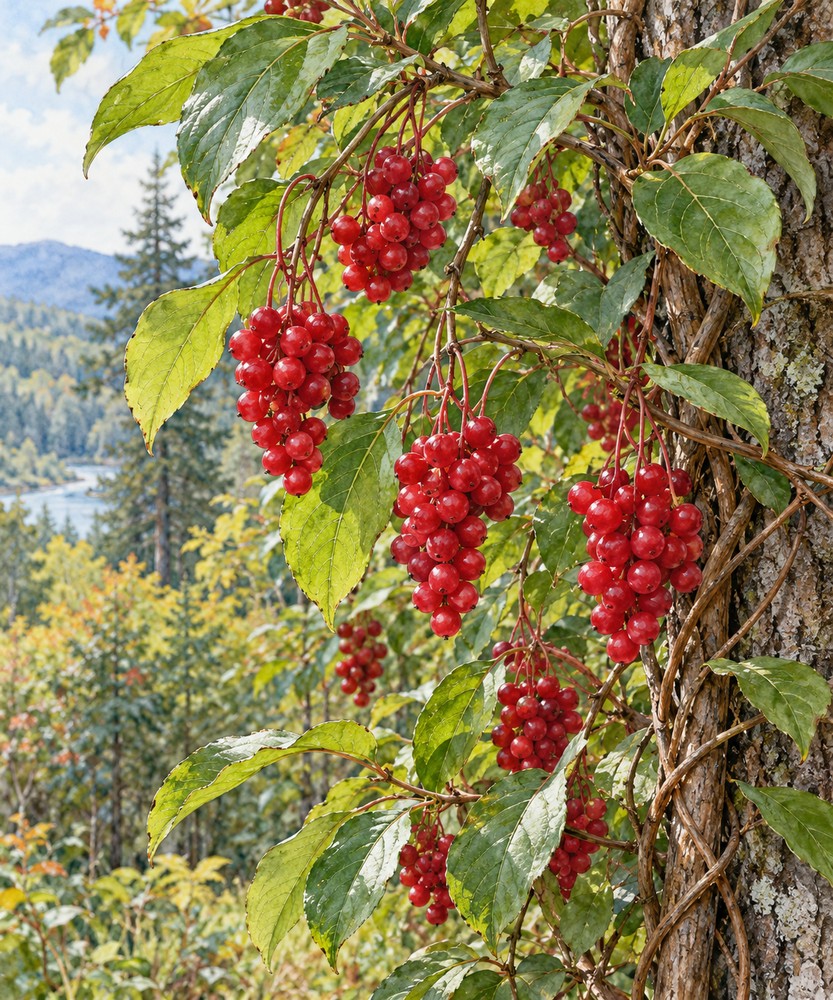
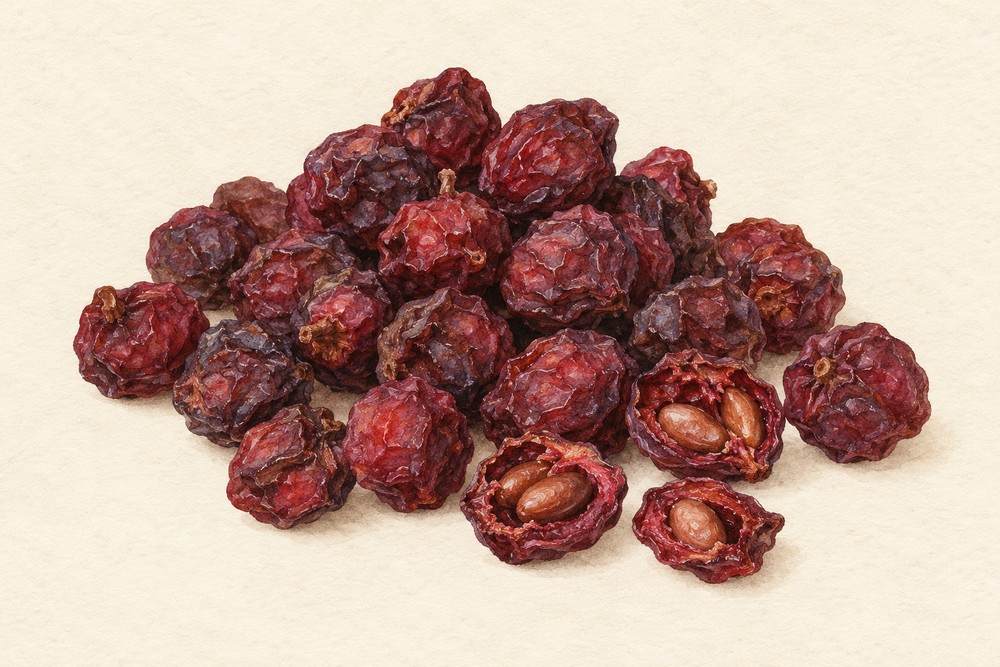
A woody climber with oval leaves and clusters of red berries; dried fruits are wrinkled and dark red-purple.
Traditional context
Northern Wu Wei Zi generally refers to mature Schisandra chinensis fruit. HKBU describes vines at forest edges and streamside thickets, ripening in late summer to autumn. Other Schisandra species exist, so scientific identity and origin matter.
Modern evidence
Astringing, fluid-generating, and kidney-tonifying are traditional descriptions. Lignans and early research do not establish clinical benefits for liver, heart, asthma, or infection.
Safety
It may affect drug-metabolizing enzymes, and HKBU notes toxicity. Do not combine casually with prescription drugs, especially narrow-therapeutic-index medicines; ask a pharmacist or clinician.
Pairing in reference texts
Wu Wei Zi is part of Sheng Mai San with ginseng and Mai Men Dong. Classical records document the formula structure, not compatibility with modern medicines.
Growing, care, and harvest timing
HKBU habitat record: Growing on sunny slopes of holt at altitude 1,500m, or in forest margins and streamside thickets. Cultivated in Northeast and North China, Henan and etc. The medicinal materials are produced in Liaoning, Heilongjiang and Jilin. The medicinal materials are mainly produced in Hebei, Inner Mongolia and etc Harvest and processing as recorded: Collected when fruits mature in autumn, sun-dried directly or after steaming, removed pedicle and impurities
Source-recorded harvest/processing: Collected when fruits mature in autumn, sun-dried directly or after steaming, removed pedicle and impurities
The reviewed source does not provide a complete species-specific sowing/growing routine, irrigation/fertilization schedule, or universal plant age. The page therefore does not infer care instructions or years to harvest; consult local cultivation guidance.
Open habitat and season source ↗FROM PLANT / SOURCE HABITAT TO DRIED MATERIAL · REFERENCE WORKFLOW
- Harvest ripe clusters in autumn according to the growing region; authenticate Schisandra chinensis against related species.
- Remove pedicels and foreign matter with clean equipment; wash only if the facility process specifies it to avoid prolonged moisture.
- HKBU records direct drying or steaming followed by drying. Steaming is facility processing, not a self-treatment recipe.
- Control moisture, grade, and record the lot; store cool and dry away from light to limit deterioration.
These are post-harvest study notes, not directions to prepare a remedy for self-treatment. Processing reference ↗
How to read formula amounts
The cited sources do not provide a formula with specific amounts for this profile; no ratio is invented. Absence from the incompatibility list does not establish safety.
Habitat, season, and harvest in the HKBU botanical record
HKBU botanical record (translated summary): Flowering and fruiting dates: Flowering: May to June, fruiting: August to September Habitat and distribution: Growing on sunny slopes of holt at altitude 1,500m, or in forest margins and streamside thickets. Cultivated in Northeast and North China, Henan and etc. The medicinal materials are produced in Liaoning, Heilongjiang and Jilin. The medicinal materials are mainly produced in Hebei, Inner Mongolia and etc Harvest and processing as recorded: Collected when fruits mature in autumn, sun-dried directly or after steaming, removed pedicle and impurities
Open botanical source ↗