Xian He Cao · hairyvein agrimony · Xian He Cao
Agrimonia pilosa Ledeb. · Dried aerial herb
Name and part used
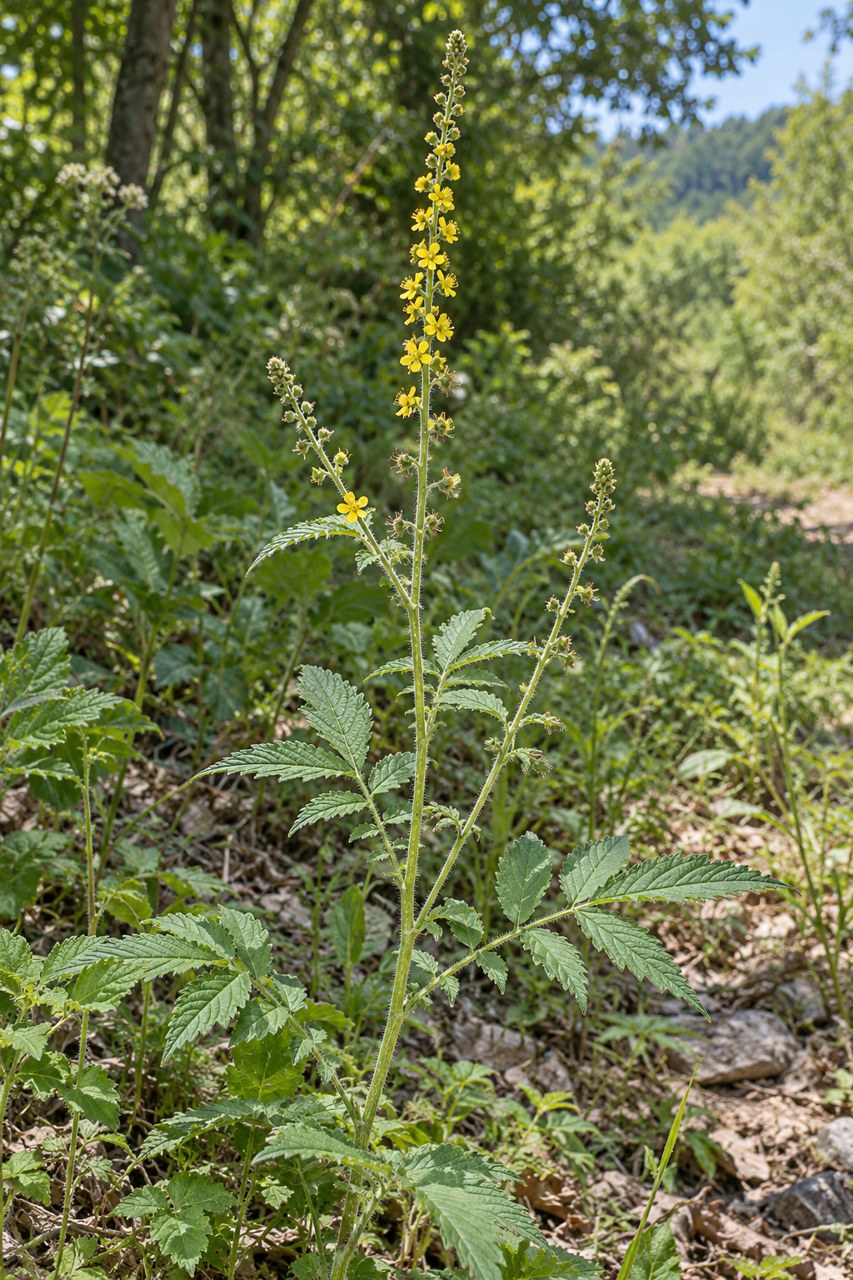
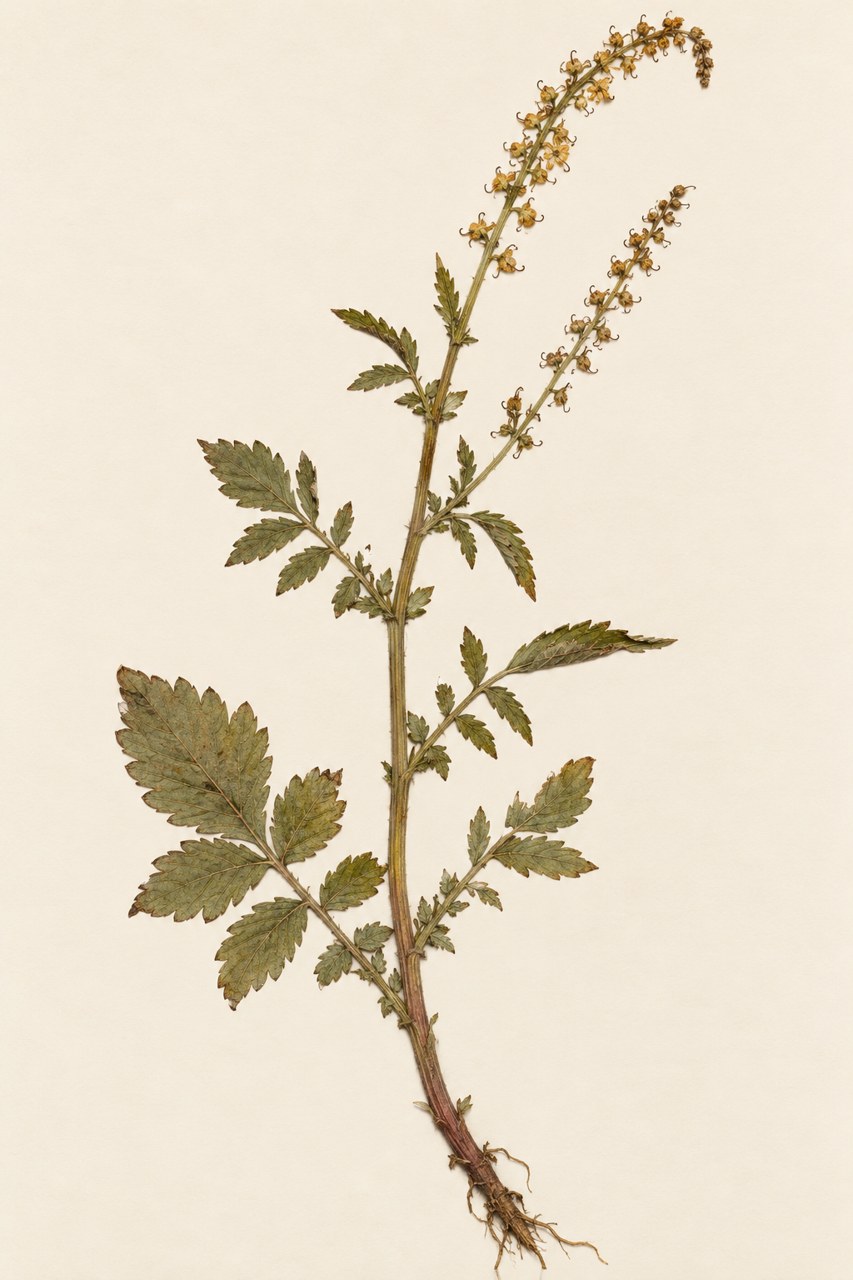
Xian He Cao in this record is the aerial part of Agrimonia pilosa Ledeb., a perennial rose-family herb usually about 30–120 cm tall. Leaves are alternate and odd-pinnate, with alternating large and small leaflet pairs; stipules clasp the stem. Long racemes bear small yellow flowers; mature calyxes have hooks that cling to fur or fabric. Stems may be hairy and older stems are often hollow in cross-section. HKBU distinguishes the aerial herb Xian He Cao from rhizome buds Xian He Ya and roots Long Ya Cao Gen; these are not the same drug. The source records aerial-part harvest before blooming in the planting year or following year, followed by cutting and sun-drying or fresh use. Do not collect wild hooked plants for self-ingestion.
Traditional context
HKBU records the aerial part as bitter, astringent, and neutral, with traditional descriptions of astringing the bowel, stopping bleeding, and expelling parasites. Specimen records list bleeding, diarrhea, and fatigue in materia medica contexts. These are not proof of treatment and do not replace investigation of bleeding; misuse can delay emergency care.
Modern evidence
HKBU provides botanical and materia-medica records; the listed actions are traditional rather than human-trial evidence. Tannins or preclinical studies do not establish that the herb stops gastrointestinal, traumatic, or uterine bleeding. Recurrent nosebleeds, black stools, blood in urine, coughing blood, unusual bruising, or persistent diarrhea require assessment; do not stop anticoagulants yourself.
Safety
Do not self-use to stop bleeding, particularly with warfarin, anticoagulants/antiplatelets, or a bleeding disorder. Pregnant people, children, people with liver/kidney impairment, or dehydration from diarrhea should consult a professional before herbal products. Do not apply unidentified plant material to wounds; contamination can cause infection. Heavy bleeding, faintness, breathlessness, severe abdominal pain, or black stools requires emergency care.
Safety reference ↗Pairing in reference texts
HKBU records a historical bleeding example containing 30 g Xian He Cao, 30 g Ce Bai Ye, and 12 g lotus node. This is a materia-medica example, not a personal dose, proof of efficacy, or a self-decoction recipe. The library has a Ce Bai Ye image but no authenticated dried-materia-medica profile for lotus node, so the source text is noted without fabricating a complete ingredient gallery. No modern toxic pair was verified; do not self-combine with anticoagulants.
Identification and study notes
Odd-pinnate leaves with alternating large and small leaflets are memorable; long yellow racemes bear hooked fruit calyxes. Dried samples have long finely white-haired stems, ridged upper sections that are hollow inside, and dark-green brittle leaves. The source separates aerial parts, rhizome buds, and roots. Do not merge Xian He Cao with similarly sounding herb names; compare Latin identity, part, and morphology. AI art may exaggerate fruit hooks. The drug name refers to aerial parts, while rhizome buds and roots of the same plant have separate names in the source. For a study collection, record the part rather than writing only “Agrimonia.” Alternating large and small leaflets along the rachis and stem-clasping stipules are more useful than flower color alone. Small hooked calyxes cling to fur or clothing; wear gloves and inspect specimens before storage. Dried herb may retain brown-green color and leaf shape but is brittle. HKBU’s pre-bloom harvest note applies to aerial parts, not roots or rhizome buds. Any retained sample should be labeled with Latin name, part, year, and growing location.A specimen log should record the harvest stage as “before flowering” only when the material is the aerial herb described by HKBU. It should also distinguish a whole intact voucher used for botanical study from a processed commercial lot, which may be cut into sections. Hooked fruits are a useful memory cue but can snag fabric and spread seed; use gloves and avoid carrying them through sensitive habitats. The image is a learning illustration, not a substitute for a herbarium voucher or supplier certificate. For bleeding symptoms, the correct lesson is to seek diagnosis and urgent care when indicated, not to memorize a recipe.
Growth and habitat
HKBU places it beside streams and roads, in grassland, thickets, forest margins, and open woodland; it occurs across much of China, with material mainly from Hubei, Zhejiang, and Jiangsu. It favors bright sites and drained soil with natural moisture. Grow in an observation bed away from pollution and children/pets; hooked fruits readily attach to clothing.
Identification and study notes
Odd-pinnate leaves with alternating large and small leaflets are memorable; long yellow racemes bear hooked fruit calyxes. Dried samples have long finely white-haired stems, ridged upper sections that are hollow inside, and dark-green brittle leaves. The source separates aerial parts, rhizome buds, and roots. Do not merge Xian He Cao with similarly sounding herb names; compare Latin identity, part, and morphology. AI art may exaggerate fruit hooks. The drug name refers to aerial parts, while rhizome buds and roots of the same plant have separate names in the source. For a study collection, record the part rather than writing only “Agrimonia.” Alternating large and small leaflets along the rachis and stem-clasping stipules are more useful than flower color alone. Small hooked calyxes cling to fur or clothing; wear gloves and inspect specimens before storage. Dried herb may retain brown-green color and leaf shape but is brittle. HKBU’s pre-bloom harvest note applies to aerial parts, not roots or rhizome buds. Any retained sample should be labeled with Latin name, part, year, and growing location.A specimen log should record the harvest stage as “before flowering” only when the material is the aerial herb described by HKBU. It should also distinguish a whole intact voucher used for botanical study from a processed commercial lot, which may be cut into sections. Hooked fruits are a useful memory cue but can snag fabric and spread seed; use gloves and avoid carrying them through sensitive habitats. The image is a learning illustration, not a substitute for a herbarium voucher or supplier certificate. For bleeding symptoms, the correct lesson is to seek diagnosis and urgent care when indicated, not to memorize a recipe.
Growing and care
- Choose seed/stock labeled Agrimonia pilosa; prepare a clean, humus-rich, drained bed in good light. Do not transplant hooked wild plants from areas with unknown pesticide use.
- Sow or plant according to nursery directions; keep lightly moist during establishment, then water for local weather without prolonged waterlogging. HKBU does not specify seed treatment or soil pH.
- Hand-weed and allow airflow to reduce fungal problems; remove diseased plants. At flowering, observe alternating large/small leaflets and hooked calyxes; wear gloves when collecting study material.
- HKBU records aerial harvest before bloom in the planting year or the following year, without a specific number of days. This is professional materia-medica context, not self-use advice.
How long until harvest? HKBU records aerial harvest before flowering in the planting year or the following year. This is source phenology, not a fixed date for all regions/cultivars; record sowing, emergence, and budding of the observation plant. Do not ingest home-grown material.
Habitat, season, and harvest in the HKBU botanical record
HKBU describes Agrimonia pilosa as 30–120 cm tall, with alternate odd-pinnate leaves, alternating large/small leaflets, yellow racemes, and hooked fruits. Flowering/fruiting may run May–December depending on region. Habitats include streamsides, roadsides, grassland, thickets, and open forest. Xian He Cao aerial parts are harvested before bloom in the planting year or next year, cut into sections, and sun-dried.
Open botanical source ↗FROM PLANT / SOURCE HABITAT TO DRIED MATERIAL · REFERENCE WORKFLOW
- HKBU records aerial harvest before flowering in the planting year or the next; do this only with authenticated cultivated material and under local rules.
- Cut aerial parts and keep roots/rhizome buds separate because HKBU treats them as distinct drugs. Remove soil, mixed plants, and damaged pieces.
- Cut into sections and sun-dry or dry hygienically; the source records sun-drying or fresh use. Ensure complete drying to limit mold.
- Label Latin name, part, date, and processing; review pinnate leaves, hollow stem, and hooked calyxes. Do not self-use for bleeding.
These are post-harvest study notes, not directions to prepare a remedy for self-treatment. Processing reference ↗