Figwort root · Xuan Shen
Scrophularia ningpoensis Hemsl. · Root
Name and part used
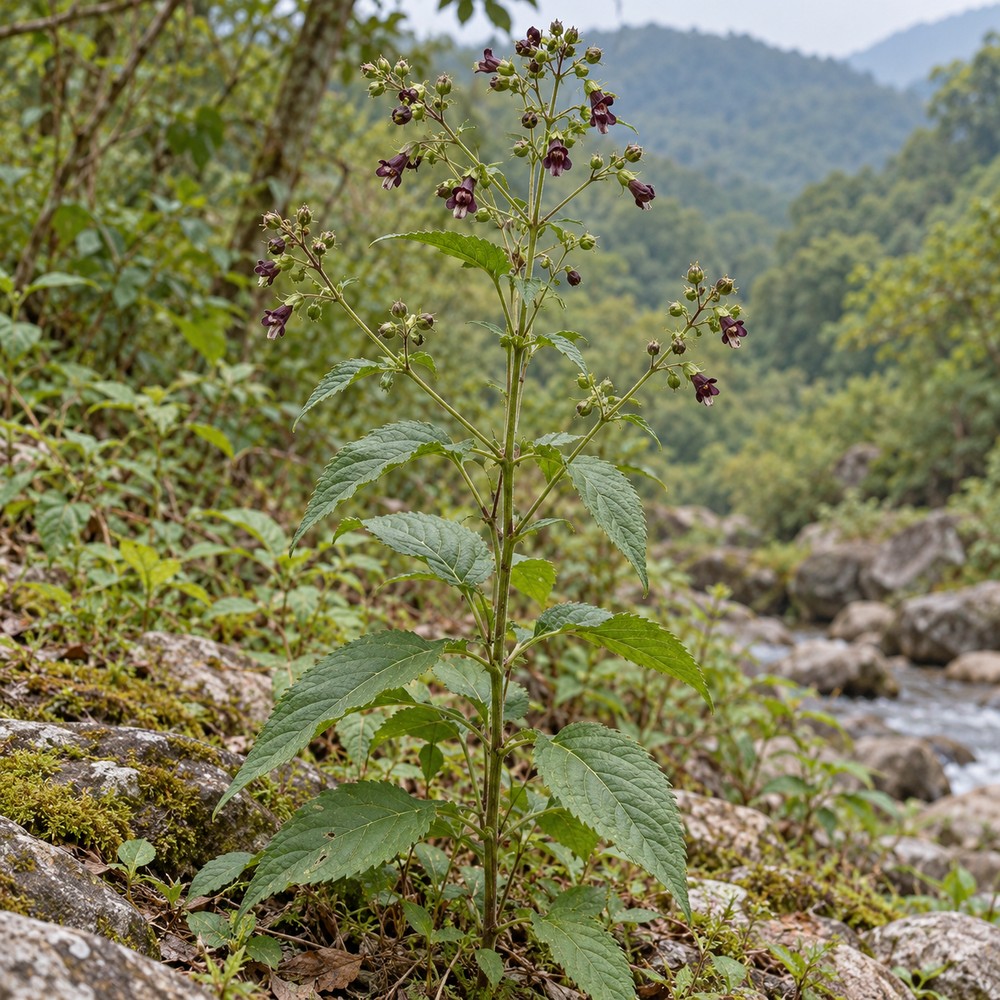
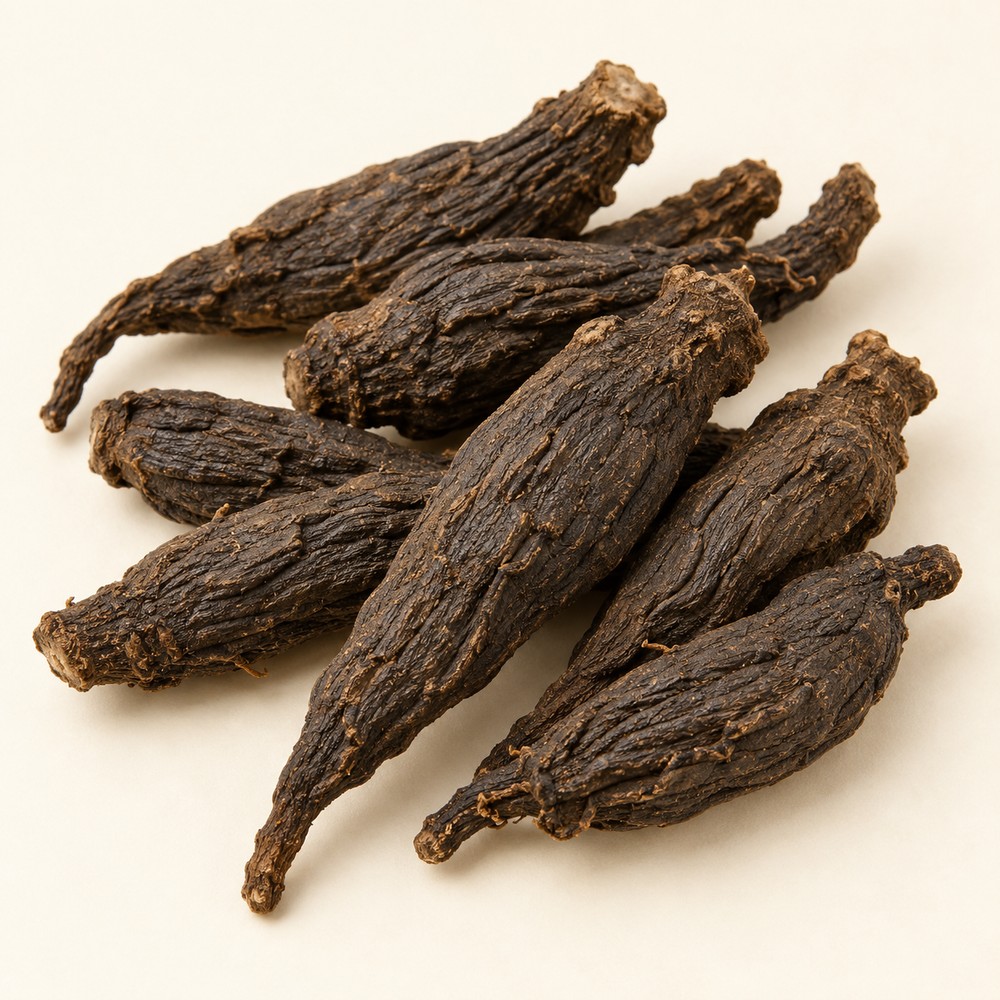
A square-stemmed herb with opposite leaves and small dark-purple flowers; its dried cylindrical root has a lustrous black interior.
Traditional context
Xuan Shen is Scrophularia ningpoensis root, harvested after foliage withers around October–November. Square stems, purple flowers, and a dark cut surface aid comparison with verified references.
Modern evidence
Heat-clearing, blood-cooling, and toxin-resolving are traditional claims. Iridoid chemistry or early pharmacology does not prove treatment of infection or heart disease.
Safety
CNS or glucose effects may occur; people using diabetes or sedative medicines or with liver/kidney disease should seek professional advice.
Pairing in reference texts
Xuan Shen appears with Mai Men Dong and Sheng Di in some historical formulas. Traditional pairing does not replace evaluation of fever or sore throat.
Growing, care, and harvest timing
HKBU habitat record: Growing under slope forests. Distributed in Hebei, Shanxi, Shaanxi, Jiangsu, Anhui, Zhejiang, Jiangxi, Fujian, Henan, Hubei, Hunan, Guangdong, Sichuan, Guizhou. Cultivated in all the southern parts of China. The medicinal materials are mainly produced in Zhejiang Harvest and processing as recorded: After cultivation of one year, collected from Oct-Nov when leaves wither. Excavated the whole plant, picked off root tuber, sun-dried or baked to half dried, piled up, covered with straw, compacted tightly, sundried, repeated several times till inner tuber turn black and sun-dried (or baked) to full dry
Source-recorded harvest/processing: After cultivation of one year, collected from Oct-Nov when leaves wither. Excavated the whole plant, picked off root tuber, sun-dried or baked to half dried, piled up, covered with straw, compacted tightly, sundried, repeated several times till inner tuber turn black and sun-dried (or baked) to full dry
The reviewed source does not provide a complete species-specific sowing/growing routine, irrigation/fertilization schedule, or universal plant age. The page therefore does not infer care instructions or years to harvest; consult local cultivation guidance.
Open habitat and season source ↗FROM PLANT / SOURCE HABITAT TO DRIED MATERIAL · REFERENCE WORKFLOW
- HKBU records root harvest from one-year cultivated plants in October–November after leaves wither; authenticate species and avoid damage.
- Remove soil, separate tuberous roots, remove fine roots, clean, drain, and lot the material.
- The source describes partial drying followed by controlled conditioning cycles until the interior darkens. This is professional processing, not a home method.
- Finish-dry, inspect cut color and moisture, and trace the lot; black color alone is not authentication.
These are post-harvest study notes, not directions to prepare a remedy for self-treatment. Processing reference ↗
How to read formula amounts
The cited sources do not provide a formula with specific amounts for this profile; no ratio is invented. Absence from the incompatibility list does not establish safety.
Habitat, season, and harvest in the HKBU botanical record
HKBU botanical record (translated summary): Flowering and fruiting dates: Flowering: July to August, fruiting: August to September Habitat and distribution: Growing under slope forests. Distributed in Hebei, Shanxi, Shaanxi, Jiangsu, Anhui, Zhejiang, Jiangxi, Fujian, Henan, Hubei, Hunan, Guangdong, Sichuan, Guizhou. Cultivated in all the southern parts of China. The medicinal materials are mainly produced in Zhejiang Harvest and processing as recorded: After cultivation of one year, collected from Oct-Nov when leaves wither. Excavated the whole plant, picked off root tuber, sun-dried or baked to half dried, piled up, covered with straw, compacted tightly, sundried, repeated several times till inner tuber turn black and sun-dried (or baked) to full dry
Open botanical source ↗