Oriental waterplantain · Ze Xie
Alisma orientale (Sam.) Juz. · Tuber
Name and part used
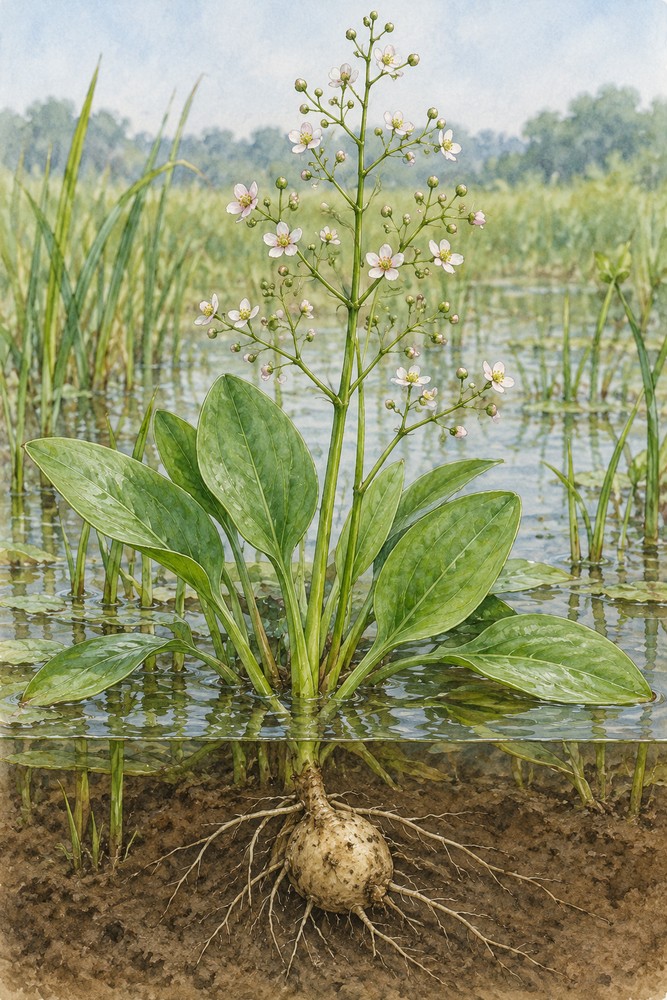
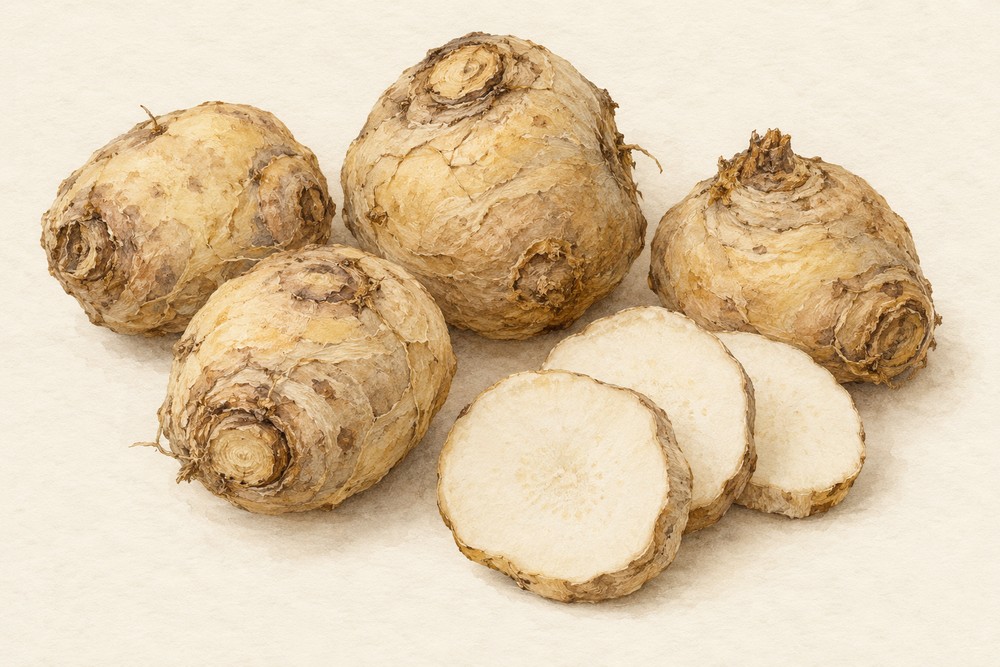
An aquatic herb with basal oval leaves, long petioles, and branched flower stalks; the materia medica is the tuber.
Traditional context
HKBU records Ze Xie as the tuber of Alisma orientale. Common water-plantain can refer to other species; leaves and fruits are separate material entries.
Modern evidence
Research on constituents such as alisols does not establish treatment efficacy for edema or urinary symptoms in an individual.
Safety
Interaction and safety evidence varies by preparation; people taking diuretics or prescription medicines, pregnant, or with kidney disease should consult a professional.
Pairing in reference texts
It appears in classical formulas such as Liu Wei Di Huang Wan; the formula name does not establish safety for every kidney condition or product.
Growing, care, and harvest timing
HKBU habitat record: Growing in marsh edges. Can be cultivated. Distributed in Northeast, East and Southwest China, Hebei, Xinjiang, Henan and etc. The medicinal materials are mainly produced in Fujian, Sichuan, Jiangxi, mostly found cultivated. Now also produced in Guangdong, Guangxi, Hubei, Hunan and etc Harvest and processing as recorded: Tuber: in late Dec Of the very year of planting when most leaves get withered and yellow, excavated tuber, removed soil and stem leaves, but the middle leaflet remained in case that black juice flow out and dried upon smokeless coal fire. Put inside the basket when still hot, removed fibrils and rough barks. leaves: harvested from June-Sept, used fresh or sun-dried. Fruits: picked in batches in summer and autumn when fruits ripen. Cut off fruits, wisped, hung in open air, threshed and sun-dried
Source-recorded harvest/processing: Tuber: in late Dec Of the very year of planting when most leaves get withered and yellow, excavated tuber, removed soil and stem leaves, but the middle leaflet remained in case that black juice flow out and dried upon smokeless coal fire. Put inside the basket when still hot, removed fibrils and rough barks. leaves: harvested from June-Sept, used fresh or sun-dried. Fruits: picked in batches in summer and autumn when fruits ripen. Cut off fruits, wisped, hung in open air, threshed and sun-dried
The reviewed source does not provide a complete species-specific sowing/growing routine, irrigation/fertilization schedule, or universal plant age. The page therefore does not infer care instructions or years to harvest; consult local cultivation guidance.
Open habitat and season source ↗FROM PLANT / SOURCE HABITAT TO DRIED MATERIAL · REFERENCE WORKFLOW
- Harvest cultivated tubers late in the year when most leaves turn yellow and wither, as described by HKBU.
- Lift and remove soil and foliage; retain the central leaflet as the source procedure notes to reduce darkening from sap loss.
- Dry under a qualified facility procedure; historical charcoal/smoke methods should not be attempted at home.
- Cool, sort, record source/date/lot, check for mold, and store clean and dry away from moisture.
These are post-harvest study notes, not directions to prepare a remedy for self-treatment. Processing reference ↗
How to read formula amounts
The cited sources do not provide a formula with specific amounts for this profile; no ratio is invented. Absence from the incompatibility list does not establish safety.
Habitat, season, and harvest in the HKBU botanical record
HKBU botanical record (translated summary): Flowering and fruiting dates: Flowering: June to August,fruiting: July to September Habitat and distribution: Growing in marsh edges. Can be cultivated. Distributed in Northeast, East and Southwest China, Hebei, Xinjiang, Henan and etc. The medicinal materials are mainly produced in Fujian, Sichuan, Jiangxi, mostly found cultivated. Now also produced in Guangdong, Guangxi, Hubei, Hunan and etc Harvest and processing as recorded: Tuber: in late Dec Of the very year of planting when most leaves get withered and yellow, excavated tuber, removed soil and stem leaves, but the middle leaflet remained in case that black juice flow out and dried upon smokeless coal fire. Put inside the basket when still hot, removed fibrils and rough barks. leaves: harvested from June-Sept, used fresh or sun-dried. Fruits: picked in batches in summer and autumn when fruits ripen. Cut off fruits, wisped, hung in open air, threshed and sun-dried
Open botanical source ↗