Zi Cao · Ying Zi Cao · Zi Cao · Ying Zi Cao
Lithospermum erythrorhizon Siebold & Zucc. (Ying Zi Cao source type) · Dried root; materia-medica source includes multiple species
Name and part used
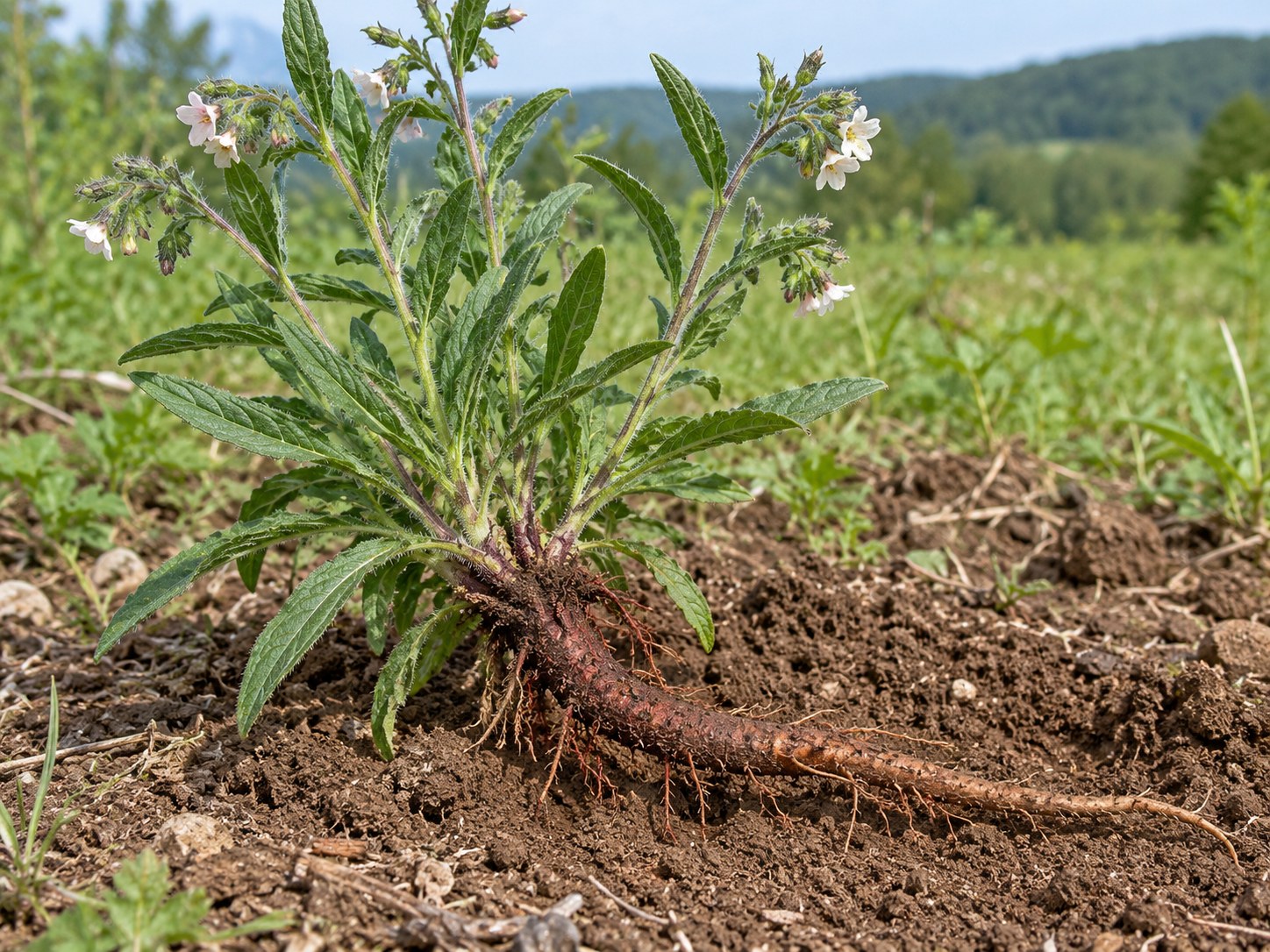
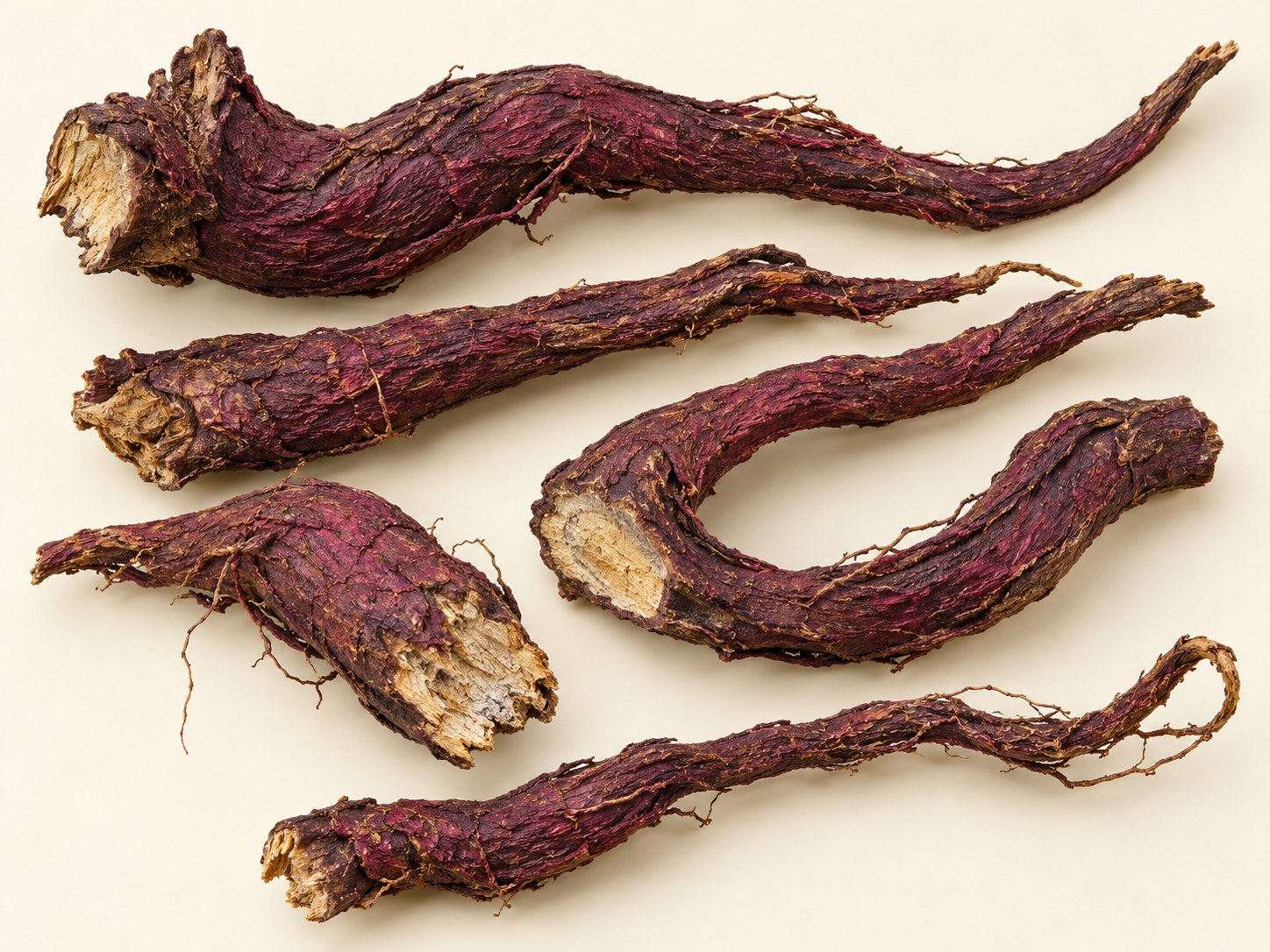
Zi Cao is a materia-medica name that can include dried roots from more than one species in HKBU records. This page focuses on Lithospermum erythrorhizon Siebold & Zucc. as one Ying Zi Cao source type; it does not represent every commercial Zi Cao. The Boraginaceae herb has narrow lance-shaped leaves, small pale flowers, and a long root. Shikonin pigments accumulate in the root bark and give it a purple-red color. HKBU also lists Arnebia euchroma (Ruan Zi Cao) and Arnebia guttata. Their roots differ in structure, firmness, and bark, so one species image cannot identify every lot. Purple color in a photo is not proof of identity or quality.
Traditional context
HKBU records Zi Cao in traditional categories for cooling blood, moving blood, resolving toxin, and promoting eruption. These are historical classifications. Mentions of burns, eczema, measles, or rash do not prove that root preparations treat skin injury or infection at home. Burns, rapidly spreading rash, fever, or allergy require medical care; do not apply crushed roots to skin.
Modern evidence
Shikonin derivatives are pigments and pharmacological research subjects; cell or model studies do not prove that Zi Cao root or cream treats burns or skin disease. Quality depends on species, root age, soil, drying, and extraction; reviews also note cultivation challenges and conservation concerns for Lithospermum. Do not equate an experimental topical product with raw root or a homemade infusion. Wound studies require a defined product and supervision.
Safety
Roots may cause contact allergy; do not use on damaged skin, deep burns, eyes, or mucosa. Do not ingest material without authenticated species; Zi Cao supply includes several species and Boraginaceae chemistry varies. Seek advice during pregnancy, breastfeeding, liver disease, treatment, or medicine use. Reject dyed, moldy, or unlabeled roots; purple color is not a safety test.
Safety reference ↗Pairing in reference texts
Historical formulas may pair Zi Cao with other herbs for eruption or toxin concepts, but ingredients and ratios vary by text and the source species may differ. This page does not establish a universal ratio. Do not combine it with topical medicines, steroids, anticoagulants, or cancer therapy without professional advice; illustrations are not a treatment recipe.
Identification and study notes
A study cue for Ying Zi Cao is dark purple-red root bark on a tapering, sometimes twisted root; Ruan Zi Cao is softer with layered bark that flakes. This page illustrates one specific type so the three sources are not mistaken as one plant. Narrow leaves and pale flowers of the living Lithospermum are not identical to every Arnebia stage. Record the Latin name alongside the drug name because “Zi Cao” does not indicate a single botanical source. No single image represents every Zi Cao source. Check the species on a label: Lithospermum roots are hard and brittle with a larger woody core, while some Arnebia roots are softer with layers of peeling bark. Cross-sections help compare authenticated specimens but do not replace expert verification. Deep purple roots may stain hands or materials; that does not prove pure shikonin content. Roots are harvested after a long growth period, and reviews describe poor germination and disease challenges. Conservation-aware cultivation needs lawful stock, documentation, and soil management; avoid digging wild plants. This page depicts one source type, not the whole market. Mẫu đã định danh cần có ghi chú kiểu nguồn và hồ sơ mẫu/lô, vì Tử thảo cứng và mềm có cấu trúc rễ khác. Lưu ảnh lá/hoa cùng rễ nhưng không dùng ảnh làm bằng chứng duy nhất. Sắc tố tím đỏ có thể bám găng/giấy; xác định thành phần cần kiểm nghiệm riêng. Thu rễ làm chết cây nên cần quan tâm canh tác và bảo tồn. Ảnh thực vật trang này chỉ minh họa Lithospermum.
Growth and habitat
Lithospermum erythrorhizon occurs in temperate Asia; Japanese cultivation research describes disease sensitivity and difficult establishment requiring careful moisture, rain protection, and soil management. HKBU lists northeastern China and Inner Mongolia as key Zi Cao production areas, but commercial material may come from other species. Follow conservation rules and do not dig wild roots for medicine.
Identification and study notes
A study cue for Ying Zi Cao is dark purple-red root bark on a tapering, sometimes twisted root; Ruan Zi Cao is softer with layered bark that flakes. This page illustrates one specific type so the three sources are not mistaken as one plant. Narrow leaves and pale flowers of the living Lithospermum are not identical to every Arnebia stage. Record the Latin name alongside the drug name because “Zi Cao” does not indicate a single botanical source. No single image represents every Zi Cao source. Check the species on a label: Lithospermum roots are hard and brittle with a larger woody core, while some Arnebia roots are softer with layers of peeling bark. Cross-sections help compare authenticated specimens but do not replace expert verification. Deep purple roots may stain hands or materials; that does not prove pure shikonin content. Roots are harvested after a long growth period, and reviews describe poor germination and disease challenges. Conservation-aware cultivation needs lawful stock, documentation, and soil management; avoid digging wild plants. This page depicts one source type, not the whole market. Mẫu đã định danh cần có ghi chú kiểu nguồn và hồ sơ mẫu/lô, vì Tử thảo cứng và mềm có cấu trúc rễ khác. Lưu ảnh lá/hoa cùng rễ nhưng không dùng ảnh làm bằng chứng duy nhất. Sắc tố tím đỏ có thể bám găng/giấy; xác định thành phần cần kiểm nghiệm riêng. Thu rễ làm chết cây nên cần quan tâm canh tác và bảo tồn. Ảnh thực vật trang này chỉ minh họa Lithospermum.
Growing and care
- Obtain stock authenticated as Lithospermum erythrorhizon; do not use generic Zi Cao labels for cultivation.
- Use loose, well-drained soil and moderate sun; research used rain shelters or mulch in some settings, but local conditions require adaptation.
- Plant clean stock and water at soil level so lower leaves stay off wet soil; monitor viral/fungal disease and avoid unsuitable disinfectants.
- Record survival, sowing date, and disease; retain healthy plants and do not harvest roots before maturity and authentication.
How long until harvest? A research review reports roughly three years may be needed to obtain sufficient roots, but cultivation is difficult and survival can be low. This is a research observation, not a home-garden guarantee; harvest only healthy, authenticated, mature plants under specialist guidance.
Habitat, season, and harvest in the HKBU botanical record
HKBU records Zi Cao as potentially sourced from Lithospermum erythrorhizon, Arnebia euchroma, or Arnebia guttata, with distinct dried-root characters. This page uses Lithospermum for its plant image and labels it as one source type only. The material database lists northeastern China and Inner Mongolia as principal production areas.
Open botanical source ↗FROM PLANT / SOURCE HABITAT TO DRIED MATERIAL · REFERENCE WORKFLOW
- Authenticate the source species and lot; never mix Lithospermum with Arnebia.
- Harvest mature cultivated roots, gently remove soil and discard damaged pieces; label the specific Ying/Ruan/Neimeng source type.
- Clean and dry under mold-preventing conditions; keep species lots separate because anatomy differs.
- Package dry, protect from light, and record Latin identity, region, cultivation/harvest year, and moisture; never dye or color-blend to imitate appearance.
These are post-harvest study notes, not directions to prepare a remedy for self-treatment. Processing reference ↗