Zi Hua Di Ding · violet herb · Zi Hua Di Ding
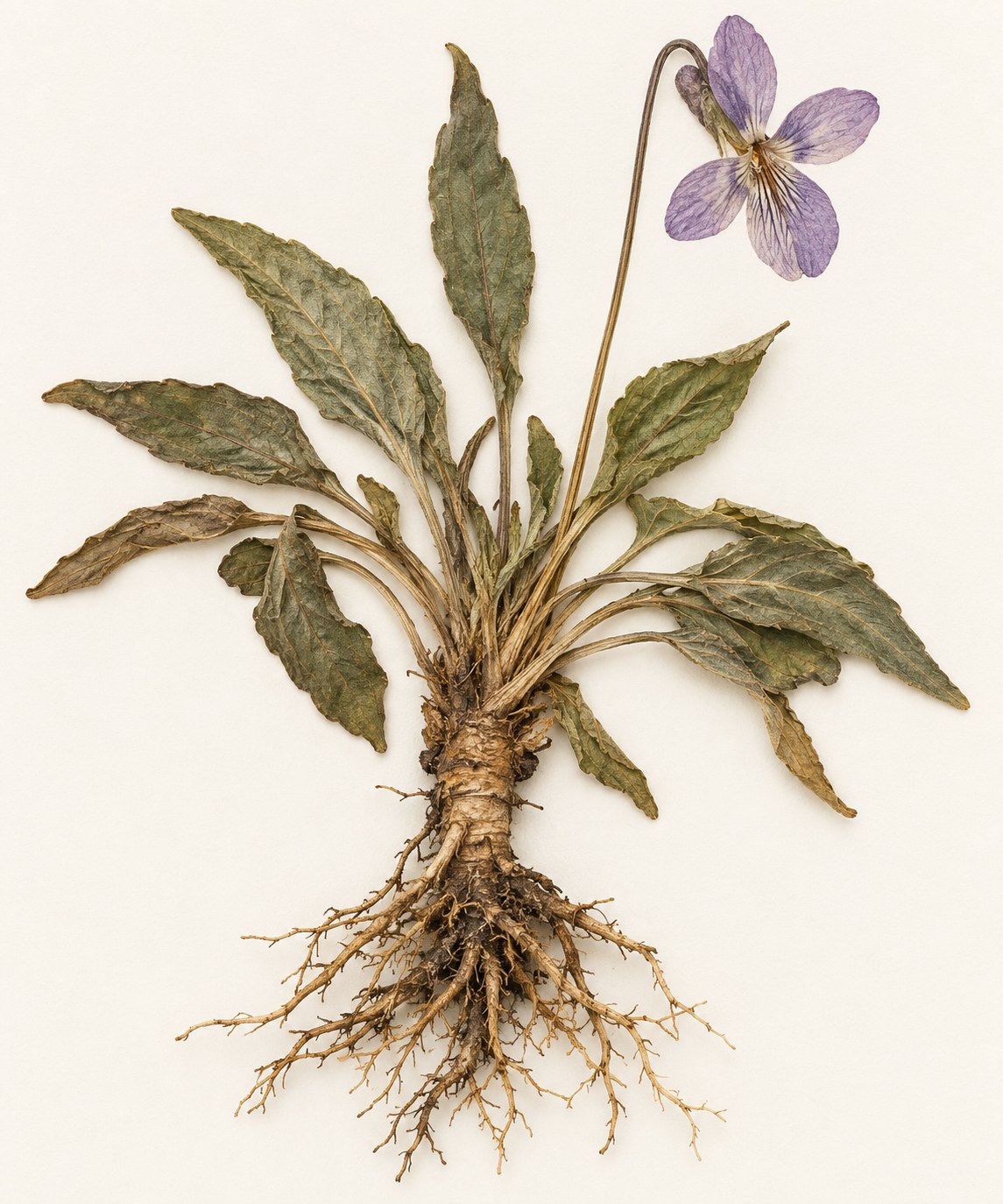
Viola yedoensis Makino · Dried whole herb with roots
Name and part used
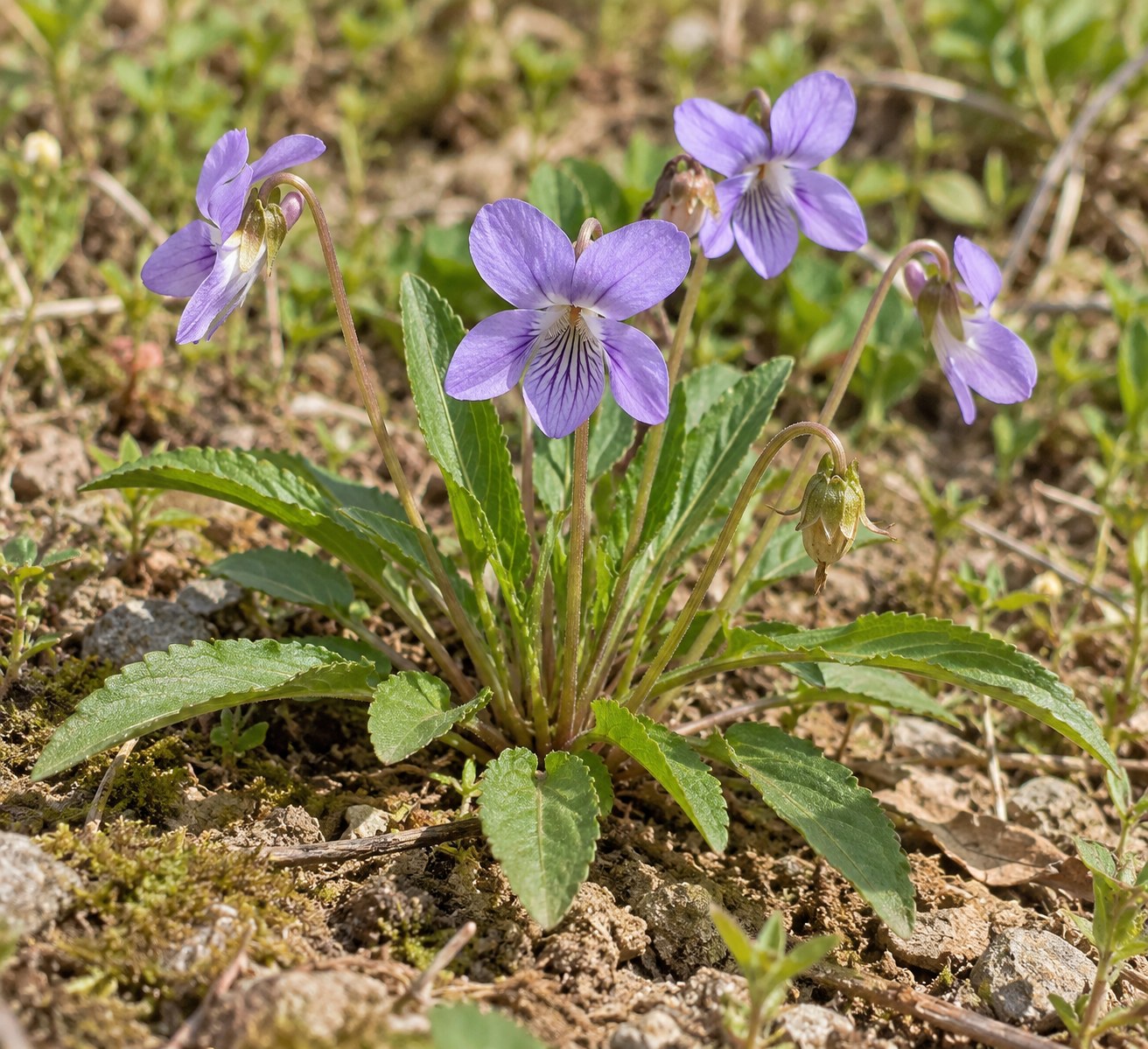
This profile identifies Zi Hua Di Ding as Viola yedoensis Makino, a low herb in Violaceae, often only several centimetres to about 15 cm tall when flowering. Leaves arise in a basal rosette, lance-obovate or narrow, with fine toothed margins; petiole and blade shape vary by season. Solitary flowers rise on stalks, usually violet to blue-purple, with five petals and a rear spur; capsules contain numerous seeds. The traditional drug is recorded as the whole plant, often including roots; do not confuse it with other Viola species or local plants called “Di Ding.” HKBU records grassland, wasteland, field edges, foothills, and forest margins; whole plants are collected in spring or autumn, cleaned of soil, and sun-dried. The small plant is easily confused and field edges may be sprayed, so do not wild-harvest it for use.
Traditional context
HKBU specimen records traditional concepts of clearing heat, resolving toxin, cooling blood, and reducing swelling. These are traditional categories, not evidence for treating infection, conjunctivitis, sore throat, or skin lesions. Eye pain with reduced vision, fever, pus, severe pain, or rapidly spreading lesions needs medical care. Do not put a decoction in the eye or apply leaves to a wound.
Modern evidence
HKBU is an identification and traditional-record source, not a clinical trial. Any in-vitro antimicrobial activity does not prove the plant treats human infection or is safe in the eye. Distinguish extract composition, Viola species, plant part, and processing; laboratory findings cannot be generalized to dried whole-herb use. This page supports identification and terminology study, not self-treatment.
Safety
Do not ingest, put in the eye, or apply Zi Hua Di Ding yourself; a home-safe dose has not been established here. Small plants from lawns or fields may carry pesticides, animal waste, or parasites. Pregnant or breastfeeding people, children, immunocompromised people, those with allergies, or people taking medicines should not experiment with it. Eye inflammation, skin infection, or fever should not delay standard care. Observe labeled cultivated specimens and wash hands after handling soil.
Safety reference ↗Pairing in reference texts
The reviewed record does not establish a specific partner and ratio with proven efficacy and safety. Do not use the phrase “clears heat and resolves toxin” to self-combine this herb with antibiotics, anti-inflammatory drugs, eye medicines, or toxic plants. No specific incompatibility was confirmed in the cited record; that does not prove arbitrary combinations are safe. This page gives no dose and invents no partner image.
Identification and study notes
Basal rosettes are easy to see before flowering. Leaf blades vary from obovate to narrow, with narrowly winged petioles and usually small teeth. Solitary violet flowers rise on stalks, with a rear spur and dark veins on the lower petal; the elongated capsule later splits into three valves. The fresh-plant image shows flowers and leaves but cannot replace a voucher because Viola contains many similar species. Dried whole plants may be curled, with small dark roots, wrinkled leaves, and flowers fading to gray-violet. A loose flower alone cannot establish identity. Record growing location, season, and morphology for comparison with botanical references.
Growth and habitat
HKBU records Zi Hua Di Ding in grassland, wasteland, field edges, hillsides, and forest margins; the low plant commonly occupies bright, drained ground with seasonal moisture. For an observation pot, use clean loose soil with moderate humus, avoid compaction, provide gentle morning sun, and prevent waterlogging. These habitats describe source-region observations and do not guarantee identical growth throughout Vietnam. Obtain accurately labeled seed or nursery plants; do not collect from fields because of chemical exposure.
Identification and study notes
Basal rosettes are easy to see before flowering. Leaf blades vary from obovate to narrow, with narrowly winged petioles and usually small teeth. Solitary violet flowers rise on stalks, with a rear spur and dark veins on the lower petal; the elongated capsule later splits into three valves. The fresh-plant image shows flowers and leaves but cannot replace a voucher because Viola contains many similar species. Dried whole plants may be curled, with small dark roots, wrinkled leaves, and flowers fading to gray-violet. A loose flower alone cannot establish identity. Record growing location, season, and morphology for comparison with botanical references.
Growing and care
- Choose seed or nursery stock labeled Viola yedoensis; sow in a clean tray with loose medium, keep moist, and place in bright cool conditions. Avoid roadside or pesticide-treated soil.
- After establishment, move it to a draining pot; water lightly when the surface begins to dry and do not let water sit around the rosette. HKBU does not specify sowing treatment, cold stratification, or a numeric pH.
- Hand-weed so seedlings are not mistaken for weeds; record the spurred violet flower, basal leaves, and capsule. Remove damaged leaves, maintain airflow, and avoid spraying chemicals on study plants.
- The source records whole-plant collection in spring or autumn but gives no fixed time from sowing. Let the plant flower and set seed for identification; do not uproot it for medicinal use.
How long until harvest? HKBU records spring or autumn as collection seasons but gives no days from sowing to harvest or home-use instructions. Allow enough time for rosettes, flowers, and capsules to develop for identification; keep the plant as a study specimen rather than treating maturity as permission to use it.
Habitat, season, and harvest in the HKBU botanical record
HKBU records Viola yedoensis as a small Violaceae herb with basal leaves and spurred violet flowers, occurring in wasteland, grassland, fields, foothills, and forest margins. The medicinal part is the whole plant; collection is in spring or autumn, followed by soil removal, cleaning, and drying. This profile distinguishes traditional materia-medica description from experimental evidence; the source is not a treatment trial.
Open botanical source ↗FROM PLANT / SOURCE HABITAT TO DRIED MATERIAL · REFERENCE WORKFLOW
- HKBU records whole-plant collection in spring or autumn; use this only to study processing history, not to encourage wild harvesting.
- For a traceable commercial specimen, confirm the Viola yedoensis label and whole-plant part; remove soil gently without losing roots in a study sample.
- The source records shaking off soil, cleaning, and sun-drying. For a study sample, spread a thin layer on a clean tray away from dust, rain, and insects; avoid harsh sun if retaining visible morphology is the goal.
- Label Latin name, season, part, and drying method; store dry material sealed away from moisture. Unknown, moldy, or mixed material must not be used medicinally.
These are post-harvest study notes, not directions to prepare a remedy for self-treatment. Processing reference ↗